





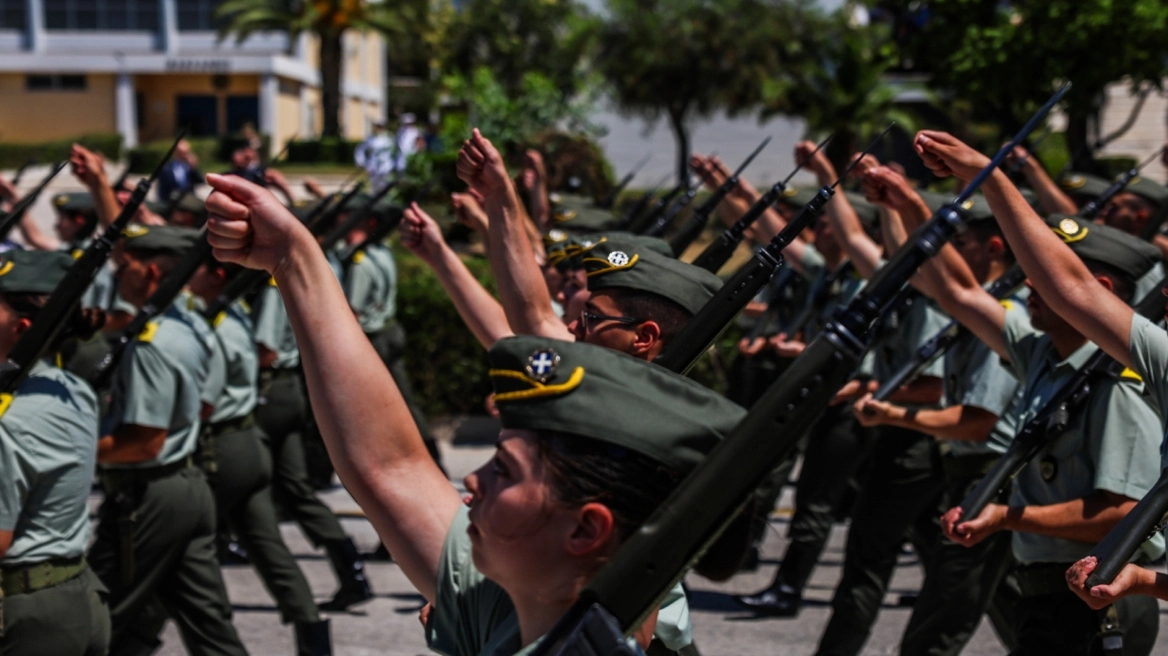
Today, Monday, December 15, 2025, the bill of the Ministry of National Defense titled “Transition Roadmap of the Armed Forces to the New Era” was submitted to Parliament.
(The bill concerns the career and advancement of Officers, permanent Non-Commissioned Officers, and Professional Soldiers of the Armed Forces; pay regulations for military personnel; reorganization of academic education in the Armed Forces; conscription of Greeks; voluntary enlistment of women; and other provisions.)
The bill, which complements the package of policies implemented under the “Agenda 2030,” was presented by the Minister of National Defense, Nikos Dendias, and was approved by the Cabinet, which met under Prime Minister Kyriakos Mitsotakis on September 30, 2025.
The purpose of the bill is:
a) to establish authorized (organic) positions for Armed Forces Officers by service branch, origin, rank, and category,
b) to redesign the composition of Officers’ Promotion/Career Review Councils,
c) to redesign the conditions for Officers’ retention by rank,
d) to establish new ranks for permanent Non-Commissioned Officers of the branches and the Joint Corps of the Armed Forces,
e) to carry out promotions exclusively to fill vacant authorized positions of higher ranks,
f) to establish new ranks for Professional Soldiers (EPOP) as Non-Commissioned Officers of Special Origin,
g) to regulate the conditions and procedure for transferring permanent NCOs—graduates of the Higher Schools of Permanent NCOs—into the Officers Corps,
h) to restructure base salaries and pay scales for Armed Forces personnel, linked to years of service and category of origin,
i) to create pay grades by category of origin reflecting their gradual salary progression in accordance with the new ranks,
j) to uniformly regulate matters concerning the service status of Officers and permanent NCOs and to clearly distinguish statuses into primary and additional,
k) to establish the Inter-Service Command for Academic Education (DIDAE) and define its responsibilities and bodies,
l) to enable cooperation between the National Defense School (SETHA) and the Supreme Joint War College (ADISPO) with Universities (AEIs) and Higher Military Educational Institutions (ASEIs) for the development of Master’s Programs,
m) to regulate matters related to compulsory military service,
n) to reform conscription legislation, especially provisions concerning deferments for secondary or tertiary students, deferments for permanent residents abroad, and the assessment of fitness for service of those suffering from mental disorders,
o) to define the training framework for conscripts,
p) to define procedures for further training of conscripts at the Armed Forces’ Lifelong Learning Centers,
q) to define the framework for postings and transfers of conscripts,
r) to regulate matters of reserve retraining and to establish the institution of the active volunteer reservist,
s) to legislate voluntary military service for women,
t) to provide an incentive for draft evaders to enlist in the Armed Forces until 31.12.2027,
u) to regulate matters concerning medical examination and discharge of Professional Soldiers, and
v) to regulate matters concerning Military Justice.
Salaries in the Armed Forces
For salary progression of personnel of all categories from the lowest to the immediately higher pay step, three years of service are required in the first step and two years for each subsequent step.
Changes to the Rank Structure
One of the bill’s changes concerns the new rank structure, which (according to leaked information) freezes promotions of permanent NCOs up to the rank of Warrant Officer. Until now, they completed their careers with the rank of Lieutenant Colonel or Colonel if they held a university degree, without any transitional arrangements being provided.
By contrast, the bill applies retroactively, resulting in adverse effects on serving Armed Forces personnel who entered the military under conditions that are now directly called into question.
In particular, the greatest consequences are expected to be borne by personnel already serving as NCOs, whose schools are even threatened with closure, given that there will no longer be a fixed advancement pathway for them going forward.
For example, a graduate of an NCO School (ASSY) from 2007 who was promoted last year to Second Lieutenant will remain at the same rank until retirement in 2040.
Similarly, reduced advancement opportunities are foreseen for Professional Soldiers (EPOP). An EPOP who enlisted in 2004 will be promoted next year to Master Sergeant (Administration) and will remain at that rank until 2039.
Deferments, Service, and the Reserve
At the same time, the new bill introduces a new framework for military service, which will henceforth also apply voluntarily to women. The content of conscripts’ training is also changing, incorporating training with the use of new technologies.
According to the new framework, the following are provided:
- basic training lasting 10 weeks,
- specialized training lasting 4 weeks, and
- training in readiness units lasting 12 weeks.
Afterward, the fully trained soldier is assigned to the reserve.
Ask me anything
Explore related questions




