





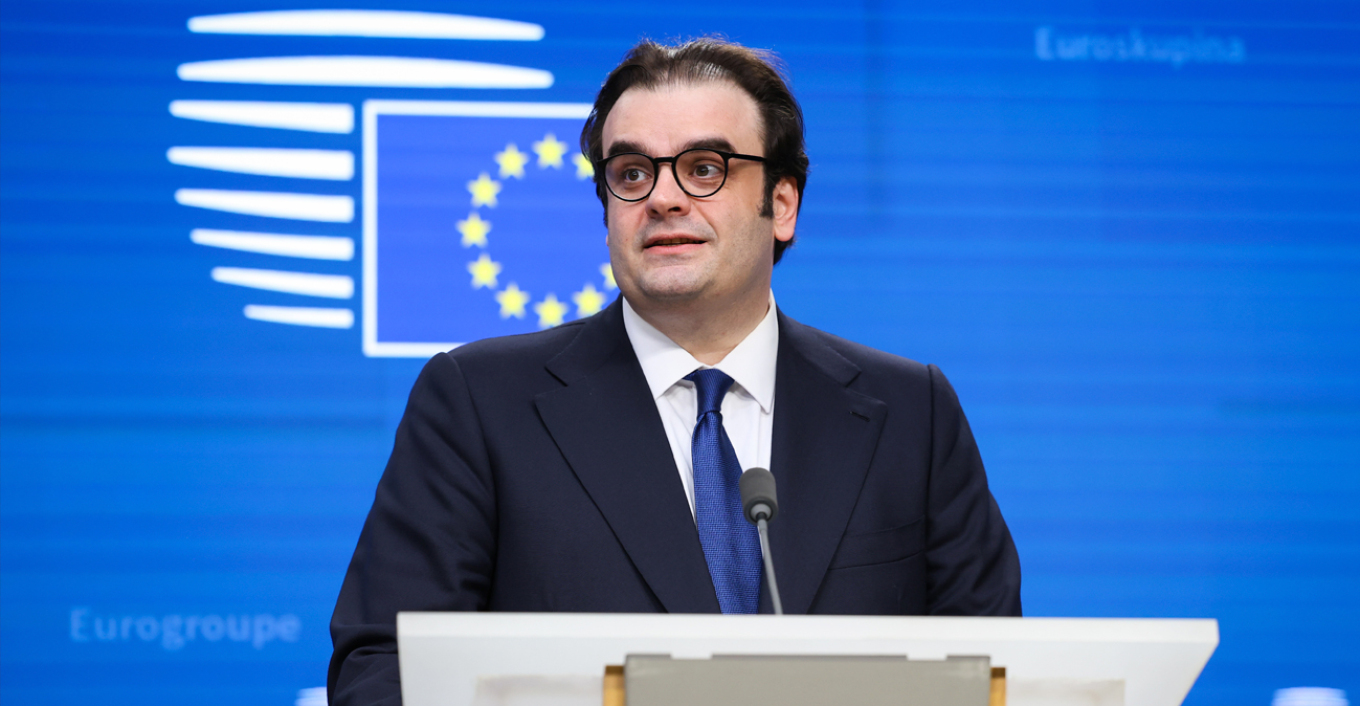
A Greek Minister of Finance as President of the Eurogroup? Just ten years ago, even the mere conception of such a phrase would have seemed unthinkable—unless it were uttered as a bitter joke. Today, the unanimous election of Kyriakos Pierrakakis to the position of head of the powerful European body symbolizes the recovery of the Greek economy’s credibility. In the person of the 42-year-old minister, one can vividly see the country’s definitive transition from its unreliable image as a “weak link” to the upgraded profile of an institutional player within the Eurozone.
Neither a bolt from the blue, nor a puzzling development, nor even domestic lyrical triumphalism or national exaggeration is required to illustrate clearly that the country’s collective odometer is effectively recording achievements for the benefit of citizens. Despite his young age, the “orchestrator” of the Digital Transformation introduced by the Mitsotakis government carries with him a powerful seal of accomplishment that would make many of his European counterparts envious.
In every government post he has held, he has contributed to Greece—once a pioneer of deficits—achieving a budget surplus in 2024, one of only six EU member states to do so. From his own position, he has helped ensure that the country’s economic growth over the past four years has been nearly double the EU average. The affable, low-key current Minister of National Economy and Finance has his share in these successes.
With persistent, disciplined, methodical determination and a strong sense of urgency, he has systematically shaped a results-driven culture that implements the reforms the country needs. And because actions speak louder than words, and choices make history, his election to a top EU position is hardly coincidental—the first for a Greek politician since January 1, 1981, when the country officially joined the European Union.
For the quietly tireless and challenge-embracing Pierrakakis, the next 2.5 years, as the de facto “Finance Minister” of the Eurozone, open up broad scope for active, productive action marked by balance, flexibility, and speed. He has the credentials to serve as a voice of synthesis and coordination on critical European issues.
He belongs, moreover, to the new generation of European politicians who support deeper European integration. At the same time, from now on he will represent the 20 countries of the Eurozone at the meetings of the World Bank, the G7, and the G20—placing Greece as well at the heavy, solid tables where major decisions are made. He will frequently travel from Nikis Street to the core of the world’s leading economies that set the course of global developments.
His proven effectiveness enables him to go beyond mere participation. For years now, he has made clear what expresses him: “All we have to decide is what to do with the time that is given to us.” A line spoken by Gandalf in The Lord of the Rings by J. R. R. Tolkien—a book he read and loved in his childhood.
His Relationship with Mitsotakis
Eleven years ago. May 2014. On the eve of that year’s European elections. Kyriakos Pierrakakis appears on a political program on the channel ACTION 24. At the time, he is a candidate for the European Parliament on the ticket of Elia. When he finishes his remarks—combining a soft-spoken Harvard academicism with the innate popular touch of a genuine child of a neglected Athenian neighborhood—he rises from his seat. He is to be followed on the panel by the then Minister of Administrative Reform, Kyriakos Mitsotakis.
Their sudden meeting in the studio goes beyond the formal courtesy of two politicians from different, opposing political camps. It reveals an excellent relationship. They speak together on camera in the warmest terms about one another, publicly sharing the high mutual esteem and respect they hold.
Clearly, this is not their first meeting. About two years earlier, they had come into contact through their mutual friend Vasilis Karatzas, son of the late lawyer Theodoros Karatzas, president of the National Bank during the premiership of Kostas Simitis. Both open-minded men, despite a 15-year age gap, came from studies at major American universities. More importantly, they seemed to assess the evolving political landscape with similar approaches. This was a first point of convergence, as their strategic thinking focused on making citizens’ lives easier in the face of suffocating domestic bureaucracy.
Two years would pass before they met again, this time in Paris. Kyriakos Pierrakakis and Christos Protopapas had been tasked by then PASOK president and Deputy Prime Minister Evangelos Venizelos with representing the party in negotiations with the troika. As a member of the Greek negotiating team, Minister Kyriakos Mitsotakis was also present in the French capital.
The two Kyriakoses found the opportunity in the City of Light to talk more extensively. Their views converged on many points against the backdrop of the dramatic phase of the debt crisis the country was experiencing. The shared search for a better future for Greece motivated them. Yet, for their cross-party rapprochement to bear fruit, a catalyst—a favorable turn of events—was needed. Life itself would provide it.
After the 2015 elections and SYRIZA’s victory, Pierrakakis took a small step back from his political career prospects within post-Venizelos PASOK. He prioritized his professional path, becoming head of research at diaNEOsis, the think tank of Dimitris Daskalopoulos, conducting studies on the major open fronts of the Greek economy and society.
Meanwhile, Mitsotakis, bearing a heavy political surname, was elected leader of New Democracy. From the very next day, he plunged into substantive work, meticulously studying the data from diaNEOsis research and studies bearing Pierrakakis’s stamp, in order to incorporate them into his party’s program ahead of the 2019 elections. Inevitably, the two men grew closer, building an honest and solid relationship.
A Shared Vision
The timing seemed ideal for the dawn of a new, credible political landscape in the country. Pierrakakis was not particularly surprised by Mitsotakis’s rational plans for governance. What impressed him was the deeper concern to do something lasting—something that would remain beyond his term in office and define the country’s future smoothly, efficiently, and normally. This psychological motive led the 35-year-old IT specialist and political scientist to act as an informal adviser to the then leader of the opposition.
Mitsotakis, for his part, appreciated Pierrakakis’s academic and professional background, which suited the technocratic profile he favored for key government roles. A holder of postgraduate degrees from Harvard and MIT would have had to be invented if he did not already exist. In a favorable historical moment, such a person not only existed but was actively present in the country.
On July 9, 2019, the non-parliamentarian Kyriakos Pierrakakis was sworn in as Minister of State and Digital Governance in the government of newly elected Prime Minister Kyriakos Mitsotakis. He entered the ministry building in Kallithea with energy, immediately setting things in motion. Though lacking prior experience at the helm of such a post, he brought a strong knowledge base, modern ideas, international technological insight, two decades of political engagement, and above all, a willingness to work.
His aim was to quickly reclaim lost time and restore citizens’ trust in transparent government mechanisms that deliver results. What followed is a fruitful story bearing the signature of someone who learned early that “ideas are a dime a dozen; execution is what counts”—a line by science-fiction author Frank Herbert, whose books he read in his family home in Kato Patissia.
Savvidou Street 7–9
The 1990s. In this bustling, densely populated Athenian neighborhood, Kyriakos Pierrakakis grew up as the only child of surgeon Stefanos Pierrakakis and lawyer Panagiota Stratakou, both of Maniot descent from Areopoli and Krokees in Laconia. The family lived in a typical middle-class apartment building on Savvidou Street.
There, their young son took his first steps in life. He attended primary school at the private Lambos School, a talented child who loved foreign languages, sports, science-fiction reading, and technology. His parents bought him his first computer in third grade—a Hyundai 286.
He grew quickly and, due to his height, often served as flag bearer in school parades. When he reached 1.98 meters, he tried playing basketball at Sporting, training near the ISAP station at Agios Eleftherios. He did not excel, but he had other talents.
By then, he was a student at the Leonteios School in Ano Patissia, where classical French education blended with a modern international outlook. There, he drew elements that later shaped his civic identity. He was elected president of the Student Council, while his daily life remained unchanged—souvlaki with friends, billiards, bar hopping, rock clubs by the railway tracks, and a deep love for cinema. He frequented neighborhood cinemas and video clubs, wrote film reviews, and sent them to publications that printed them without knowing the author was just 15 years old.
Right- and Left-Wing Roots
An inquisitive child of his time, his interests ranged from specialized technology magazines to politics. His close-knit family was deeply politicized, though with differing views. His Maniot grandparents, despite fighting together in the Resistance, later aligned with different parties. Political debates flared at family gatherings, yet summers in Mani united everyone under Mount Taygetus.
These early experiences kept him open to political differences, eventually leading him to realize that old political divides no longer matched modern challenges.
Informatics at AUEB
His parents allowed him autonomy in choosing his studies. He entered the Department of Informatics at the Athens University of Economics and Business, ranking fourth among admitted students. Politically, he leaned toward PASOK by conviction, joining at just 16 and becoming the youngest delegate at the party’s 2001 congress.
Harvard and MIT
After graduation, he pursued postgraduate studies in the United States. In September 2005, he left for Boston. During the flight, he opened an envelope containing a 1934 photograph of his barefoot, impoverished grandparents in Areopoli—a reminder of origins and humility.
For four years along the Charles River, between Harvard and MIT, he immersed himself in research, broadened his worldview, and learned alongside some of the brightest minds, with figures like Noam Chomsky nearby. He realized that the so-called “Greek exception” often served as an excuse to avoid necessary reforms.
In 2006, he worked briefly at the Center for American Progress, gaining valuable insight into think-tank culture.
Active Politics
Returning to Athens in 2009 with master’s degrees from Harvard and MIT, he was recruited by Anna Diamantopoulou as an adviser at the Ministry of Education. He later headed the Youth Institute, gaining hands-on experience in public administration.
Under Evangelos Venizelos, he became head of PASOK’s policy unit and was elected to the party’s Political Council in 2013, symbolizing renewal.
Parallel to politics, he taught at Athens Information Technology, believing politics should not be a full-time profession or a means for personal gain. He often recalled Asimov’s Foundation: “In life, unlike chess, the game continues after checkmate.”
Personal Life
Since 2010, his personal life has been marked by love. He moved to Menidi, married civil engineer Dimitra Moustakou, and they had three children: Stefanos and twin daughters Panagiota and Katerina.
He guards his family’s privacy, living a modest life—walking his dog in Parnitha, meeting friends at a local taverna. Few know the terror he felt during the deadly Mati wildfire in 2018, when his family narrowly escaped by fleeing into the sea. He never spoke publicly about it, maintaining dignity and restraint.
What ultimately guides his life and work is a single word inscribed at his alma mater, Leonteios School: “humilité”—humility. A virtue he believes should define all public figures, and above all, himself. A quality that may well serve him in the forthcoming Eurogroup meetings.
Ask me anything
Explore related questions




