





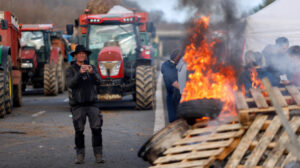
With roadblocks on motorways and country roads, as well as protests in cities, French farmers are continuing their demonstrations across much of the country, focusing on the impending signing of a trade deal between the EU and South American countries.
Farmers’ protests in France began days ago in response to the authorities’ order to slaughter cattle suffering from tuberculosis. The disease is not transmissible to humans, but it is recommended that the affected animal be killed.
Les agriculteurs sont toujours mobilisés contre la gestion gouvernementale de la dermatose nodulaire. Les blocages d'autoroutes, de routes et d'axes ferroviaires se poursuivent. →https://t.co/xHa6KJT15X pic.twitter.com/Bfz5G82lO3
— Le Figaro (@Le_Figaro) December 17, 2025
The government’s recommendation was to kill all animals in the herd, not just those that are sick.
The wave of protests subsided when the government promised to increase vaccination of cattle to curb the epidemic.
However, in the process thebroader issue of the Mercosur free trade agreement between the EU and South American countries was raised, which farmers in France, as in other countries, are calling for to be rejected or at least significantly modified.
Les blocages se répandent comme une tache d’huile, sur l’A43 vers Bourgoin-Jallieu (38) et vers Avignon, où les agriculteurs du Vaucluse et des Bouches-du-Rhône convergent vers Bonpas. pic.twitter.com/7Tcs3VsaFz
— Baudouin Wisselmann (@Baudouin_wissel) December 17, 2025
The confederation of farmers’ associations, FNSEA, France’s largest agricultural union, called for new protests on Thursday, with farmers planning to march their tractors to Brussels.
We will remain on the roadsuntil Christmas if necessary, a group of farmers told ICI France.
🔴 #DNC – LA MOBILISATION PREND DE L’AMPLEUR : LA FRANCE AGRICOLE EST DEBOUT ! Blocages, rassemblements, actions symboliques : partout sur le territoire, les agriculteurs se lèvent pour défendre leur métier, leurs élevages et l’avenir de l’agriculture française. Au départ,… pic.twitter.com/fWwplIrcD7
— Coordination Rurale (@coordinationrur) December 17, 2025
Public opinion on the side of farmers
Elabe’s latest poll for BFMTV, published today (Wednesday), shows that nearly 6 in 10 French people (58% in particular) approve of blocking roads in opposition to the state’s policy of slaughtering all animals in an infected herd, not just those that are sick. However, opinions are divided on the method: 50% of respondents believe the State is acting “excessively”, 36% “disproportionately” and 13% “insufficiently”.
The perception of excessive strategy is widespread in rural municipalities (56%) and politically among Le Pen’s National Rally voters (70%).
In any case leading farmers’ associations in France say protests will intensify if the EU adopts the deal.
Farmers argue that the deal will flood the EU with cheap products from South America, which are not subject to the same degree of regulation as their European counterparts. This means that crops, meat, and ingredients containing pesticides banned in the EU or coming from destroyed rainforests can be imported at prices lower than those that European farmers can afford.
🚧🇫🇷 ALERTE INFO – De nombreux BCLOAGES d’autoroutes sont en cours dans toute la France, notamment sur l’A9 : blocage au PÉAGE A9 CROIX SUD à NARBONNE, et sur l’A43 où les AGRICULTEURS ISÉROIS poursuivent leur mobilisation. pic.twitter.com/GZEaJiH4e0
— Prem's (@PremsNews) December 17, 2025
France and Italy oppose Mercosur deal
The vote on the Mercosur bloc deal was scheduled for the end of the week. European Commission President Ursula von der Leyen was due to travel to Brazil to sign the deal, which was reached a year ago after decades of negotiations with Argentina, Bolivia, Brazil, Paraguay, and Uruguay.
Despite this, today, Wednesday, France and Italy called for a postponement of the 2026 vote. The deal is still opposed by Hungary and another agricultural powerhouse, Poland.
By contrast, Germany, Spain and the Nordic countries argue that the deal will help exports hit by US tariffs and reduce dependence on China while providing access to minerals.
France wants stricter frameworks, including clauses requiring Mercosur products to comply with EU rules on pesticide and chlorine use, and stricter food safety controls.
But French President Emmanuel Macron will also be “very strict” on French demands, government spokeswoman Maude Breson said. The president believes “there is not enough clarity on the three conditions required” by France: “corresponding measures, a safeguard clause and controls,” she added.
At the same time, officials from Latin America have begun to show impatience, with one Brazilian official warning that it is “now or never.”
What the European Parliament is asking for
Meanwhile, the European Parliament is also calling for clauses to protect agricultural production
In a resolution adopted by a large majority (431 votes in favour, 161 against and 70 abstentions) MEPs call for the introduction of a safeguard clause in the EU-Mercosur agreement to prevent damage to Europe’s agricultural sector from imports from Latin American countries.
The draft regulation sets out how the EU can temporarily suspend tariff preferences for imports of certain sensitive products (such as poultry or beef) from Argentina, Brazil, Paraguay and Uruguay if it is deemed that these imports are hurting EU producers.
According to the European Parliament, the Commission should investigate the need for safeguard measures when imports of sensitive agricultural products increase by an average of 5% over three years (instead of the 10% annual limit under the Commission’s proposal). MEPs also call for faster investigations (results in three months instead of six and in two months instead of four for sensitive products) so that safeguard measures can be implemented more quickly.
MEPs also point out that the measures could take the form of a “reciprocity obligation”, under which Mercosur countries would have to apply EU production standards.
Ask me anything
Explore related questions




