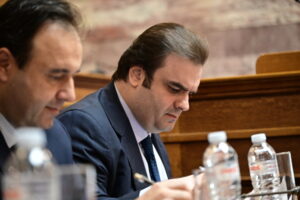
Today, the Minister of National Economy and Finance, Kyriakos Pierrakakis, presented to Parliament the new plan of the Hellenic Corporation of Assets and Participations (HCAP) for the transformation of the Hellenic Post (ELTA), stressing that it is a comprehensive intervention that strengthens the company’s sustainability, ensures universal postal service, and secures ELTA’s presence in every corner of the country.
As the Minister emphasized, the plan provides for the transformation of 158 branches, based on a flexible model tailored to the needs of each area.
In 28 cases, there is already an ELTA Courier branch within a distance of 100–200 meters. It will be examined whether these branches can take over the service so that nothing changes in citizens’ daily lives.
For 113 branches, the transformation will proceed only after an ELTA agent is found and only following full and timely information of citizens. There is already significant interest from local communities themselves, confirming both acceptance of the plan and its potential.
At the same time, 17 branches will not be transformed, as they cover critical banking transaction needs. As Mr. Pierrakakis noted, “this proves that the plan is not implemented mechanically, but with respect for local particularities and the real needs of citizens. No local community is left in limbo,” he stated characteristically.
The transformation of ELTA, based on HCAP’s plan, also includes the development of the “shop-in-shop” model, with ELTA presence inside supermarkets, bookstores, newsstands, and other retail outlets.
This model is already being implemented at 500 locations nationwide with very positive results.
The Minister underlined that the new plan is part of ELTA’s overall modernization strategy, aiming for a modern, reliable, and financially sustainable postal network that will continue to serve all citizens and businesses in the country on equal terms.
Excerpt from the Minister’s Address
“Thank you, Mr. President,
Ladies and gentlemen colleagues,
I will begin by acknowledging the obvious interest that I believe we all have in the organization we are discussing today.
Much has been said in previous years, including the term ‘sell-off,’ in discussions about the Hellenic Post. I believe this is entirely contradictory to a government decision to proceed with a substantial capital increase in the organization in order to safeguard its national and public character. I mention this at the outset because, in a sense, it is the elephant in the room.
However, I would add what Mr. Tembos mentioned earlier: due to European rules, the way one can support this organization is unfortunately not the same as the way one supports a classic structure of the Greek public sector. Since ELTA operates in a private market, it is governed by private-sector criteria.
In simple terms, the Greek state cannot simply come along and sign off on funding for ELTA. Any funds provided must meet specific criteria. When the capital increase took place, the goal was, first, to pay for the universal service obligations that had not been paid under the previous government, and second, to provide additional funding governed by a European rule known as the ‘private investor test.’ This will be assessed by Brussels in the coming period to determine whether the capital increase indeed met that criterion.
I mention this because the choices required to return the organization to operational profitability are necessary, regardless of who governs, if the organization is to function within the European institutional framework.
Another key fact concerns the market itself. Letter mail in Greece has declined by 90% in recent years due to digitization. The main market now is parcels and courier services. In this sector, the company has performed well in recent years, moving from fifth to second place in courier services, according to the data.
We are here today because, in our view, there was a misguided decision in the past—both communicatively and operationally. Communicatively, because it was not sufficiently explained nationwide what a postman can now do using simple technologies when knocking on a citizen’s door. Operationally, because not all alternative options were fully explored across all regions.
Across Europe and indeed worldwide, similar discussions are taking place regarding national postal services. All countries are trying to find solutions to manage costs while maintaining nationwide coverage. This shared challenge explains the sensitivity of local communities, especially outside urban centers, to the role of postal services.
Therefore, the plan managed by the new, currently transitional administration under HCAP’s supervision does not foresee closures, but transformations—specifically, the transformation of 158 branches, with exceptions where a courier branch exists within 100–200 meters.
For the remaining 113 branches, transformation will only occur once an ELTA agent is found and citizens are fully informed. There is strong interest from local shop owners and community members themselves.
Service needs are examined on a case-by-case basis: where most bills are paid, where voucher usage is higher, where parcel shipments dominate. Reorganization will proceed only if there is nearby banking infrastructure and citizens’ service is fully guaranteed.
That is why 17 branches from the initial list will not be transformed, as they cover critical banking needs. This shows that no decision is made mechanically and no local community is left behind.
A central pillar of the new approach is the ‘shop-in-shop’ model—postal services offered inside already operating neighborhood stores such as supermarkets, bookstores, and newsstands. This is not an experiment; it has already been implemented in over 500 locations nationwide, including urban, semi-urban, and remote areas, with proven effectiveness, extended opening hours, and significantly lower operating costs.
ELTA agencies will operate as partner service points under contract with ELTA S.A., with services, prices, terms, and procedures determined exclusively by ELTA, which will retain full control and oversight. This ensures service to small communities where a full branch is not viable, while maintaining the state’s physical presence.
Finally, assessing sustainability requires looking not only at individual branches as isolated cost centers, but at the organization as a whole. Direct state funding is not legally possible under current rules. Therefore, financial sustainability must be a central part of the discussion if we truly care about the organization and are not merely engaging in rhetorical hypocrisy.
The discussion thus shifts to available alternatives and citizen coverage—those whom we all serve in this chamber—and this goal is fully achieved through the adjustments made to the plan in cooperation with local communities.”
Ask me anything
Explore related questions