





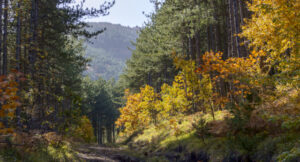
Severe evidence of widespread collapse of mountain spruce forests in the Peloponnese is being recorded by Greek researchers, as large areas of greenery are turning into dead zones, even in areas not directly affected by fires. The findings immediately mobilized the authorities, as the phenomenon far exceeded what had been observed in previous years.
Dimitris Avtzis, a senior researcher at ELGO-DIMITRA’s Forest Research Institute (FIR), was in the area to record the effects of spring fires. As he told the British newspaper The Guardian, the picture he saw was not limited to the expected fire losses. “There were hundreds of acres of trees that were lost or dying in places where the fire had not reached,”
he notes.
Greek spruce trees, one of the country’s most resilient species to drought, insects and fires, appear to be retreating under the weight of multiple pressures. According to scientists, the prolonged and intensifying drought, coupled with decreasing snowfall, is gradually weakening the trees. A study by the National Observatory of Athens shows that between 1991 and 2020 Greece lost an average of 1.5 days of snow cover per year, depriving forests of a key mechanism of natural moisture.
This weakening opens the way for canker-eating insects. “The severe drought weakens fir trees and then canker-eating insects find fertile ground,” explains Dimitris Avtzis. The insects, by penetrating under the bark, interrupt the transport of water and nutrients. Once their populations get out of control, “it is extremely difficult to contain them,” he adds.
The phenomenon is not limited to Greece. As the researchers point out, similar developments have been observed in other countries in southern and central Europe, such as Spain, reinforcing the assessment that this is a broader ecological change rather than a local anomaly.
According to the researchers, this picture is the result of accumulating pressures, which have intensified in recent years due to the climate crisis. Although fires are a long-standing feature of forests – with a loss of about 200,000 hectares in the period 2001-2024, according to Global Forest Watch – they are no longer the only or even the dominant factor in mortality.
Despite the concern, experts point out that Mediterranean ecosystems retain regeneration capacities. Forest climatologist Nikos Markos, also of the IDF, notes that post-fire regeneration can be satisfactory in some areas of the Peloponnese, although “it is not immediate” and requires four to five years to become visible.
Asked whether changing meteorological conditions may accelerate further and threaten southern European forests as a whole, Dimitris Avtzis says “there is no time for pessimism, but adds that “we have a lot of work ahead of us. He stresses that the scientific knowledge and tools exist, but public debate and timely action are needed, as the phenomena that are currently causing concern are expected to become more frequent and intense.
Ask me anything
Explore related questions




