





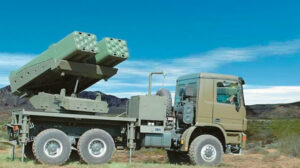
The green light has been given for the procurement of five armaments, including the Multiple Launchers system PULS (Precise & Universal Launching Sydtem) missile system was lit by the House Special Standing Committee on Armament Programmes and Contracts, intensifying the processes to further strengthen the country’s deterrent power and also to implement the five-tiered dome, namely the “Scythe of Achilles”, just before the advent of the New Year.
After months of negotiations, the Pentagon has contributed to the €692 million deal with Elbit Systems, which was subsequently approved by the KYSEA, carrying a strong geopolitical bias, with the Southeastern Mediterranean as a backdrop.
This particular arms program consists of multi-missile launcher systems and their procurement is expected to be done through a transnational agreement with Israel, as Athens wishes to transfer know-how and develop joint actions in the field of defence industry with Tel Aviv, in a period of intense transnational partnerships. In particular, the CIPs will be carried by Italian-made vehicles of the IVECO company, while the supply specifically concerns:
■ 36 vehicles of the CIP
■ 6 fire control centres (FDC) fire brigade vehicles
■ 6 vehicles.
■ 2 squadron KPI vehicles
■ 2 squadron KPI vehicles
■ 36 ammunition transport vehicles
■ 288 rockets with a range of 35 km (Accular 122 mm calibre).
■ 320 missiles with a range of 150 km (EXTRA 306 mm calibre).
■ 120 missiles with a range of 300 km (Predator Hawk, calibre 370 mm).
■ 108 roving munitions (SkyStriker, range 100+ km).
■ 324 training missiles.
Greek interest in the PULS missile system began to be expressed at the staff level as early as 2019, and was reiterated at the summit level, namely between Prime Minister Kyriakos Mitsotakis and his Israeli counterpart Benjamin Netanyahu, in 2020, as it is a system that is the natural evolution of the new generation of missiles, since it has precision and massiveness of fire, long range (deep strikes), which reaches up to 300 km., and high dispersion. In this sense, the PULS system will defend Greek sovereign interests on Greece’s northeastern border with Turkey, as well as the Greek islands in the Aegean Sea, as Reuters observed, composing a missile shield in the most marginal areas of the country. For example, such a system offers the potential for quick strikes “behind the front line,” in the case of Evros.
At the same time, the Pentagon’s discussions with the Israeli side reportedly include new partnerships, since Tel Aviv has a long tradition of joint research and development (R&D). In this direction, Israeli interest revolves around the development of the Greek canopy, which is being developed in five levels: anti-aircraft, anti-missile, anti-drone, anti-ship and anti-submarine, under the sea. At the same time, the green light from the GSC for the Follow-On-Support (FOS) contracts for the Rafale, with a horizon of the next four years, intensifies mobility around the armament programmes, while the Pentagon has signed a contract worth €50 million over the next five years to increase the operational availability of the fleet of NH90 Tactical Transport Helicopters.
Empowerment in the Emirates
In addition to deepening, however, Greece’s cooperation with Israel in the defense sector, a key objective of National Defense Minister Nikos Dendias is the further strengthening of the bilateral relationship with the United Arab Emirates. In this context, Mr. Dendias is currently participating in the 16th Sir Bani Yas Forum, on the sidelines of which he is to hold contacts with officials of the United Arab Emirates, as well as with officials of other countries that will participate in its proceedings. Besides, the UAE’s investment presence with a training center within the EAB is a crucial factor, if not a springboard, for new future partnerships, at a time when the Greek defense industry is beginning to form a pacing, notable by strategic players in the region.
In this perspective, the Minister of National Defence underlined the “excellent ties” and the importance of the strategic relationship between Greece and the Emirates at a recent event to celebrate the country’s 54th National Anniversary, preparing the ground for his new visit.
It is recalled that all this comes as yesterday, Thursday, in Lorian, France, the official ceremony of raising the Greek flag on the Belharra frigate “Kimon” (F-601), marking her handover to the Navy, took place in the presence of National Defence Minister Nikos Dendias.
A few days later, the ship is expected to go to Brest to receive its initial load of armament and in early 2026, to be at the Salamis Naval Station, opening the “internal” process of integration and certification in the fleet.
Ask me anything
Explore related questions




