





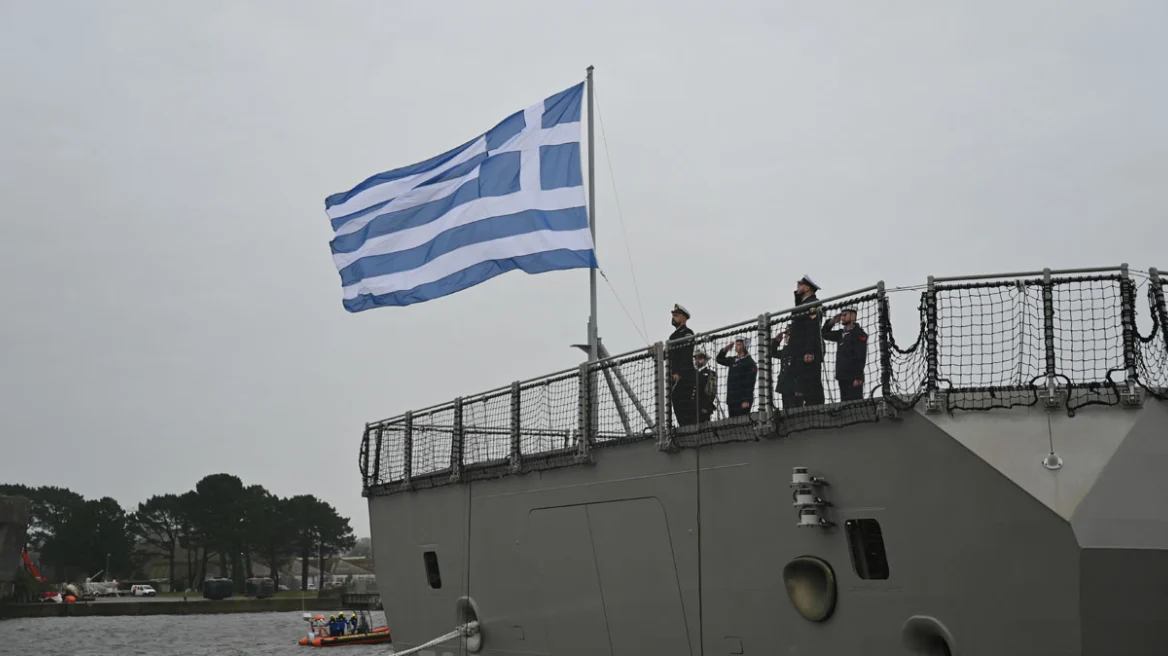
The HS Kimon, the first Greek Belharra-class frigate, officially joined the force of the Hellenic Navy just a few hours ago, following an emblematic ceremony held on Thursday at the pier of the Naval Group shipyard in Lorient, France.
As stated by the Minister of National Defense, Nikos Dendias, “General Kimon linked security with the prosperity of Athenian democracy, and ‘Kimon returns to the Mediterranean 2,500 years later to project Greece’s strength,’” emphasizing that “the integration of the four Belharra frigates into the Navy creates the strongest Navy that Hellenism has ever had.”
After Lorient, the frigate Kimon will sail to Brest, where it will receive its initial weapons load. There, the first full integration of sensors, the combat management system, and weapon systems under real operational conditions will be completed.
Subsequently, the ship will set course for Greece and dock at the Salamis Naval Base in early 2026. From that point on, the internal process of integration into the Fleet will begin: certifications, testing within Greek networks, training in national procedures, and the gradual assumption of operational roles.
The ceremony concluded with the raising of the Greek flag at the stern and the commissioning pennant—the international distinguishing mark indicating that the ship has a commanding officer—after which the name of the frigate was announced and the boarding of the 128 crew members took place.
The 6 “weapons” the frigate Kimon provides to the Armed Forces
The integration of the frigate KIMON into the Hellenic Navy fleet does not merely increase the number of available units. It changes the way Greece controls, monitors, and defends the maritime space of the Aegean. More specifically:
1. From local defense to area air defense
Until now, Greek frigates primarily protect themselves and nearby units. KIMON introduces, for the first time on a Greek ship, the capability of area air defense. With Aster 30 missiles and the Sea Fire radar, the frigate covers a wide maritime and aerial area, creating a protective “umbrella” over groups of ships, islands, or critical sea zones. In practice, this means that the Navy does not merely react to threats but actively shapes the operational environment.
2. Sees farther—earlier
The Sea Fire radar does not operate in isolation. It is combined with data from aircraft, UAVs, other surface units, and surveillance systems. KIMON does not only “see” what lies on its horizon; it sees what the entire network reveals. This gives the Navy reaction time—the most critical factor in an environment like the Aegean, where distances are short and developments are rapid.
3. Handles saturation and multiple threats
The Aegean is characterized by dense geography, a large number of islands, and limited maneuvering space. In such an environment, saturation attacks pose a serious threat. KIMON is designed to manage multiple simultaneous threats from the air, surface, and underwater. The combination of sensors, combat system, and weapons allows the ship to prioritize targets and react without delay, shifting the balance in any high-intensity incident.
4. Controls the underwater domain
The Aegean and the Eastern Mediterranean are not only aerial and surface spaces; they are also arenas of underwater competition. With the CAPTAS-4 towed sonar, KIMON gains the capability to detect submarines at long ranges, decisively enhancing the Fleet’s anti-submarine warfare picture. This acts as a deterrent and forces any adversary to operate with greater risk and constraints.
5. Acts as a force multiplier
The true power of KIMON lies not only in its armament but in its role as a command and sensor hub. The ship does not fight alone; it coordinates, guides, and enhances other units. In Aegean terms, this means that a group of ships led by an FDI does not operate defensively, but sets the tempo, limits options, and increases the cost of any provocation.
6. Changes doctrine, not just capabilities
KIMON embodies a different doctrine: fewer but more capable ships, high connectivity, and emphasis on information and cooperation. This doctrine matches the geography of the Aegean and the modern form of naval operations. For the Hellenic Navy, the frigate KIMON is not merely a new unit. It is the tool for transitioning from an era of managing attrition to an era of active deterrence.
Ask me anything
Explore related questions




