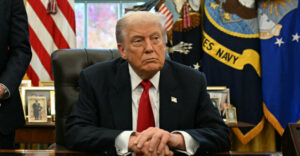
Donald Trump has returned to the White House with a slogan of radical change. A year later, he governs as if he has a mandate to overturn – not just policies, but rules, balances and limits.
The central idea is twofold: harsh repression where it can show measurable results (borders) and at the same time a concentration of power in the Oval Office. The paradox is that the country has not faced a similar national crisis as it did under Abraham Lincoln or Franklin Roosevelt.
Nonetheless, Trump has chosen to rule frequently with “emergency powers,” turning the exemption status into an everyday policy tool. But what has the US President “produced” by category based on what he pledged during the election?
Immigration: the most tangible result
immigration was the core of his campaign. In practice, the government escalated the crackdown not only on illegal entry but also on legal entry. By executive order, it drastically restricted access to asylum for those entering without permission. At the same time, it put pressure on Mexico to put the brakes on the flows before they reach the border. The result has been spectacular: fewer than 10,000 illegal crossings a month at the Southwest border, levels reminiscent of other times.
However, on the deportation front, the goal has not been met. Deportations are likely to reach 500,000 this year – below the goal of one million. And despite the rhetoric about “worst of the worst,” the data show that many of those arrested in high-profile operations had no criminal record. The framework was also tightened institutionally: two laws boosted detention of immigrants under certain conditions and tripled ICE’s budget. At the same time, the government cut the refugee program to its lowest level in history, kept limited slots for white Africans from South Africa, and tightened the green card process for countries covered by the travel ban.
Federal government: ‘Tearing down’ with purges and shrinking services
With a hollowing out of services and hiring of services, hiring and shutting down hiring.
The second big promise was the “demolition of the deep state. The implementation began with purges at the Department of Justice and the Federal Bureau of Investigation (FBI). Massive removals of officials linked to cases against him were made, while FBI Director Cash Patel redirected resources toward arrests of illegal immigrants and curtailed other areas, such as public corruption.
Under Elon Musk’s Department of Government Efficiency, the administration has made cuts, frozen grants, and unilaterally dismantled agencies created by Congress, such as USAID and the Department of Education. In human resources, the Office of Personnel Management (OPM) estimates 317,000 employee departures this year, compared to 68,000 hires. Immigration enforcement was strengthened, but – according to the document – public functions such as health, disaster management, and cancer research were weakened. At the same time, Trump undermined control mechanisms by purging independent inspectors general who oversaw waste and abuse.
Trade: Tariff shocks, uncertainty, and a system in shuffle
On trade, Trump made the biggest break: tariffs 25% on Canada and Mexico, 20% on China, and then a wave of tariffs on dozens of partners, with pauses and resets that increased uncertainty. The paper notes that the US effective tariff rate exceeded 18% – highest since 1934. China responded with mineral restrictions and by cutting off purchases of US soybeans until there is a truce and an agricultural “bailout.”
The promise of re-industrialization was not fulfilled. The manufacturing sector has continued to lose jobs, over 50,000 since Trump took office. Businesses rushed to import before the tariffs, built up inventories, and are now beginning to pass increases on to consumers as inventories decline. The 2025 trade deficit remains higher than the previous year, and the Supreme Court appears wary of using extraordinary powers to impose tariffs.
Accuracy: Fewer promises, more pressure on the Fed
Less pressure on the Fed and more pressure on the Fed.
Trump promised “rapid” price declines. The document documents that inflation remains elevated and prices are higher than last year, despite White House rhetoric about gasoline near $3 a gallon. In food and basics, there is no relief that voters expected. The government has begun easing tariffs on products such as coffee, bananas, beef, and tomatoes. The economy, however, continued to “run” through the end of September, showing that the tariffs did not stifle growth as many feared. Trump is pushing the Federal Reserve to cut interest rates, but mortgages remain high. The 50-year mortgage proposal was met with bipartisan disapproval, and ideas for $2,000 checks have been brought back without a clear plan.
Drugs, wars, and military at home: Aggression with heavy institutional consequences
In the “war on cartels, Trump has gone to unprecedented escalation: designating cartels as “terrorist organizations” and military attacks on suspect vessels in international waters, with 29 attacks and 105 deaths since September 2. Legal experts in the US reject the “armed conflict” argument with cartels. The contradiction is compounded by suggestions that the pressure is also linked to leadership change scenarios in Venezuela, while Trump pardoned Juan Orlando Hernández and signed an executive order easing restrictions on marijuana.
Abroad, he helped bring about a ceasefire in Gaza but fell short of the “peace in 24 hours” promise in Ukraine. At the same time, it has invoked mediation on many fronts, with unstable or partial results. And in the most explosive move, he green-lighted a strike on Iranian nuclear facilities and then announced a ceasefire, leaving behind fears of generalized ignition.
Domestically, he tested the limits: troops at the border with a legal trick that gave them an arrest role, deployment of National Guard and Marines in Los Angeles without governor’s consent, power moves in Washington and elsewhere. Courts have put the brakes on some deployments, but the precedent – the “normalization” of troops on the streets – has already been set.
Justice, DEI, presidential power
Trump has moved to an open instrumentalization of the Justice Department: direct orders for investigations and prosecutions, with Pam Bodie abandoning the post-Watergate tradition of independence. Cases such as James B. Comey and Leticia James moved aggressively, but stumbled into procedural matters and continued as a political message.
On the DEI front, the government is attempting to make “diversity” taboo, cutting funding, squeezing schools, controlling libraries, targeting corporations and law firms, restricting teaching around racism and trans issues, reinstating Confederate symbols, and changing state documents to reflect biological sex. We’re probably not just talking about a “war on woke culture” here, but a departure from central principles of the Civil Rights Act of 1964.
All of this ties at the top the expansion, i.e., by any means and by any means of presidential power. Trump is simultaneously attempting to control the executive function, to dismantle independence that Congress set up, to transfer to the Oval Office the “power of the purse” through spending delays and cancellations, and to set a precedent of “non-enforcement” of laws, as in the case of TikTok.
Donald Trump‘s data cannot be described as “okay” or “inconsistent” as there have literally been weeks of managing many, most often disparate issues of major domestic and global importance within the same day. Trump is also creating data something not only the US but the entire Western world has never encountered before, a democracy that “tilts” at will to his moods and goals. The question is whether after the end of his second term the American President will have left Americans room for change or whether he will have marked not only his country but also our time in an “indelible” – or even incorrigible – way.
Ask me anything
Explore related questions