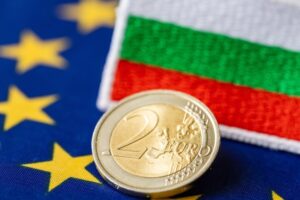
On January 1, 2026, Bulgaria is expected to become the 21st member state of the Eurozone. Joining the single currency marks a major milestone for the country, which acceded to the EU in 2007. Once Bulgaria joins, only six of the EU’s 27 member states will remain outside the euro area. Economists, however, warn that it is crucial for incomes to always reflect the productivity of the economy and for people not to live beyond their means.
“If incomes become detached and are artificially inflated through borrowing, distortions can arise, as we saw in Greece,” they note.
The euro “is not simply a currency, but a strategic decision” that strengthens Bulgaria’s position in Europe, Bulgarian Prime Minister Rosen Zhelyazkov said.
As Rositsa Rangelova, professor at the Institute for Economic Research of the Bulgarian Academy of Sciences (BAS), explains to DW, supporters of Bulgaria’s euro accession “present the situation as if the standard of living and the country’s prosperity will automatically increase.
However, it is not clear how this can happen, given the necessary and long-delayed reforms, without which Bulgaria will not be an equal member of the Eurozone.”
What is the state of the country’s economy?
In recent years, the Bulgarian economy has followed a relatively stable path: inflation has declined, the fiscal deficit and public debt remain low, and there are positive growth prospects.
“The economic situation has been stable over recent decades, even if growth and convergence did not evolve in the optimal way,” says Guntram Wolff, an expert on Eurozone fiscal policy at the European economic think tank Bruegel.
This view is shared by Norbert Beckmann, head of the Konrad Adenauer Foundation (KAS) office in Bulgaria. As he noted, the country meets all convergence criteria for joining the Eurozone, highlighting in particular the low level of public debt. “However, the Bulgarian economy still has a way to go in terms of structure and productivity.”
Fiscal discipline and risks
Experts warn the government not to relax fiscal discipline after adopting the euro. “The main risk is that fiscal discipline may be seen as less binding after joining the Eurozone, leading to higher deficits. Given the low debt level, however, I consider this risk limited,” Wolff stresses.
Beckmann also underlines the need to avoid market distortions: “It is important that incomes always reflect the productivity of the economy and that people do not live beyond their means.
If incomes become detached and are artificially inflated through borrowing, distortions may arise, as we saw in Greece.”
The major challenge of political instability
A major challenge appears to be political instability, as public anger and frustration over economic mismanagement and widespread corruption are evident.
Bulgaria—one of the poorest countries in the EU—ranks among the most corrupt member states according to Transparency International’s Corruption Perceptions Index. The country of 6.4 million people has held seven parliamentary elections since 2021 and may be headed for another election in the coming months.
Prime Minister Rosen Zhelyazkov’s government resigned on December 11 amid mass protests against corruption and government fiscal plans, which included tax and social security contribution increases. Although the budget was withdrawn, public anger has not subsided.
At the same time, according to opinion polls, Bulgarians are divided over the introduction of the euro. Skeptics fear rising inflation due to price conversion from the Bulgarian lev to the euro and worry that part of the country’s ability to conduct an independent monetary policy will be lost.
“The process of joining the euro area will not benefit the Bulgarian economy. Bulgaria will end up as a peripheral state of the Eurozone, less flexible and incapable of absorbing or managing crises,” Rangelova argues. She also criticizes Bulgarian authorities for failing to hold a referendum on euro accession.
“On such fundamental issues, governments in democratic countries take public opinion into account,” she says, adding that “for years Bulgarian authorities have categorically rejected referendums as a means of expressing the popular will and continue to find ways to ignore them.”
“Joining the Eurozone at any cost does not lead to prosperity”
Although there are legitimate concerns, Wolff explains that euroskepticism surrounding accession is also driven by disinformation campaigns and conspiracy theories, with “Russia clearly trying to bring the country back into its sphere of influence.”
Beckmann, however, believes that euroskeptic positions “have always been a minority in Bulgaria, and I do not think this will change.”
Despite frequent changes of government in recent years, “the parties and politicians seeking euro adoption and the country’s integration into the West have always held a majority in parliament.”
Finally, Rangelova warns that joining the Eurozone “at any cost” does not lead to prosperity. “Instead of immediate accession, Bulgaria should focus on stabilizing the political situation, pursuing a prudent macroeconomic policy based on strong domestic institutions, and ensuring good governance.”
Ask me anything
Explore related questions