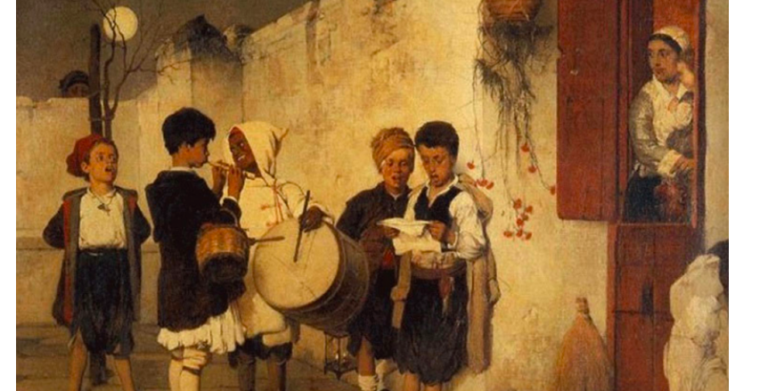
New Year’s carols are traditional folk songs created by the people, with roots dating back to Ancient Greece. Over time, they became firmly established as part of major religious celebrations, mainly Christmas, New Year’s Day, and Epiphany.
They are sung primarily by children and teenagers, though sometimes by adults as well, either individually or in groups. Carolers go from house to house, as well as to shops and public spaces, accompanied by the familiar metal triangle and occasionally other musical instruments such as harmonicas, accordions, drums, flutes, or similar.
Traditionally, the singers first ask, “Shall we sing them?” and wait for the response, “Sing them,” before beginning.
The main purpose of the carols, after conveying wishes of “Happy New Year,” is to receive a small reward—nowadays usually money, while in the past it was often food or goods. Related to this custom is the preparation of special festive bread, known as kolliki (in Veria) or kouliantina (in Siatista). Those who carried these breads were known as Koulourades or Fotades.
Regional New Year’s Carols
Zakynthos
The New Year’s carols of Zakynthos include lyrical verses wishing health, love, joy, and prosperity for the household and its members, often asking symbolically for a coin as a token of goodwill.
Asia Minor
In Asia Minor, children traditionally sang carols on the evening before major feasts. They often carried handmade boats decorated with colorful lanterns and paper ornaments. Sometimes, instead of boats, they made illuminated paper churches—small replicas of Hagia Sophia.
Macedonia
Macedonian New Year’s carols are a representative example of the region’s rich musical tradition, with lyrics invoking Saint Basil and blessings for families, education, and those living abroad.
Thrace
The carols of Thrace reflect the region’s refugee heritage and deep connections with Eastern Rumelia and Eastern Thrace, blending ancient traditions with Christian symbolism.
Islands (Ikaria, Corfu, Chios, Kefalonia, Crete, etc.)
Island carols stand out for their expressive performance style. The singers often focus on praising the household members in detail, sometimes humorously or poetically, rather than simply narrating religious events.
Pontus
Pontic New Year’s carols are accompanied by traditional instruments such as the Pontic lyra, bagpipes, and flute, and feature distinctive dialect and rhythm.
Ask me anything
Explore related questions