Long before Tyrannosaurus rex and the dinosaurs immortalized by Hollywood, Earth was ruled by creatures even stranger—and arguably more terrifying. During the Permian period, roughly 299 to 251 million years ago, the planet belonged to super-carnivorous beasts armed with tusks, massive jaws, and bodies built for brute strength. It was a harsh world, moving steadily toward the greatest mass extinction in the history of life.
As the BBC reports, new light was shed on this shadowy era in 2021, when paleontologist Julien Benoit of the Iziko Museum of Natural History in Cape Town opened an old, forgotten box of fossils. Inside, he made a remarkable discovery: a small, glossy tooth lodged in the skull of another animal. Further analysis revealed that it was a broken tooth from a violent clash between two large predators of the same species—a previously unknown type of gorgonopsid, among the most formidable carnivores of the Permian.
A World of Extremes
The Permian was an age of dramatic contrasts. All of Earth’s landmasses were fused into the supercontinent Pangaea, surrounded by a single vast ocean. The period began with glaciers and low sea levels, but gradually shifted toward intense global warming and widespread drought. Deep within the continent stretched enormous deserts where temperatures may have reached as high as 73°C, while coastal regions remained wetter and habitat-friendly.
Monsters Older Than Dinosaurs
In this unforgiving environment, the synapsids evolved—a diverse group of animals ranging from bulky herbivores to the most fearsome predators of their time. Synapsids possessed a critical advantage: they could reproduce away from water, either through internal fertilization or by laying eggs resistant to drying out. This adaptation allowed them to spread across nearly every corner of Pangaea.
The Rise of the Carnivores
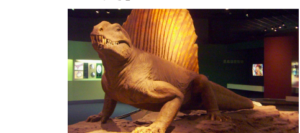
As herbivorous synapsids grew larger and more abundant, they provided ample prey for carnivores. This led to the emergence of giant predators such as Dimetrodon, which could weigh up to 250 kilograms and was famous for the large sail on its back. Once thought to function as a solar panel for temperature regulation, the sail is now believed to have played a role in display and mating.
In some regions, however, predators became so numerous that they outnumbered large land prey. Fossil evidence later solved this puzzle: top predators had expanded their diet to include massive freshwater fish and even sharks, filling the gap in the food chain.
The True Nightmares of the Permian
Predatory evolution reached its peak with giants such as Anteosaurus and, later, the gorgonopsids, distinguished by their enormous saber-like tusks. Some species stretched up to six meters in length and possessed jaws powerful enough to crush bone. Fossils from South Africa’s Karoo Basin suggest these animals were fast, agile hunters with excellent balance and visual stability—traits strikingly similar to those of modern apex predators.
Intriguingly, fossils of certain species have been found in regions where they should not have existed geographically. This suggests that Permian ecosystems were already becoming unstable, with predators disappearing and being replaced by others—a warning sign of the catastrophe to come.
The Great Extinction and Its Legacy
Toward the end of the Permian, massive volcanic eruptions in what is now Siberia released vast quantities of carbon dioxide into the atmosphere. Global temperatures soared, oceans became depleted of oxygen, and both marine and terrestrial ecosystems collapsed. An estimated 90% of all life on Earth was wiped out in what became known as the “Great Extinction.”
Not even the most dominant predators survived this upheaval. Yet a small number of synapsids endured into the next geological period. From these survivors, millions of years later, mammals—and eventually humans—would evolve.
The monsters of the Permian have long vanished, but their story remains deeply relevant. Their rise and fall remind us that ecological disasters rarely strike without warning. More often, they build slowly, driven by imbalances we fail—or choose not—to see.
Ask me anything
Explore related questions