





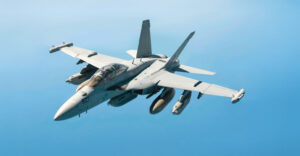
Among the more than 150 U.S. military aircraft operating over Venezuela last weekend was the EA-18G Growler, a fighter jet that does not target people, but electronic signals.
The Boeing EA-18G Growler is a key tool of electronic warfare. According to the Wall Street Journal, the U.S. Navy Growler—nicknamed the “Zappers”—is said to have played a decisive role in Venezuela, where air-defense systems were quickly neutralized. In electronic warfare, the targets are the opponent’s communications, radars, and electromagnetic signals in general.
The aircraft is based on Boeing’s F/A-18F Super Hornet and is considered a core pillar of U.S. electronic-warfare capabilities. As analysts explain, the Growler can locate enemy radars, jam them, and block military communications.
According to the same information, during the operation in Venezuela the United States also used F-22, F-35, and F-18 fighter jets, B-1 bombers, and drones, aiming to neutralize air defenses and communications before the arrest of the country’s president, Nicolás Maduro, by special forces.
According to experts, the success of the operations is also due to the fact that Venezuela possesses outdated and limited air-defense systems, mainly of Soviet and Russian origin, which were unable to counter modern electronic-warfare technologies. The country had, among other systems, S-300 systems, which in the past have been bypassed and destroyed in other conflicts as well.
Electronic warfare is not new, but in recent years it has gained particular importance. In the war in Ukraine, the mass use of drones highlighted the capabilities of signal jamming and deception, with Russia considered particularly advanced in this field.
The Growler is equipped with specialized electronic-warfare equipment, missiles that detect and destroy radars, and a two-person crew, one of whom is exclusively responsible for electronic operations. The cost of the aircraft was estimated in 2021 at approximately $67 million.
At the same time, electronic warfare is emerging as one of the most profitable sectors of the defense industry, with new technologies—such as the use of lasers in communications and artificial intelligence—shaping the future.
However, analysts express concerns that the United States and Europe may be lagging behind China, as modernization programs, such as those for the Growler, are progressing at a slow pace.
Ask me anything
Explore related questions




