





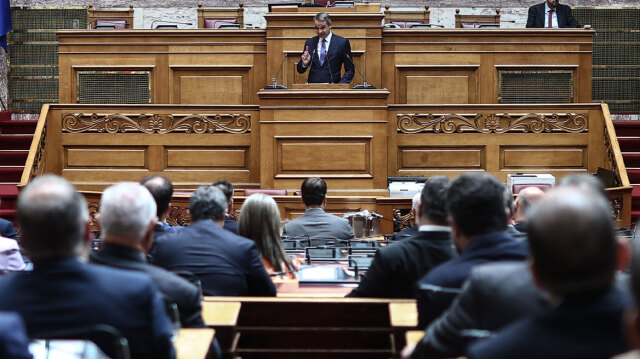
Prime Minister Kyriakos Mitsotakis has officially signaled the start of Greece’s top parliamentary procedure: the Constitutional Revision. At the same time, he announced the government majority’s intention to introduce bold institutional reforms aimed at modernizing the country’s supreme legal framework. The leadership of the “blue” parliamentary group believes there is social readiness to push through key initiatives, such as the establishment of private universities, public sector employee evaluations, limiting civil service tenure, and reforms to Article 86. However, it is also aware that the lack of political consensus makes achieving broader agreement—essential for major constitutional changes—particularly challenging.
Given that the Constitutional Revision must begin before national elections, New Democracy (ND) is expected to present a wide-ranging set of proposals by March. At the same time, the opposition will be compelled to clarify its positions on issues of broad societal interest.
The institutional discussion is expected to trigger a sharp ideological debate and turn the Revision into a voting benchmark. Party positions on necessary reforms will be scrutinized by voters, and many analysts anticipate that the process will also indicate potential post-election coalitions.
It should be noted that the current “pre-revision” Parliament selects the articles, while the next Parliament determines their content. Elections are held so that voters can evaluate party positions. If an article is deemed revisable now with 180 votes, the next Parliament only needs 151 votes to amend it. If the required three-fifths majority is not reached in the current Parliament, 180 votes will be needed in the second phase, in a post-election environment likely to be fluid.
Detailed Steps
Preliminary Parliament (Current)
- By the upcoming March, written proposals for revision must be submitted, signed by at least 50 MPs. Proposals must include a rationale and specify the constitutional articles for revision.
- The Speaker of the Parliament, Nikitas Kaklamanis, will then invite parties to appoint MPs to the Cross-Party Constitutional Revision Committee. Reportedly, Euripidis Stylianidis (ND), Panagiotis Doudonis (PASOK), and Theofilos Xanthopoulos or Dionysis Kalamatianos (SYRIZA) are considered as potential rapporteurs.
- The Committee will submit its report to the Plenary within the established deadline (2–3 months).
- A discussion will follow to determine the need for constitutional revision and to define the specific articles to be revised. This decision is taken through two roll-call votes at least one month apart, applying only to articles proposed for revision, not their content. Articles need at least 151 votes in both votes to move to the next phase.
Revision Parliament (Next)
- The Speaker of the newly elected Parliament will establish a new Constitutional Revision Committee, which will receive the decisions from the previous Parliament.
- Members of the Committee will determine the content of the proposed articles.
- The final report will be submitted to the Plenary for roll-call votes, with the required majorities:
- 151 votes for articles previously approved by at least 180 votes.
- 180 votes for articles previously approved with 151 votes.
Required Majorities
A key element of the two-phase revision process is the majorities required.
- The current Parliament holds two roll-call votes.
- Articles failing to reach 151 votes in any vote are rejected.
- Articles approved with at least 180 votes in both votes will require 151 votes in the next Parliament.
- Articles approved with 151–179 votes in any vote will require 180 votes in the next Parliament.
Repeat Elections
Additional complications arise if the next Parliament is dissolved immediately due to a failure to form a government.
- Some constitutional scholars argue that a so-called “one-day Parliament” would invalidate the revision process, citing Article 110, paragraph 3:“Once the revision is decided by Parliament, the next Parliament, at its first session, decides by absolute majority of all members regarding the revisable provisions.”
- Government sources refer to Supreme Court case law, which ruled that a “one-day Parliament” does not count as a session. While the precedent concerned criminal statute-of-limitations issues for former Minister Giorgos Papakonstantinou, the government argues it should apply by analogy to the current constitutional revision process.
Ask me anything
Explore related questions




