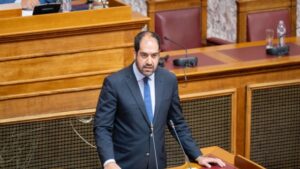
The Minister for Climate Crisis and Civil Protection, Giannis Kefalogiannis, addressed Parliament yesterday (19/2) during the debate and vote on the “Active Battle” bill, presenting the overall reform of the national system for prevention, preparedness and response to forest fires and other natural, technological and man-made disasters.
As he emphasized, the management of natural disasters “is not a one-off policy, but a long-term strategy. A civil protection system learns cumulatively, builds institutional memory and incorporates experience.”
He stressed that the aim of the bill is not ideological confrontation, but the creation of a stable, functional and lasting framework to protect society, ensuring institutional continuity and operational consistency. In this context, he noted that the draft law is not the product of a closed administrative process or a unilateral government initiative, but rather an exercise in “institutional maturity and a sincere effort to establish common ground.”
Incident Command System
In his speech, he highlighted that the new framework establishes, for the first time, a comprehensive Incident Command System (ICS), with clear rules of engagement, on-site command structures, and operational and regional crisis management centers, “so that we move from fragmentation to interoperability, from improvisation to process, and from ad hoc reaction to a system that learns and evolves.”
He noted that a common operational language and a clear allocation of roles among all involved bodies are prerequisites for the state’s credibility in the eyes of citizens.
Particular emphasis was placed on institutionalized evaluation and the extraction of operational lessons. The bill provides for the establishment of Special Scientific Evaluation Committees for major disasters, as well as the introduction of an Annual Wildfire Season Report with measurable indicators such as response times, causes of fires, effectiveness of preventive interventions, and availability of resources.
As he stressed, “a major forest fire cannot conclude with a political confrontation. Experts must be tasked with clearly defined missions to analyze the causes and handling of the incident and draw concrete lessons.” The report will be submitted to Parliament and made public, enhancing transparency and accountability and turning evaluation into a tool for institutional self-improvement.
The Minister also referred to the Ten-Year Strategic Plan for the Integrated Management of Forest Fires, which introduces long-term planning with measurable prevention targets, risk analysis per Region and Municipality, local-level specialization, and digital mapping of critical assets (networks, paths, infrastructure).
As he explained, “the disaster management cycle will no longer depend on the circumstantial pressure of a difficult summer, but will be organized around measurable targets, prioritized interventions and continuous monitoring.” The plan will also be further specified at regional and local levels.
In the field of scientific documentation, he pointed to the strengthening of the National Database, the establishment of an Operational Meteorology Unit within ESKEΔΙΚ, and the creation of a Flood Risk Assessment Committee, aimed not only at forecasting weather phenomena but also at predicting their potential consequences.
“We need data, data analysis and the effective use of that data. There are not infinite ways to connect scientific knowledge with operational choices,” he noted. Moreover, the committee will not be limited to approvals but will also be able to form inspection teams to verify whether projects are actually carried out, whether clearances are performed, and whether interventions are completed.
Mr. Kefalogiannis placed particular importance on strengthening prevention at the local government level, with the creation of an Evaluation and Oversight Committee for prevention projects and the possibility of auxiliary licensing by the General Secretariat for Civil Protection for small island and mountainous municipalities within a 90-day deadline.
In addition, the bill provides for the possibility of assigning supportive responsibilities for the preparation, implementation and management of civil protection actions to the Technical Chamber of Greece (TEE), ensuring that planning, technical specifications and operational guidelines can be translated into mature and implementable interventions, particularly at regional and municipal level. Addressing longstanding dysfunctions, the Minister noted that “municipalities lacking adequate technical services will no longer be left behind.”
At the same time, the bill includes provisions to upgrade the Fire Service Academy, increasing from 3% to 10% the special admission category for large families and families with three children, as well as provisions for special transfers and training of graduates of productive schools.
The Minister also submitted a package of legislative-technical improvements, which, as he said, stemmed from interventions by stakeholders and political parties in committee and serve two main objectives: strengthening effectiveness, prevention and accountability, and substantially incorporating documented observations made during the committee process.
As he explained, Article 13 corrects a cross-reference to ensure precise alignment with the appropriate regulatory provision and avoid interpretative ambiguities. Articles 14 and 15 explicitly clarify the advisory role of the regional and local coordinating bodies (P.E.S.O.P.P. and T.E.S.O.P.P.), strengthen their operational linkage and clearly distinguish their role from the executive authority of Regional Governors and Mayors, reinforcing institutional safeguards in decision-making.
Article 19 enriches the framework for allocating measures with explicit reference to flood and other risk indicators, as well as identified staff shortages.
Articles 37 to 40 incorporate observations raised during the debate, particularly regarding the institutionalization of health and environmental protocols for monitoring air quality and publishing real-time data, the training and retraining of responsible controlled-burning officers using international programs, and the clarification of the framework for controlled grazing as a planned and recurring intervention with specific criteria.
Concluding, the Minister for Climate Crisis and Civil Protection reiterated that “no legislative initiative can eliminate risk,” but that the present bill organizes its management in a more responsible and institutionally mature way, representing, as he underlined, “a lasting choice of responsibility toward citizens and their future.”
Ask me anything
Explore related questions