





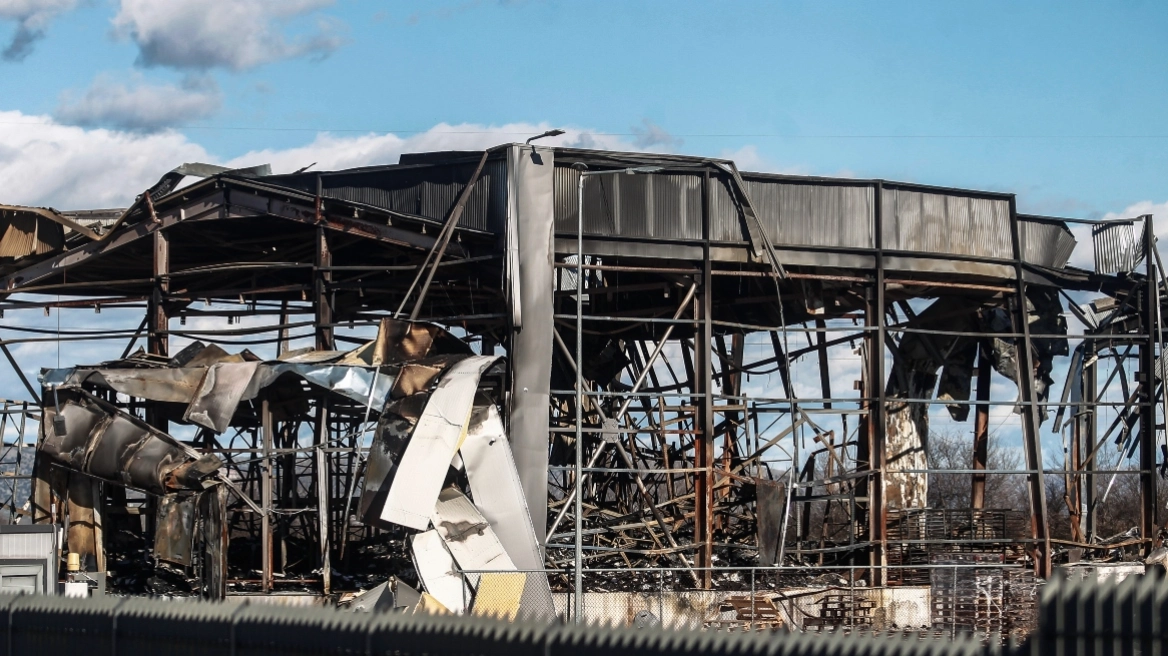
The investigation into the corroded pipe, from which propane leaked and caused the deadly explosion at the Violanda factory, has been completed by the NTUA laboratory.
The NTUA finalized the report and is expected to forward the file to the courts. According to ERT, the report includes detailed data following a thorough examination of the affected section, which reportedly had holes of varying depths along its entire length, examined under a microscope at NTUA laboratories. The pipe was pierced in multiple spots over approximately 7.5 meters, according to the same sources.
The report emphasizes the incorrect installation of the pipe, which was buried without sand, without pitch, and without the required anti-corrosion protection. However, the correct material, steel, was chosen. It is estimated that corrosion occurred every year from the moment it was buried, at a rate of approximately 0.3 millimeters per year, with the pipe’s initial thickness at 2.7 millimeters, according to the same information.
On-site inspection and impact testing could have helped prevent this disaster if the propane leak had been detected earlier.
According to the protocol for underground pipes, testing must occur every five years.
Owner imprisoned
It is recalled that the owner of Violanda was remanded in custody with the agreement of both the investigator and the prosecutor. Konstantinos Tziortziotis submitted a written defense and answered questions from the investigator.
Following the upgraded indictment, the owner of Violanda faces charges of explosion with possible intent, multiple counts of negligent homicide, and multiple counts of causing bodily harm.
Meanwhile, judicial authorities appear to be considering extending the indictment to other individuals potentially responsible for the operation, and especially the installation, of the propane system, which, according to the DEAE report, had serious safety issues that led to the tragedy.
“Smelled like gas” months before the explosion
As part of the investigation, employee testimonies were recorded describing a preexisting smell problem linked to propane. For example, a 31-year-old employee with two months at the company said that a few days after starting work, from December 8–10, 2025, he noticed a gradual smell that sometimes intensified and sometimes faded, which he compared “only to the smell cars give off at gas stations during LPG refueling.” He reported it to a colleague, who passed it on to management.
The same employee mentioned an incident with a faulty power strip connected to a stove and, when asked what he should do in case of a fire, replied that “someone showed me some things, but not what to do if the oven caught fire.” Regarding evacuation plans and training, he said plans existed but “no one ever showed them to me,” and during his time there “we didn’t have any kind of training.” About the explosion, he said that “before the explosion I didn’t hear anything,” and afterwards he heard “a small alarm sound.”
A 28-year-old employee with 28 years at Violanda testified that “nothing had ever changed” and that she had informed production managers about the smell. A plumber was called but assured them “there is no odor.” Her testimony also mentions cables on the floor that had caused electric shocks to employees and two small fire incidents in ovens in Building B. She added that the smell was noticeable “mainly in the dishwashing area and bathrooms,” and that Building B “was never maintained,” providing photographic evidence of poor workmanship.
“Explosion like a grenade” and escape
Another employee, 27, who had worked about 14 months, described the night of the incident, stating that around 22:30 he started his shift, and at the moment of the explosion “the lights went out and a loud noise was heard, which I would describe as a grenade-like blast,” while objects were thrown around, “panels, sheets of metal, oven parts.” He described exiting the back near the propane tanks and calling the police around 04:01, hearing voices inside calling for help. He tried to re-enter to help but “the metal sheets and ceiling were falling” and the fire had spread. He then moved to the parking area and tried to locate colleagues, encountering three women “hugged together and covered in blood” before they managed to exit through a loading door.
“Uncertified plumber” and “so-called septic tanks”
The case file includes testimony from an employee performing plumbing duties without certification or a technical school diploma. He said he noticed the smell from at least November 2025, which he recognized “as propane,” stronger “in the bathrooms and dishwashing area, in Building 2.” He reported it verbally to the owner, and together with the production manager inspected the area but found nothing. Later, a person responsible for gas installations measured the area but found no indication that day in the bathrooms.
When asked what he told staff, he said the production manager instructed him to claim “the smell comes from the septic tanks until we figure out what happened.” The testimony also mentions “gas pressure loss in the ovens” in the last month and a half and references a new propane line installed eight years prior, with the employee noting that Konstantinos Tziortziotis gave him the installation plan and knew he did not have a certified propane installer license.
Another 24-year-old employee described the smell as so strong that “it made my eyes sting,” noting that in the 15 days before the fire she noticed it in the bathrooms of Building 2, and it did not resemble a sewage odor. She expressed concern it might be propane, but was told “it’s something with the septic tanks.” Similarly, another employee detected the smell about four months prior, identifying it “as propane, not like sewage,” noting that despite reporting it, “no work had been done,” and the smell persisted.
Leak testing and measurements
A mechanical engineer involved in checking the propane network for leaks with special equipment testified that he detected a “strong gas leak,” indicating a preexisting underground leak through which propane traveled from the tanks to the ovens’ burners. He described that a section of the underground steel pipe was uncovered, and the detector showed “high propane concentration” at about 60 centimeters depth, with even higher readings in a basement area. He concluded that long-term leakage, accumulating in the underground space since propane is heavier than air, could have led to an explosion when it reached explosive levels, “likely triggered by a spark.”
It is noted that, apart from the factory where the explosion occurred, safety issues were also found at the company’s second facility in Petroporos, which was temporarily shut down by the Thessaly Region due to unlicensed tanks. Additionally, at the Larissa factory, which uses electricity rather than propane, an underground storage area was discovered that appears undeclared and lacks fire safety measures.
Judicial investigation continues, focusing on both the causes of the explosion and the possibility of preexisting leaks, as well as on staff awareness, maintenance, and adherence to safety protocols before the January 26, 2026 disaster.
Ask me anything
Explore related questions




