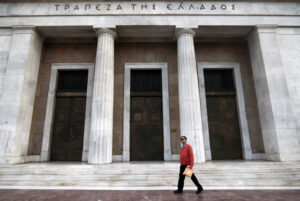
The Bank of Greece is trimming its growth projections for the Greek economy for 2026 and 2027. Following yesterday’s downward revision of the ECB’s forecasts for the entire Eurozone, the Bank of Greece also revised downward its projections for Greek economic growth.
The GDP growth rate for 2026 is now revised to 1.9% from 2.1%, which was the forecast in the 2025 Interim Monetary Policy Report published on December 22, 2025. A few days ago, the Bank of Greece Governor, Yiannis Stournaras, had stated that growth in 2026 could remain at 2025 levels (around 2.1%) provided that the Middle East crisis is short-lived.
At the same time, the Bank of Greece slightly revised downward its GDP forecast for 2027 to 2% from 2.1%, while keeping the 2028 forecast unchanged at 2%.
As noted in the latest Bank of Greece report on the Greek economy (note on the Greek economy), the Greek economy is expected to continue exhibiting higher growth rates compared to the Eurozone economy, mainly due to private consumption and investments, while the contribution of net exports is expected to be slightly negative.
Inflation is expected to remain high at 3.1% in 2026, reflecting higher energy and unprocessed food prices, as well as persistent inflation in services. Over the forecast period, HICP-based inflation is expected to gradually moderate as energy commodity prices are projected to decline from their recent highs. The main risks surrounding the growth projections are mostly downside and are primarily associated with further escalation of the Middle East war and the resulting increase in economic uncertainty, with further international trade protectionism, more persistent inflation, and unpredictable climate events.
As the report emphasizes, the Greek economy has proven particularly resilient during recent periods of turbulence, significantly outperforming the Eurozone. Specifically, the real GDP growth rate reached 2.1% in 2025, with private consumption and investments being the main contributors. This performance is stronger than the real GDP growth rate in the Eurozone, which was 1.4% in 2025.
According to Bank of Greece economists, Europe currently faces a very significant negative energy supply shock due to the Middle East war. The impact of this adverse shock on the real economy and inflation will depend on the duration and intensity of the conflict and any damage to the supply capabilities of Middle Eastern oil-producing countries.
The Bank of Greece projections are based on the key assumptions used in the ECB macroeconomic projection exercise of March 2026. Consequently, there is no explicit assumption regarding the duration and intensity of the Middle East war, while energy commodity prices follow the latest technical assumptions based on futures markets (reference date March 11, 2026). Compared to the assumptions in the December 2025 projections, the latest assumptions imply significantly higher energy commodity prices, particularly in the current year, due to the Middle East war, higher short-term interest rates, weaker euro effective exchange rate, lower international food prices, and higher stock prices.
The Greek economy is expected to maintain a steady growth momentum in the coming years and continue to grow faster than the Eurozone, gradually narrowing the gap from the EU average per capita real GDP.
Finally, it is clarified that the new forecast for the revised GDP growth rate (projected at 1.9% in 2026) does not incorporate any additional fiscal or monetary policy measures due to the war.
Ask me anything
Explore related questions