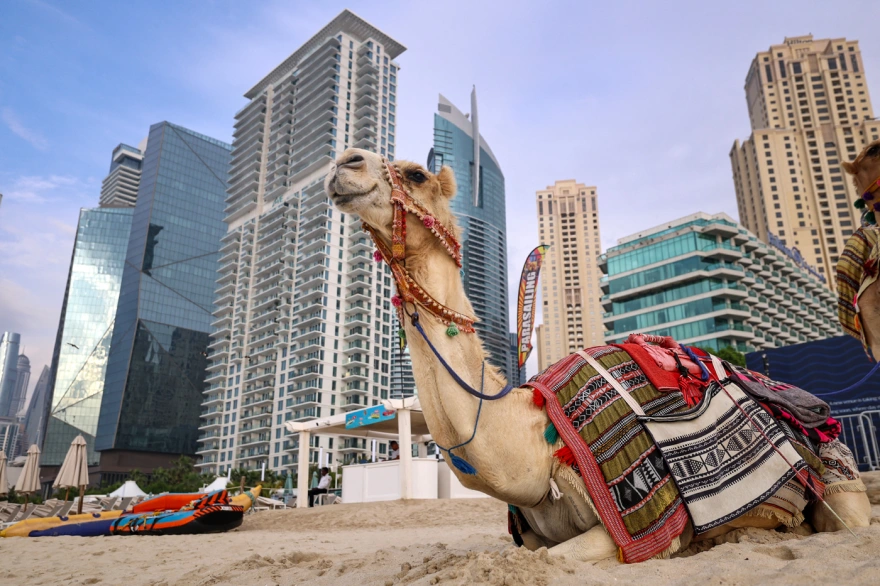
For many decades, gradually and meticulously, the United Arab Emirates, with Dubai at its center, were “building” the model of an investment and tourism paradise, a global economic and commercial hub, seemingly immune to any external threats. Despite the fact that they are located within the most volatile region on the planet, where periods of peace and ceasefire are merely intermissions, and conflicts or total wars—like the current one between the U.S.–Israel and Iran—are the rule.
All the previous period, the Emirates managed to stay out of the consequences of these conflicts, creating the certainty that whatever happened in the surrounding region would stop at their borders. For many, in fact, Dubai—beyond skyscrapers, tax privileges, ease of doing business, luxury, and pleasures—offered above all the guarantees that this city would remain an “oasis,” shielded against any military and geopolitical upheavals taking place in the surrounding region.
Change in data
The—obviously long-calculated—choice of the Iranian regime to respond from the very first moment to relentless Israeli and American bombardments with barrages of hundreds of ballistic missiles and waves of thousands of drones, even against countries friendly to Tehran, striking beyond military installations also civilian targets such as airports, ports, hotels, tourist infrastructure, shopping centers, has already changed the data of the war. Moreover, however, it seriously calls into question precisely the model of the “safe haven,” as Dubai and the other Emirati centers were presented to the global community, thus attracting a huge number of international investors, global business giants, and millions of high-income tourists-visitors.
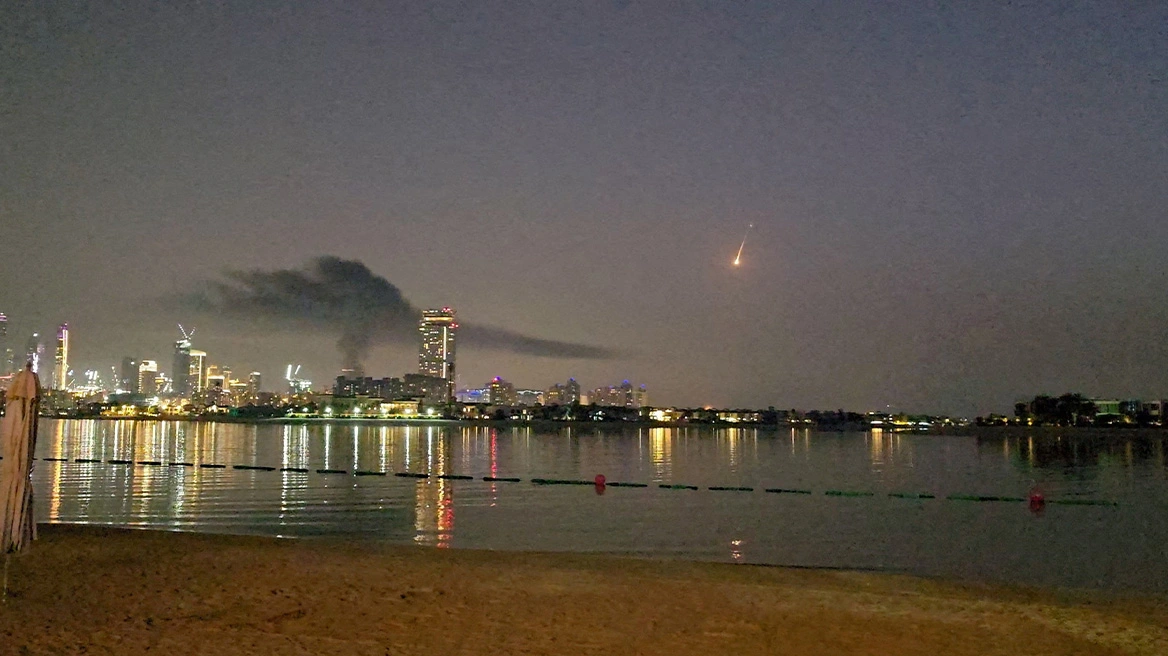
As the new war in the Middle East has now entered its third week, this landscape has changed. The main narrative upon which the development of the Emirates—and especially Dubai—was based, namely that they constitute a safe area for investments, business activity, and tourism-entertainment in the Middle East, has now been shaken. The images from the strikes of Iranian missiles and drones that hit the heart of the Emirates—Dubai—do not allow for other interpretations.
Fires in hotel skyscrapers, panic, deserted streets, empty tourist resorts and shopping centers, mobile phones constantly bombarded with warning messages of impending strikes, under-functioning businesses, queues and crowding at the country’s exits, with the privileged seeking to flee in haste from the danger zone—all these set ablaze with insecurity and uncertainty anyone connected with Dubai. Especially when they live there and expect to increase their wealth in an environment free, full of incentives and additional pleasures, and above all safe. Something that now seems to belong to the past.
A huge blow to the model of prosperity, stability, investment flourishing, and financial frenzy, which was gradually accompanied by ever more widespread luxury, opulence, and the over-concentration of the finest representatives of the international jet set, celebrities, influencers, and similar figures. According to most international analysts, whether this blow will be manageable and whether the image can be reversed is something that today cannot be taken for granted. It may take a long time for any return to normality—which in any case will be different from what existed until February 28.
How it was built
This observation is by no means exaggerated. The transformation of Dubai from a modest pearl-diving and fishing port into a global financial center is a project of four decades. The launch of the—today world-leading—airline Emirates in 1985, the inauguration in 1999 of the “Burj Al Arab,” the iconic ultra-luxury hotel-skyscraper designed to resemble a billowing sail and anchored on an artificial island, and the successive favorable laws in the early 2000s that allowed foreigners to acquire property for the first time, were the first pillars of the “brand Dubai.”
On these it was based, thus it was presented, and thus it flourished. In the following years, Dubai was transformed from a simple regional trading post into one of the most advanced commercial hubs in the world, offering something the rest of the Middle East could not provide reliably: predictability. Low taxes, world-class infrastructure, an open economy, growth opportunities, and a geographical position that made it a natural gateway between East and West. Businesses, wealthy individuals, and global capital flooded the region, as Dubai appeared as the safe harbor in an unstable neighborhood. At the same time, it turned into one of the most popular tourist destinations, even acquiring a significant position on Europe’s basketball map, with the participation of Dubai BC in the EuroLeague and the Adriatic League, while the capital of the UAE, Abu Dhabi, has for years been included in the Formula 1 Grand Prix program.
In contrast to the other Emirates and Gulf countries, Dubai’s economy is fueled almost entirely by non-oil sectors. Oil now represents less than 2% of its GDP. Its economic model consists of a mix of trade, tourism, high-end real estate, and financial services, highly competitive—sometimes superior—to other major financial and business centers such as New York, London, Hong Kong, etc.
The “explosion”
In recent years, however, the growth of the “Dubai model” has taken on explosive rates. The city’s millionaire population has doubled since 2014 to more than 81,000, according to the consulting firm Henley & Partners. Its luxury real estate market has grown for five consecutive years, with 500 properties sold last year at prices above $10 million, up from just 30 in 2020.
Dubai now hosts 237 individuals with wealth above $100 million and at least 20 billionaires, according to H&P data recently published by CNBC. It is also estimated that 9,800 millionaires moved to Dubai in 2025, bringing with them wealth of $63 billion—more than any other country in the world. The majority come from the United Kingdom, China, India, and other countries of Europe and Asia.
With the ruling Al Maktoum family beginning to diversify the economy away from oil decades ago, Dubai created special economic zones and “golden visa” programs. As cynical as it may sound, attracting wealth constitutes a national strategy for Dubai. It has no personal income tax, no capital gains tax, nor inheritance tax. These make it ideal for the ultra-rich and family offices.
Thus, especially in the last five years, it has emerged as the top destination for high-net-worth individuals worldwide. Russian oligarchs, Indian industrialists, European entrepreneurs, and cryptocurrency billionaires have all chosen it as their base, precisely because they feel isolated and shielded from regional instability and its risks.
The DIFC
The Dubai International Financial Centre (DIFC), a special economic zone, reported at the beginning of January that the 120 top families within it managed total assets exceeding $1.2 trillion. The DIFC currently hosts 290 banks, 102 hedge funds, and 500 asset management companies, as well as 1,289 “family entities,” marking a 61% increase compared to a year earlier.
Last year, Dubai’s total population increased by 5.6%—the fastest rate since 2019—reaching 3.9 million residents. Overall, the population in the UAE grew from about 1 million in 1980 to 11 million in 2024.
The increase in wealthy—and consequently ultra-wealthy—individuals in Dubai is closely followed by the establishment of new businesses or expansion of existing ones, primarily financial and tourism giants, real estate companies, and other services. In the broader financial sector of Dubai, in just the first half of 2025 more than 1,000 companies set up operations in the DIFC—about one-third more than in 2024.
Technology giants have also been attracted to Dubai, which, according to The Economist, now hosts at least 18 data centers (including AWS facilities that were struck after the outbreak of the war). Overall, the UAE—with a GDP of $847.5 billion in 2024—accounts for more than half of the Gulf’s planned data center investments. The Emiratis are investing massive sums in artificial intelligence, having signed huge agreements, among others, with Microsoft and BlackRock for $30 billion in infrastructure investments, while participating in OpenAI, Anthropic, and xAI.
All of the above narrative is now under intense pressure. Wealthy individuals, institutional investors, and major companies make decisions about where to establish themselves based on a long-term horizon. But they are forced to urgently reassess the data when missiles are intercepted above the city they call home. Any assessment, however, is risky. “It is difficult to assess the risk to Dubai’s economic model,” said Jim Krane, a researcher at the Baker Institute of Rice University.
For now, many companies and professionals in Dubai say that the arguments for staying remain strong. And they are careful not to clash with the country’s government amid such an unprecedented crisis. Hasnain Malik, who leads equity strategy and emerging markets geopolitics at Tellimer, based in Dubai, said that hedge funds and family offices are mainly attracted by the city’s tax, regulatory, and stable banking regimes—features that remain in place.
But H&P also insists that Dubai has always proven resilient in times of uncertainty. Dominic Volek, head of private clients at the firm, said the attacks are also a reminder of the importance of geographic diversification:
“Situations like this reinforce a core principle we often discuss with clients: the value of global choice. Families that move internationally usually diversify their exposure in residence and citizenship across multiple regions—including the Americas, Europe, the Middle East, and Asia—to maintain flexibility in the face of geopolitical uncertainty wherever and whenever it arises. These decisions are generally strategic and long-term, not reactions to short-term events.”
A sector that will almost certainly face medium- to long-term pressure is Dubai’s real estate market. Prices have been rising rapidly for five consecutive years, thanks to the Golden Visa program, which grants foreigners a renewable 10-year visa for purchasing property worth $550,000 or more. However, even before the Iran war, there were indications that Dubai’s dizzying construction activity, high prices, and widespread speculation were “hitting the ceiling” and could begin to decline. Last September, UBS estimated that Dubai had the fifth-highest “bubble” risk among 21 major cities, ranking behind Zurich and Los Angeles.
Earlier, Fitch Ratings predicted a correction in late 2025 and 2026, with prices falling by up to 15%. In a word, the Dubai model seems to be reaching its limits in some sectors regardless of the war. Anton Lopatin of Fitch Ratings said that the impact on property values will depend on the scope and duration of the conflict. For now, he said, resident departures could put pressure on Dubai’s housing market.
New calculations
Although it is still early, the attacks are changing many companies’ calculations. Few appear to have previously considered the risks arising from even passive involvement of the UAE in war. Now, they are examining political risk insurance—policies companies typically buy to protect themselves in emerging markets, said Christopher Coppock, head of geopolitical and economic risk analysis at Marsh. Pricing for such insurance is based on factors such as terrorism, war, and strike risks, the criticality of the insured activity, and its exact location—for example, proximity to a military base increases cost.
Moreover, any companies considering leaving or scaling back will have to weigh alternatives to the Emirate. Some financial firms that relocated to Dubai after dealing with the effects of the Covid-19 pandemic in Hong Kong or Singapore may decide to reverse course—this time urgently—meaning Dubai will need to act quickly to retain them.
However, as long as columns of white smoke and the sounds of bombardments or missile interceptions dominate, alongside images of fighter jets and sirens—or conversely an eerie silence in a city synonymous with glamour, luxury, and one that “never sleeps,” like New York—uncertainty about how things will unfold remains extremely intense.
Already, an extensive report by the Wall Street Journal notes that the uncertainty has had immediate economic consequences for both Dubai and the wider UAE, as many investors have begun considering moving their capital to regions deemed safer, while several real estate deals have been temporarily frozen. At the same time, some foreign residents have begun to question whether it is wise to continue living and investing in Dubai long-term.
Government officials have said Dubai “turns well” in a crisis. It has survived upheavals in the past. Its institutional resilience and financial reserves are real. How quickly it acts now to reassure businesses, investors, and people is the next major test.
Initial assurances that everything is under control did not seem entirely sufficient. Much is also beyond the control of its leaders. They cannot determine how the war will unfold, nor can they… relocate Dubai elsewhere. What is certain is that for the millions who live there—and the many more who planned to emulate them—its greatest advantage was that they never imagined they would need to have such a discussion.
Therefore, the war must not only end, but end in such a way that Iran permanently loses the ability to strike Gulf countries again. If the regime is not overthrown, the risk will inevitably persist, and the outlook for Dubai and the UAE more broadly will become more difficult, as it will constantly pass through the “Caudine Forks” of the threat of new attacks and the need for further strengthening of its defensive shielding under the U.S. umbrella.
The “D33” agenda
To understand the critical juncture Dubai now faces, one must also consider what lies ahead. On January 4, 2023, Sheikh Mohammed bin Rashid Al Maktoum—Vice President and Prime Minister of the UAE and ruler of Dubai—presented the Emirate’s new economic agenda, “D33,” with a horizon to 2033, marking 200 years since its founding. The goal is for Dubai to become the world’s most important business hub.
The D33 agenda aims to double GDP by 2033, making Dubai the fastest, safest, and most connected city in the world. To achieve these goals, Dubai will accelerate development by investing in human capital, advanced technology, and the digital economy.
A broader issue
It should be noted, however, that the entire Persian Gulf region has in recent years invested in an economic development model based on diversifying economies beyond oil and natural gas. Countries like Saudi Arabia and Qatar have attempted to follow Dubai’s example, creating tourist resorts, financial centers, data centers, and major investment opportunities to attract international capital.
Part of reshaping their image in global markets includes massive spending in football, such as hosting the 2022 World Cup in Qatar and offering enormous contracts to top players by Saudi clubs. However, rising geopolitical tension threatens to undermine these efforts, increasing the sense of risk for those considering investing in the region—exactly as is happening with Dubai.
The inability of the U.S. to provide strong defense protection to its Gulf allies has already caused dissatisfaction among emirs, governments, and the business world. For decades, relations between Washington and Gulf countries were based on a specific exchange: the U.S. provided security, and they provided energy and money, explained Fawaz Gerges of the London School of Economics. According to him, the war has shaken this relationship. Gulf countries will now accelerate efforts to diversify their partnerships, realizing that “they cannot truly rely on the U.S. to protect their energy, oil, gas, citizens, and sovereignty.” Another challenge for the UAE—and especially Dubai.
Capital and investments
120 top families in Dubai manage total capital exceeding $1.2 trillion. The International Financial Centre hosts 290 banks, 102 hedge funds, 500 asset management firms, and 1,289 family entities, marking a 61% increase compared to a year earlier. Dubai’s population grew by 5.6%—the fastest rate since 2019—reaching 3.9 million residents. Overall, the UAE population rose from about 1 million in 1980 to 11 million in 2024.
Oil now represents less than 2% of GDP. Its economic model consists of a mix of trade, tourism, high-end real estate, and financial services, highly competitive—sometimes superior—to other major financial and business centers such as New York, London, Hong Kong, etc.
81,000 is the estimated number of millionaires in the city, which has doubled since 2014, according to Henley & Partners.
Dubai now hosts 237 individuals with wealth above $100 million and at least 20 billionaires, according to H&P data.
An estimated 9,800 millionaires moved to Dubai in 2025, bringing with them $63 billion in wealth—more than any other country in the world. Most come from the United Kingdom, China, India, and other countries in Europe and Asia.
Ask me anything
Explore related questions