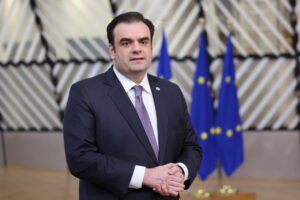
The need for European governments to act with “balance and responsibility” in addressing the economic fallout from the Middle East crisis was emphasized by Eurogroup President Kyriakos Pierrakakis, who stressed that any support measures should be “targeted, temporary and focused on the most vulnerable households and businesses.”
“Our decisions must reflect balance and responsibility,” the finance minister said following a Eurogroup teleconference. He added that “the measures adopted at this stage must be targeted, fair and effective, prioritising the most vulnerable households and businesses.”
Pierrakakis underlined that interventions should be implemented without delay, while remaining temporary in nature, in order to address the crisis without creating “new and potentially greater problems in the future.”
He noted that the general direction for Europe’s response had already been set by the European Council on March 19, with the Eurogroup now continuing discussions on shaping appropriate policies to support citizens and businesses. “We must remain consistent with the commitments we have made,” he said, adding that “sound fiscal management enables a country to protect society and invest in its future.”
Europe better prepared than in 2022
According to Pierrakakis, “Europe today is better prepared than it was in 2022 during the previous energy crisis,” citing reduced energy dependence, strengthened infrastructure and more diversified energy sources.
He described the current crisis—affecting energy, trade, prices and overall economic stability—as “alarming,” stressing the need for “heightened vigilance, coordination and preparedness” to support citizens.
He acknowledged that, less than a month after the outbreak of the conflict, the impact is already being felt in the real economy, affecting businesses and households, increasing inflationary pressures and raising the risk of slower growth across Europe.
The scale of the economic impact, he said, will depend on the duration and intensity of the crisis. “Uncertainty remains high,” he noted, expressing hope for de-escalation and the avoidance of major, lasting disruptions to energy infrastructure and global markets.
Focus on investment and long-term resilience
Pierrakakis stressed that Europe must not lose sight of its strategic objectives, highlighting that the energy transition and energy independence remain central to EU policy. He added that the current crisis underscores the need for increased investment in clean energy, infrastructure and the broader energy economy.
He said Europe must now fulfill a dual role: protecting citizens in the short term while building a more resilient and competitive economy for the future.
In this context, he highlighted the importance of the Savings and Investment Union, describing it as a “key tool for growth” that can strengthen the EU’s competitiveness. He noted that finance ministers from the six largest EU economies presented related initiatives, while the Cypriot Presidency updated participants on progress in integrating European capital markets and enhancing supervision.
Finally, Pierrakakis said ministers also discussed international economic developments ahead of upcoming IMF and G7 meetings, pointing to a period of profound change in the global economy driven by geopolitical tensions, shifting trade patterns, currency movements and evolving economic balances.
The Eurogroup meeting was held via teleconference instead of taking place in Cyprus as originally scheduled, due to developments in the Middle East. The session was also attended by International Energy Agency Executive Director Fatih Birol, who briefed ministers on the latest trends in global energy markets.
Ask me anything
Explore related questions