The blaze, which erupted on March 12 in the ship’s laundry facilities, provided Tehran with an opportunity to undermine the prestige of what is considered the “crown jewel” of the US Navy. For the second time since the start of the Gulf conflict, Iranian officials claimed they had struck the world’s largest (333 meters long) and newest (nine years old) aircraft carrier with ballistic missiles.
However, US Central Command (CENTCOM) firmly denied these claims, stressing that the most powerful warship in the world continued flight operations throughout “Operation Epic Fury.”
The fire, which reportedly started in the main washer-dryer units, spread rapidly toward the pier and—initially undetected due to insulation—into living and sleeping quarters. According to The New York Times, two sailors required medical treatment, around 200 were given first aid for smoke inhalation, and more than 100 beds were destroyed through the ventilation system. The incident dealt an unprecedented blow to the ship’s international image and the morale of its nearly 4,000-strong crew.
This is particularly significant for a $13 billion aircraft carrier that had already experienced hydraulic system issues while at sea, with US media reporting clogged systems and long queues for toilets. Despite the fire, which reportedly burned for about 30 hours, the vessel remained fully operational, as no damage was recorded to its propulsion system, according to US military officials. Nevertheless, repairs were deemed urgent and essential.
European military officials had initially assessed that it would be extremely difficult for the carrier—equipped with 75 advanced fighter jets and cutting-edge radar systems—to return directly to the United States without extensive repairs at a nearby base. Reports indicate that at least 600 crew members lost their beds. For this reason, more than 1,000 mattresses, along with clothing, were removed from the future aircraft carrier USS John F. Kennedy and sent to the Ford following the destruction caused by the fire.
From Souda to Croatia
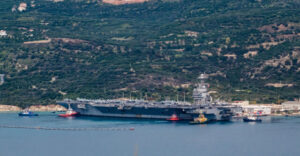
Given these circumstances, the initial decision was for the USS Gerald R. Ford to dock at the Souda Bay naval base in Crete for over a week of repairs, according to well-informed sources. There had been expectations that restoration work—such as smoke cleanup and system checks—would be completed by April 2 at the latest.
Indeed, the carrier arrived at Souda Bay earlier last week, a base that has had upgraded maintenance and repair infrastructure since 2021, signaling the start of restoration efforts. However, within days, its departure for Split, Croatia, was unexpectedly announced, amid a shifting social climate in the Chania region.
Shortly after the ship’s arrival in Crete, at least two anti-war protests were organized on the island by peace committees, labor unions, and student groups. A large-scale demonstration was also scheduled at the Souda base.
At the same time, it is widely acknowledged that images of a fire-damaged aircraft carrier would be the last thing the US military would want from a communications standpoint, even as it recognizes an increase in technical issues affecting its most prominent warship.
“The port call allows the ship to undergo effective assessment, repairs, and resupply,” the US Navy said in a statement.
While the fire is believed most likely to have originated in a dryer ventilation duct—due to lint buildup, poor maintenance, or overloading—military analysts have not ruled out the possibility that the ship has reached operational fatigue after more than 272 consecutive days at sea. This approaches the record of 294 days set by the USS Abraham Lincoln.
In this context, there are increasing reports that the USS George H. W. Bush may replace the Ford during its repairs. Although US officials say the cause of the fire remains under investigation, this has fueled speculation, including scenarios of sabotage. This is especially so as the extent of the damage appears greater than initially estimated, and it remains unclear whether the carrier will stay deployed in the Eastern Mediterranean or Middle East after repairs, or return directly to the United States from Croatia.
Conspiracy theories
The successive setbacks affecting the operational capacity of the USS Gerald R. Ford—most recently the large-scale fire—have raised concerns among US Navy officials and international analysts alike. Just a month earlier, the ship had faced issues with its hydraulic systems affecting 650 toilets.
Given that the carrier has been continuously deployed for the past nine months, including participation in operations in the Caribbean against Venezuela that led to the arrest of the Maduro couple, all possibilities remain open—including sabotage. Such a scenario does not necessarily involve Iranian agents, but could also relate to crew morale and signs of burnout.
In this context, The Telegraph questioned whether “exhausted sailors may have started the fire,” citing reports that potential sabotage could have come from dissatisfied crew members whose standard six-month deployment had been extended due to operations in the Gulf.
Simultaneously, the presence of anti-war protests in Souda during the ship’s stay may have significantly limited shore leave for the crew, a factor that may have influenced the US Navy’s decision to move the carrier to Croatia for repairs.
Amid this backdrop, the fire aboard the USS Gerald R. Ford—the flagship of US naval aviation forces—has also triggered political reactions. Democrats have sharply criticized US President Donald Trump.
“I am grateful that all sailors aboard the USS Gerald R. Ford are reported safe and that their training allowed them to control this fire,” said Democratic Senator Mark R. Warner of Virginia, Vice Chairman of the Senate Intelligence Committee. “But the Ford and its crew have been pushed to the brink after nearly a year at sea and are paying the price for President Trump’s reckless military decisions. The reported scale of this fire, which has left hundreds without beds during this near-historic deployment, is deeply concerning.”
“Our sailors are doing their job. The president must start doing his: putting their safety, readiness, and dignity above impulsive decisions,” Warner added.
Tensions are rising in Congress over the course of operations in Iran, with the US president also facing potential intra-party repercussions related to the War Powers Act, which limits military engagements to 60 days unless authorized by Congress.
Ask me anything
Explore related questions