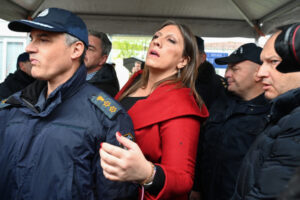
The trial regarding the “missing” videos of the freight train will now be conducted from scratch, as the proceedings—ongoing since last October at the Single-Member Misdemeanor Court of Larissa—collapsed yesterday. The presiding judge, following a heated exchange with lawyer Zoe Konstantopoulou, who represents the prosecution, stated she could no longer تحمل the insults and submitted a statement of recusal.
Six hours later, this request was accepted by the competent judicial council, and the trial was postponed indefinitely. This means a new date will need to be set, and when the trial resumes—likely in a few months—it will start from zero, with a different judge on the bench.
Up until now, the court had held 19 sessions and heard three witnesses. “Tell me your name, who you are, and explain the reasoning behind accepting the judge’s recusal,” Konstantopoulou shouted when another judge took the bench to announce the decision.
Before the council’s ruling became known, unprecedented scenes unfolded at the Larissa courthouse. Konstantopoulou launched repeated attacks against the presiding judge, triggered by her decision regarding access to copies of digital evidence recorded by court-appointed expert Stavros Batzopoulos, who had arrived at the train crash site in the early hours.
Specifically, the judge decided that lawyers supporting the prosecution would be granted access (copies) only to the material recorded by the expert and seized on March 6–7. However, the court reserved judgment on other material seized from the expert’s work computer at the Region of Thessaly. As the judge explained, this was to allow for the possible appointment of another expert to identify relevant material, in the presence of technical advisors for the victims’ families.
A tense exchange followed:
- Konstantopoulou: “Are you withdrawing your previous decision? That was not your earlier ruling. Why didn’t you say this on the 10th when you fainted? This is a scandal…”
- Judge: “Please! I want the copying to proceed calmly…”
- Konstantopoulou: “It takes 30 minutes and you know it…”
- Judge: “Do not shout…”
- Konstantopoulou: “You are mocking people, the victims’ parents…”
During a break, Konstantopoulou persistently questioned whether the judge had met with the head of the Judges and Prosecutors Association and accused her of acting under external instructions. She even searched for the judge in the courthouse corridors and eventually found her in the office of the court’s chief.
Back in the courtroom, tensions escalated further:
- Konstantopoulou: “You went three times to the chief’s office during the break… This is a shadow justice operation… Tell us who pressured you…”
- Judge: “I went to get a key. Everything else you say is unfounded… I have received no pressure.”
Finally, the judge stated: “Under these conditions, the trial cannot continue… I will submit a recusal statement; I have received many insults.”
What happened with the evidence
It was previously revealed in court that the expert who visited the crash site had videos and other material stored on both his mobile phone and his work computer.
Following this testimony, lawyers for the prosecution requested the seizure of the material and access to copies. On March 9, 2026, the judge approved the request, and the material was seized the next day and handed over to the Larissa court.
However, on March 10, the judge requested a recess, nearly fainted, broke into tears, and the proceedings halted. The next day, when lawyers arrived to obtain copies as previously ordered, the decision was reversed, reportedly by order of the court’s chief, citing the absence of the presiding judge.
When the trial resumed yesterday, instead of handing over the evidence as expected, the court partially reversed its earlier decision. The prosecutor noted that some files might be unrelated to the case and unclear in format. As a result, access was granted only to part of the material, while the rest remains under review.
Ask me anything
Explore related questions