





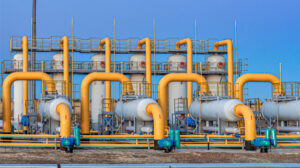
Exports of natural gas quadrupled in the first quarter of 2026, according to data from the National Natural Gas System Operator (DESFA), reflecting the strengthening of Greece’s role as an energy hub in Southeastern Europe.
Specifically, exports reached 5.99 TWh, up from 1.44 TWh in the corresponding period of 2025. This surge was the main driver behind an 18.5% increase in total gas demand, which rose to 26.42 TWh.
By contrast, domestic consumption stood at 20.43 TWh, marking a marginal decrease of 2.1% compared to the first quarter of 2025 (20.86 TWh). This reflects a shift in the demand structure, with reduced use in power generation and increased demand from industry, CNG, and distribution networks.
According to DESFA, total imports reached 26.40 TWh. Liquefied Natural Gas (LNG) further strengthened its position in the energy mix, accounting for approximately 56% of imports. LNG imports rose to 14.90 TWh, compared to 10.96 TWh in the same period of 2025.
Revithoussa remained the main entry point, handling 11.44 TWh (about 43% of total imports), while the Alexandroupolis FSRU significantly increased its contribution, covering around 13% with 3.46 TWh. At the same time, pipeline imports amounted to 8.77 TWh via Sidirokastro and 2.73 TWh via Nea Mesimvria.
The breakdown of domestic consumption highlights changes in natural gas usage:
- Consumption for electricity generation declined to 12.48 TWh (from 13.33 TWh in 2025)
- Consumption in industry and CNG rose to 2.28 TWh (from 2.13 TWh)
- Distribution networks increased to 5.67 TWh (from 5.40 TWh)
These figures point to a gradual diversification of consumption patterns.
The United States remained the main LNG supplier, with 7.60 TWh, accounting for about 66% of total LNG imports, followed by Nigeria with 3.02 TWh. Additional volumes were sourced from Mauritania (0.35 TWh) and Egypt (0.51 TWh).
A total of 16 LNG cargoes were unloaded, carrying 11.48 TWh, compared to 20 cargoes carrying 10.65 TWh in the first quarter of 2025.
The LNG truck loading service also showed strong growth. In the first quarter of 2026, 273 LNG trucks were loaded—almost double the 144 recorded in the same period of 2025. Total volumes reached 12,496 m³ of LNG (up from 6,527.09 m³), while the corresponding energy amounted to 83,252.18 MWh, an increase of approximately 92%. This development underscores the rapid expansion of the small-scale LNG market in Greece.
Ask me anything
Explore related questions




