





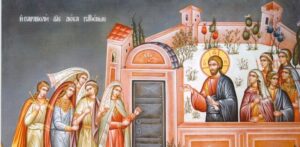
According to the Christian calendar, it has come to be called Great Tuesday, the third day of Holy Week or the Passion Week of Jesus Christ.
Holy Tuesday, with the Kassiani troparion, calls us to stand between repentance and hope, preparing our hearts and spirits for the Resurrection.
On Holy and Great Tuesday in the Orthodox Church, we commemorate and reflect on some of the Lord’s most profound parables, especially the Parable of the Ten Virgins (Matthew 25:1–13). Through this, the Church calls us to spiritual vigilance: to be prepared to receive the heavenly Bridegroom, our Lord Jesus Christ, who comes “at midnight”—either at the hour of our death or at His Second Coming.
The central message of the day is watchfulness and readiness. We are urged to keep our spiritual lamps lit—not only with faith, but with the oil of virtues, especially love and almsgiving. The wise virgins, who had oil in their lamps, represent those who live a life of active virtue and mercy. The foolish virgins, though outwardly pure, lacked this living faith expressed through deeds of compassion, and so they were not ready when the Bridegroom came.
The Church also presents the Parable of the Talents (Matthew 25:14–30), calling us to cultivate and multiply the gifts God has entrusted to us. These gifts—whether spiritual, material, or personal—are not to be hidden or neglected, but offered back to God through faithful stewardship and service to others.
As Christ journeyed toward Jerusalem and His voluntary Passion, He taught these parables to prepare His disciples—and all of us—for the mystery of the Kingdom. While some teachings rebuked the hypocrisy of the scribes and Pharisees, others, like these, were given for our instruction and salvation.
A key teaching emphasized by the Fathers is that no single virtue alone is sufficient. Even something as exalted as virginity or outward piety, if not accompanied by mercy and love, cannot lead us into the Kingdom. The oil in the lamps is often interpreted as acts of charity and compassion—without which even the most disciplined spiritual life remains incomplete.
The Services of Holy Tuesday
During Orthros (Matins) of Holy Tuesday—traditionally chanted on Monday evening—the Gospel reading continues from Matthew, highlighting Christ’s warnings about the end times and His call to vigilance. The two central parables—the Ten Virgins and the Talents—frame the entire service and its hymnography.
One of the most moving hymns of the day is the Troparion of the Bridegroom:
“Behold, the Bridegroom comes at midnight,
and blessed is the servant whom He shall find watching…”
This hymn sets the tone for the first three days of Holy Week, often called the “Bridegroom Services.”
Looking Ahead: The Hymn of Kassiani
On the evening of Holy Tuesday, we chant the Orthros of Holy Wednesday, which commemorates the sinful woman who repented and anointed Christ’s feet with myrrh. Her deep love and repentance stand in contrast to Judas’ betrayal.
During this service, we hear one of the most beloved hymns of Orthodox Holy Week, the Hymn of Kassiani, composed by the 9th-century nun Kassiani. This hymn beautifully expresses repentance, humility, and the overwhelming mercy of Christ.
In summary, Holy Tuesday invites us into a deep inner examination:
Are we spiritually awake?
Are our lamps filled with the oil of love and mercy?
Are we using the gifts God has given us?
The Church, through its hymns and Gospel readings, gently but firmly calls us to prepare—because the Bridegroom comes “at an hour we do not expect.”
Ask me anything
Explore related questions




