





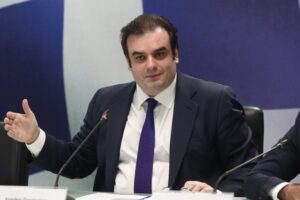
Kyriakos Pierrakakis gave a critical assessment of the international economic and energy landscape in an interview with the American network CNBC and journalist Karen Tso.
The Minister of National Economy and President of the Eurogroup warned of the unprecedented scale of the current crisis, while also analyzing Europe’s resilience and the necessary fiscal countermeasures.
Worse crisis than the 1970s
Mr. Pierrakakis stressed that the impact of the current situation is extremely significant, adopting the International Energy Agency’s (IEA) assessment that we may be facing the largest energy crisis in history.
The minister sounded the alarm for the immediate period ahead, noting that April may prove more problematic than March. As he pointed out:
• the last shipments that departed at the end of February are expected by April 20, meaning the effects will soon become more visible in the markets.
• even if there is an immediate diplomatic solution, it will take at least two months to restore the supply chain, which will then operate at lower levels.
• already, 80 energy facilities in the Middle East have been affected, with one-third of them suffering significant damage.
Resilience and stagflation
Despite the IMF’s bleak forecasts for growth of just 1.1% in the eurozone, Mr. Pierrakakis appeared cautiously optimistic about Europe’s defenses.
Europe is in a better position than in 2022 due to the diversification of energy sources and investments in infrastructure, he noted. 43% of electricity production now comes from renewable sources, although dependence on imports remains high, at 57%.
However, he stressed that although lower growth and high inflation are being observed, “we are not yet in stagflation conditions,” which he described as the worst-case scenario.
Ask me anything
Explore related questions




