





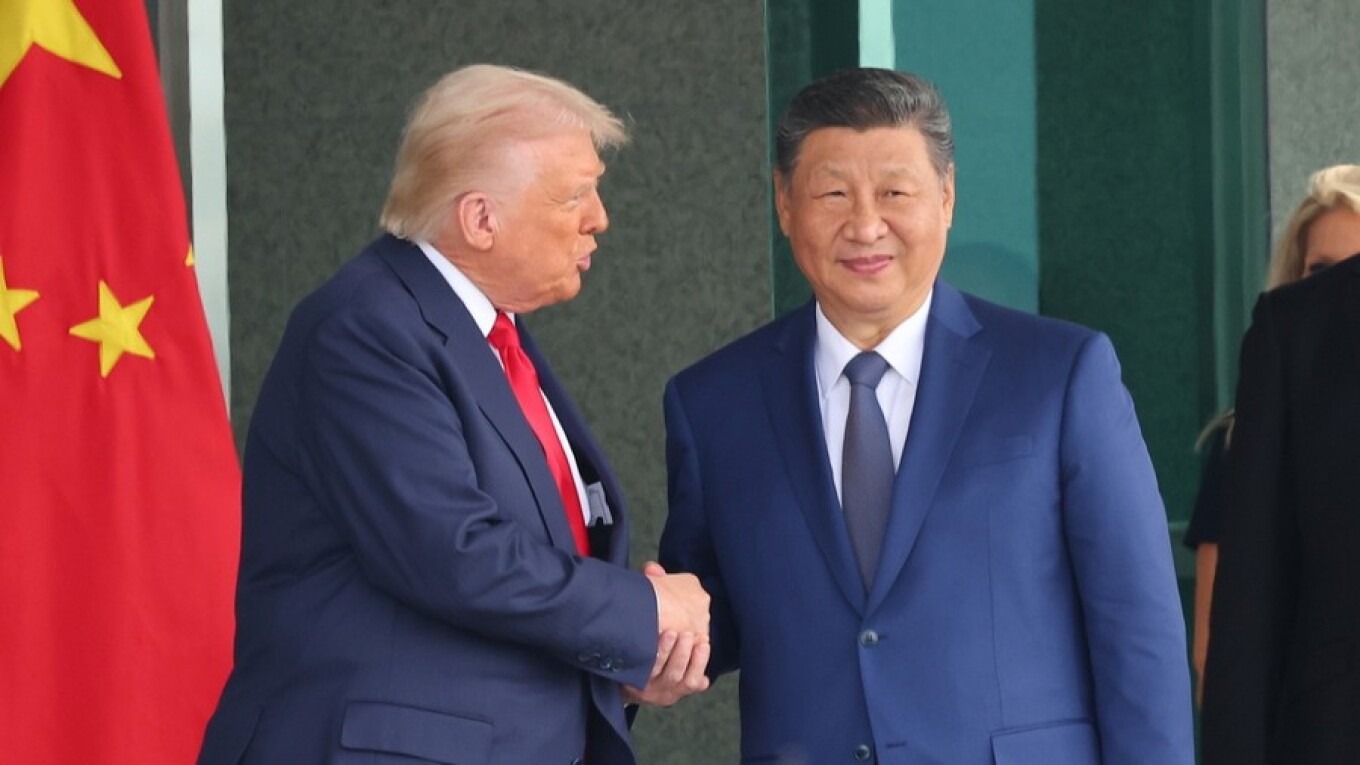
The upcoming meeting between Donald Trump and Xi Jinping in Beijing is not taking place only against the backdrop of trade, tariffs, Taiwan, or the war in Iran. It is also taking place with a new reality on the table: China is now showing it can advance in artificial intelligence even without full access to US technology — and in a highly competitive way against the United States.
This message does not come through an official Beijing statement. It comes through DeepSeek, the Chinese start-up — the “blue whale” of Chinese artificial intelligence — which has already unsettled Silicon Valley and, by extension, the White House. The company announced that its latest model has been optimized to run on Huawei chips. For the first time, one of China’s most closely watched AI models is taking a structural step away from full dependence on Nvidia.
This does not mean China has won the technological war. Nor does it mean Chinese chips have reached the level of American ones. But it does mean something more important for the Trump–Xi negotiation: US export restrictions on advanced semiconductors have not stopped China’s AI development. They have pushed it toward its own architecture.
From dependence to a parallel technological sphere
For years, Washington believed that controlling Nvidia’s most advanced chips was one of the few real levers of pressure on China. The logic was simple: without access to the most advanced processors, Chinese companies would not be able to train and run AI models at the level of US tech giants.
Reality proved more complex. Companies like DeepSeek and Moonshot AI did not simply wait for Washington’s policy to change. They began designing their systems around the restrictions — making them lighter, more efficient, more flexible, and adaptable to different processors, not just Nvidia chips.
China does not necessarily need to fully replicate the US model. It can build a parallel ecosystem: Chinese models, Chinese chips, Chinese data centers, Chinese applications. Not necessarily the best in the world — but good enough to meet the real needs of its market, state, and industry.
This is exactly what Nvidia CEO Jensen Huang has long feared: that strict restrictions would not permanently slow China down, but instead accelerate its push for autonomy — ultimately creating two AI markets, one American/western built around Nvidia, and one Chinese built around Huawei and domestic suppliers.
The limits of US pressure
DeepSeek still needs Nvidia. According to industry sources, the training of its latest model was still carried out using US chips. The difference is that the model’s operation — the so-called “inference,” meaning how it responds to users — can now also run on Huawei chips.
This is a smaller technical step than full model training on Chinese hardware, but politically it is much larger. It shows that Beijing can begin shifting critical parts of the AI value chain onto domestic infrastructure. And each such step reduces the effectiveness of US restrictions.
Huawei has already announced it is developing chips for training AI models. It acknowledges it will take time to reach Nvidia’s current performance levels. But the issue is not only raw power — it is direction. And the direction is clear: China is trying to turn pressure into industrial policy.
This is where the problem for Trump emerges. If China believes it can continue without the most advanced US technology, the bargaining value of chips decreases. The US still has an advantage — but no longer the same certainty that it can simply “turn off the switch.”
The Nvidia dilemma — and Washington’s dilemma
Nvidia is at the center of this conflict. On one hand, it is the key commercial driver of US technological dominance. On the other, it wants access to one of the world’s largest AI markets: China.
Trump had opened the door for Nvidia to sell the H200 chip to China. But the issue became trapped between two pressures: in Washington, lawmakers demanded stricter controls; in Beijing, companies were pushed toward domestic alternatives.
The result is paradoxical: the US theoretically allows exports, but the chips do not meaningfully enter the Chinese market. The US Commerce Secretary has said no H200 chips have been sold in China, and Nvidia has confirmed it has not yet generated revenue from such sales there.
So ahead of the Trump–Xi meeting, Nvidia remains unresolved — not due to licensing alone, but because the political economy of AI has shifted. The US wants control over China’s access to advanced chips. China wants to prove it will not need that access forever.
China’s obstacles remain significant
Despite the momentum, Chinese technological independence is not guaranteed. SMIC, the company producing some Huawei chips, still faces serious manufacturing issues. Chinese chips are harder to mass-produce, have higher defect rates, and consume more energy compared to foreign competitors.
Huawei is attempting to compensate by combining large numbers of less powerful chips to achieve total computing power close to advanced systems. This is a practical solution, but costly: it requires massive production capacity, more energy, and strong hardware–software integration.
This is where DeepSeek becomes important. Its cooperation with Huawei shows China is building not just better chips, but a coordinated system where AI models are designed for domestic processors, and processors are adapted to the models.
This may not bring China to the technological top immediately, but it offers something strategically crucial: resilience.
The real stakes of the Trump–Xi meeting
In Beijing, Xi Jinping goes into the meeting with Trump with an argument that is now more credible than before: China was pressured and restricted, but it did not collapse. It adapted.
The US still holds key advantages — Nvidia, TSMC, and cutting-edge chip design. China has not yet proven it can match next-generation AI at scale.
But the message has changed: it is no longer “give us access so we can continue,” but “if you don’t give us access, we will build our own system.”
And that is what weakens US leverage. The more China adapts to a future without Nvidia, the less effective restrictions become. The more Huawei integrates chips with models like DeepSeek’s, the harder it becomes for Washington to reverse course.
The AI race is no longer just about performance — it is about ecosystems. And China is showing it is willing to accept lower peak performance in exchange for strategic independence.
For Trump, that is the real problem: not that China has already caught up — but that it is learning to move forward without waiting for permission.
Ask me anything
Explore related questions




