





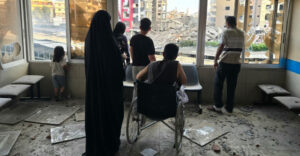
Israeli forces and Hezbollah continued exchanging fire overnight, despite U.S. President Donald Trump’s claim that he had secured commitments from both sides to halt hostilities ahead of talks between Lebanese and Israeli representatives in Washington.
In response to Israel’s intensified military campaign in Lebanon, Iran’s Revolutionary Guards—the ideological military force of the Islamic Republic—warned yesterday that they could open “new fronts” in the conflict.
The upcoming negotiations, opposed by Hezbollah, will be the fourth round of talks between Lebanon and Israel since the war began in early March. The discussions are scheduled to take place over two days.
Lebanese President Joseph Aoun described the negotiations as “the only way to end the war,” while condemning Israel’s “brutal attack” and its deeper military advance into Lebanese territory against the Iran-backed Hezbollah movement.
Israel’s incursion has reportedly reached its deepest point inside Lebanon since 2000, when Israel withdrew after 18 years of occupation.
Yesterday, Israel threatened to strike Hezbollah’s main stronghold in Beirut’s southern suburbs, triggering an exodus of residents. Israeli Prime Minister Benjamin Netanyahu cited Hezbollah’s “repeated violations of the ceasefire” and attacks against Israel.
Trump Calls Netanyahu “Crazy”
According to a report by Axios, President Donald Trump reportedly described Netanyahu as “crazy” during a phone call, accusing him of jeopardizing negotiations with Iran.
Trump later posted on Truth Social that he had asked Netanyahu not to launch a “major strike on Beirut” and claimed the Israeli leader agreed to pull back troops that were already en route.
Trump also asserted that Hezbollah had agreed to stop firing at Israel and that Israel had similarly agreed to halt attacks on Hezbollah fighters.
The Lebanese government said it had also accepted a U.S. proposal for a mutual cessation of attacks.
However, events on the ground appeared to contradict these announcements, as fighting continued throughout the night.
New Attacks
Hezbollah claimed responsibility for a rocket attack against an Israeli Merkava tank early today, saying it was attempting to stop an Israeli advance near the town of Haddatha in southern Lebanon. The group also reported targeting four additional tanks and Israeli soldiers with rocket barrages and artillery fire.
The Israeli military announced that it intercepted two projectiles launched from Lebanon and reported no injuries.
Meanwhile, Lebanon’s state news agency ANI reported Israeli airstrikes on several southern Lebanese villages, including Marwaniyah, Siddiqin, Yater, and Mansouri. A powerful explosion was also reported in Debbine.
Earlier yesterday, Israeli forces struck more than 40 communities in southern Lebanon, including the city of Tyre. According to ANI, a strike near a hospital caused damage, injured people, and cut power to intensive care units.
Hezbollah also claimed missile attacks against military targets in northern Israel.
Israeli Ambassador to the UN Danny Danon warned that “if there is no calm in northern Israel, there will be no calm for Hezbollah.”
Growing Regional Tensions
Lebanon entered the conflict on March 2 when Hezbollah launched attacks against Israel in response to U.S.-Israeli strikes on Iran. Although a ceasefire was officially supposed to take effect on April 17, hostilities have continued almost daily.
According to Lebanese authorities, more than 3,400 people have been killed and over one million displaced in Lebanon since March. Israel reports 27 deaths on its side, including 26 military personnel.
UN Secretary-General António Guterres stated in a report that a continued UN military presence in Lebanon after the current UN peacekeeping mission ends in late 2026 is “essential” for monitoring the ceasefire and supporting Lebanese armed forces. However, the proposal may face opposition from Israel and the United States.
Iran Warns of “Red Lines”
Iran accused Israel of crossing “red lines” and threatened to open “new fronts” despite the ceasefire that has technically been in effect since April 8.
Tehran insists that any broader agreement to end the regional conflict must include a genuine ceasefire in Lebanon.
Trump stated on Truth Social that talks with Iran were continuing “at a rapid pace.” However, Iran’s Tasnim news agency disputed this, reporting that Tehran had suspended indirect negotiations with Washington, partly because of Israel’s escalating operations in Lebanon.
Despite the disagreement, Trump told ABC News that a U.S.-Iran agreement could potentially be signed “as early as next week.”
The indirect negotiations have been ongoing for weeks. Iran again accused the United States yesterday of violating the ceasefire following U.S. airstrikes on Iranian territory, which prompted retaliatory actions.
Ask me anything
Explore related questions




