





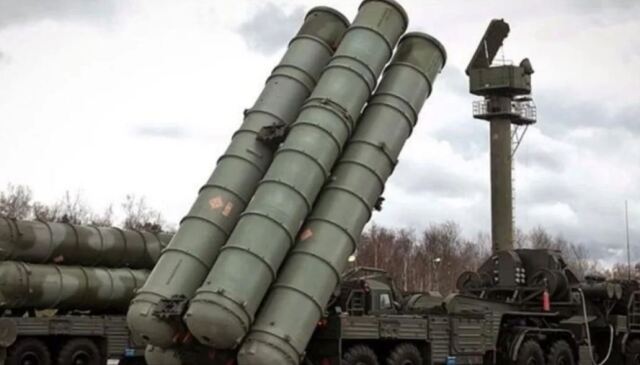
The pro-government newspaper Hürriyet presents the transfer of Turkey’s Russian-made S-400 air defense systems to a third Gulf country as the most likely solution to break the deadlock in U.S.-Turkish relations.
According to the report, this formula is viewed by the U.S. side as the option most compatible with the current legal framework, potentially paving the way for both the removal of CAATSA sanctions and the reopening of discussions regarding the F-35 fighter program, although it would not automatically restore Turkey’s participation in the program.
A Formula for the S-400s
Hürriyet argues that there are currently two parallel but separate issues in Ankara-Washington relations: CAATSA sanctions and Turkey’s possible return to the F-35 program.
The newspaper stresses that lifting the sanctions would not automatically mean rejoining the F-35 program, but it would remove one of the most significant political and legal obstacles.
According to the report, citing information from U.S. officials, the strongest option under consideration is the sale of the S-400 systems to an unnamed third country in the Gulf.
The newspaper says Washington continues to insist that the S-400 systems must no longer be part of Turkey’s military inventory.
It also notes that alternatives discussed in the past—such as storing the systems inside Turkey, removing key activation components, or placing them under joint custody—are not considered by the United States to comply with the existing legal framework.
Hürriyet further adds that, under Turkey’s end-user agreement with Russia, any transfer of the S-400s to a third country would require Moscow’s approval. According to the same sources, Russia does not appear to be fundamentally opposed to such a move.
Conditions for Lifting CAATSA Sanctions
The newspaper recalls that CAATSA sanctions were imposed in 2020 following Turkey’s purchase of the S-400 system from Russia and primarily targeted Turkey’s Presidency of Defence Industries.
According to the report, lifting those sanctions would require the U.S. president to certify to Congress that Turkey no longer possesses the S-400 system—or any comparable Russian system—and has committed not to acquire similar systems in the future.
A Separate Process for the F-35
Hürriyet emphasizes that Turkey’s return to the F-35 program is a separate matter from the lifting of sanctions.
Even after CAATSA sanctions are removed, additional political, legal, and technical steps would still be required, including:
- White House notification to Congress.
- A 15-day congressional review period.
- Security assessments by the Pentagon and the F-35 Joint Program Office.
The newspaper also notes that it remains unclear whether Turkey would return as a production partner or merely as a customer.
The Six Completed F-35s
According to the report, if negotiations progress positively, the first issue likely to be addressed would be the delivery of the six F-35 aircraft that had already been built for Turkey and fully paid for before Ankara was removed from the program.
However, before any delivery, the aircraft would require maintenance, Turkish pilots would need renewed training, and technical personnel would have to undergo recertification.
Developments in the KAAN Program
Hürriyet also reports that the U.S. approval process is in its final stages for the export of 80 engines, worth more than $700 million, intended for 40 KAAN fighter aircraft.
According to the newspaper, this approval sends a political signal that Washington is willing to gradually restore defense-industrial cooperation with Turkey, beginning with less sensitive areas rather than immediately returning to the F-35 program.
The F-16 Issue Remains
Regarding the F-16, Hürriyet reports that the contract for the purchase of 40 new aircraft remains in force and that Turkey has already paid an advance.
However, the newspaper says the two sides are engaged in new negotiations over disagreements concerning the cost of the production line and the aircraft’s new mission computers.
It concludes that progress on the CAATSA sanctions and the F-35 issue could also help facilitate completion of the F-16 agreement.
Ask me anything
Explore related questions




