





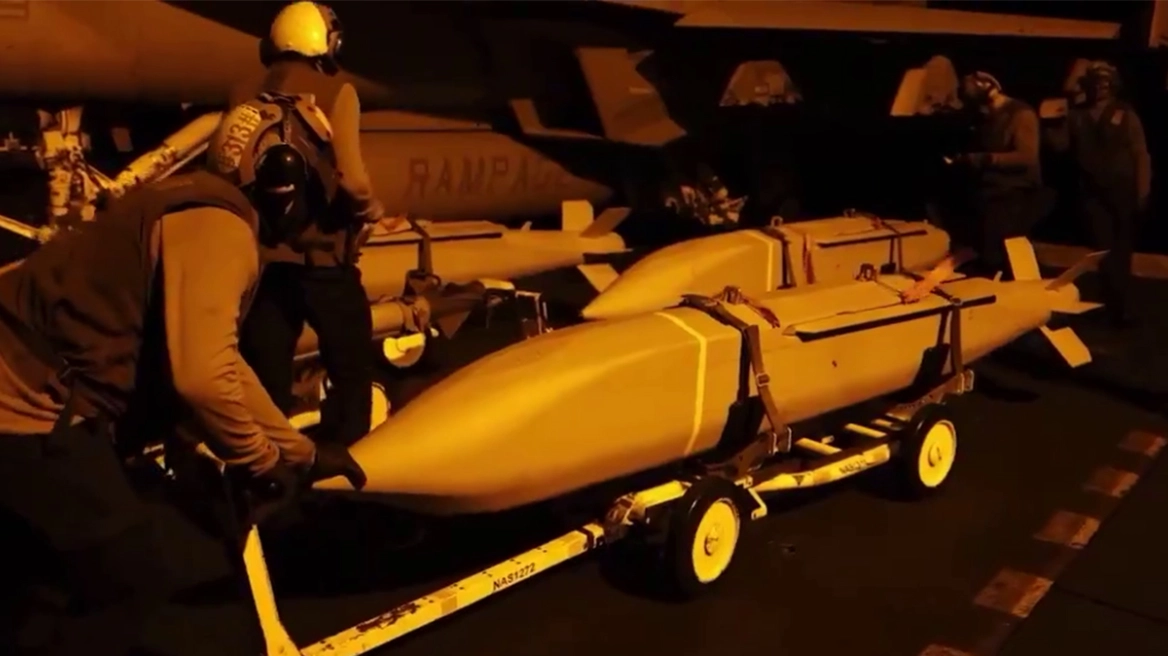
The U.S. armed forces announced early this morning that they had completed the airstrikes they carried out for the ninth consecutive night against Iran, with Tehran responding by once again targeting neighboring Gulf countries and announcing that it had attacked two oil tankers in the Strait of Hormuz.
The overnight raids “targeted Iranian military command centers, air-defense and coastal surveillance facilities, naval capabilities, missile and drone launch facilities, as well as communications networks, in order to further reduce Iran’s ability to attack commercial vessels and civilian maritime workers passing through the Strait of Hormuz,” the U.S. Central Command (CENTCOM) — the unified command responsible for the Middle East — said on X.
“We hit them very hard again tonight,” U.S. President Donald Trump told reporters, emphasizing that the bombings were carried out to “honor” American soldiers who had been killed in recent days in the Middle East.
Two members of the U.S. armed forces were killed when Iran struck a base in Jordan, and remains found at the site of the attack but not yet identified may belong to a third person, according to CENTCOM.
Another American service member was killed the day before yesterday, Saturday, in a controlled explosion involving the warhead of an Iranian one-way unmanned aerial vehicle in northern Iraq.
The official death toll among U.S. armed forces since the war in the Middle East began on February 28, with the U.S.-Israeli attack against Iran, has therefore risen to 17 fatalities.
On the other side, according to the latest official toll announced Friday by Iran’s Ministry of Health, more than 50 people have been killed and another 500 injured since hostilities resumed at the beginning of the month.
The “memorandum of understanding” signed by the presidents of the United States and Iran on June 17, which was supposed to lead to a round of negotiations aimed at permanently ending the armed conflict, has fallen apart as weapons have taken over and the deadlock in the strategically important Strait of Hormuz has become entrenched.
The maritime passage, through which under normal conditions one-fifth of the world’s consumed oil and liquefied natural gas passes, was declared closed again by Iran after hostilities resumed. In retaliation, the United States reimposed a blockade on Iranian ports in the Gulf.
Ship in Flames
The Islamic Revolutionary Guard Corps (IRGC) — Iran’s ideological military force — announced that it had “stopped” by force two tankers as they attempted to cross the Strait of Hormuz without Tehran’s permission, in an “unauthorized” manner, according to Iranian state media.
The British maritime security information service UKMTO, which operates under the Ministry of Defence, announced that a vessel was on fire in the Strait of Hormuz, 8 nautical miles (approximately 15 kilometers) northwest of the village of Kumzar in the Sultanate of Oman.
Oil prices, which had returned to more normal levels after the signing of the U.S.-Iran agreement, have begun rising again. Early this morning, the price of a North Sea Brent crude barrel — the benchmark grade in international markets — for September delivery exceeded $90, reaching its highest level since June.
U.S. Secretary of State Marco Rubio demanded on Sunday that the international community pressure Iran alongside the United States in order to “protect international maritime navigation” in the Strait of Hormuz.
“Other countries need to begin increasing their efforts and contributing assistance to share this burden, whether that involves equipment or funding,” he argued.
“The United States remains always open to a diplomatic solution. We have attempted this many times with Iran and we will continue trying,” he added.
Explosions in Bahrain After Iranian Strikes on Kuwait
Explosions were heard in Manama, the capital of Bahrain, a country that for days has been targeted by repeated Iranian attacks against its neighbors and U.S. allies. The Interior Ministry announced that air-defense sirens had been activated again, according to journalists from Agence France-Presse.
During Sunday night into Monday, the U.S. embassy in Bahrain warned through X and its website, citing “information” it had received, that Iranian armed forces could “target unspecified locations” in Manama, especially in the “central” part of the city.
The Revolutionary Guards said this morning that they had targeted U.S. facilities at a base in Kuwait, according to Iran’s official news agency IRNA.
The Islamic Republic’s ideological military claimed that it had “completely destroyed a U.S. early-warning radar” in a drone strike, and that it had also hit an equipment and spare-parts warehouse as well as an MQ-9 drone hangar at Ali Al Salem Air Base, causing “many” such drones to catch fire, according to a statement carried by IRNA.
The Revolutionary Guards also announced that they had carried out a “surprise” attack on an “enemy special operations command center” (meaning the United States) at Al-Tanf in Syria.
The attack was described as “retaliation for the blood of the soldiers who fell as martyrs in Iranshahr,” a city in southwestern Iran, according to the official news agency IRNA via Telegram.
Last night, the Tasnim news agency reported the funerals of three Iranian soldiers killed in a U.S. attack against a military camp in Iranshahr, in the southeastern part of the country.
The Revolutionary Guards had also announced on Friday that they had attacked the base at Al-Tanf, where control was handed over to the army of Syria’s de facto government in February following the withdrawal of U.S. forces. A Syrian army source speaking to Agence France-Presse denied that the base had been bombed.
The base is located in southeastern Syria, near the tripoint border area with Jordan and Iraq.
The Revolutionary Guards further claimed that they had attacked with ballistic missiles and struck U.S. transport aircraft and AWACS aircraft at the airport in Aqaba, Jordan. They claimed that “serious damage” had been caused to some of them, according to a statement cited by Iranian state television IRIB.
The Israeli military announced last night that, in cooperation with the Jordanian army, it had intercepted “fragments” of an Iranian missile that had been launched toward Aqaba, a Red Sea port located not far from the Israeli port of Eilat.
Ask me anything
Explore related questions




