





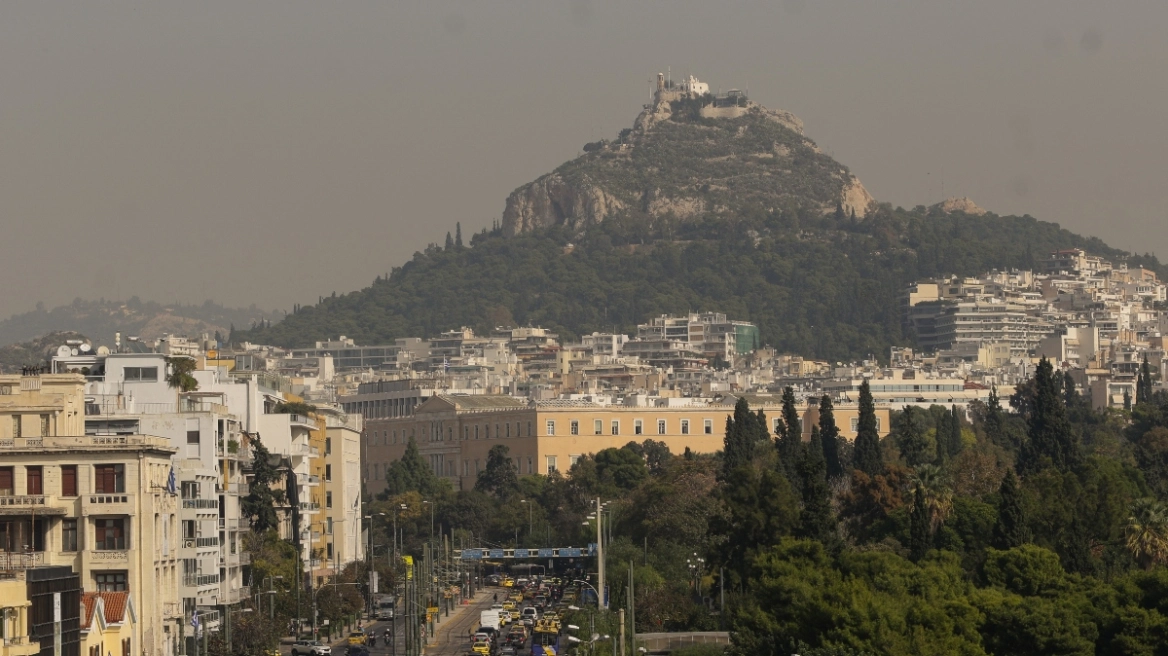
Greece is on the front line of the climate crisis, as the Mediterranean basin is warming faster than the global average. Prodromos Zanis, a professor at the Department of Meteorology and Climatology at the Aristotle University of Thessaloniki (AUTh), spoke to protothema.gr about the real scale of the problem.
Air quality: improving, but challenges remain
Zanis says Greece is neither among Europe’s cleanest countries nor its most polluted, in terms of air quality. Over the past 30 years, Greek cities have seen major reductions in classic pollutants regulated by EU law, including sulphur dioxide, carbon monoxide and benzene, along with significant drops in nitrogen oxides. Reductions in particulate matter (PM10 and PM2.5) have been more modest, while ozone, a secondary pollutant, shows no clear trend. He credits the overall improvement to EU legislation on fuels, vehicles and industrial emissions.
Even so, fine particles (PM2.5) and summertime ground-level ozone, caused by photochemical pollution, remain major public health concerns. In 2019, long-term exposure to fine particles and ozone accounted for 5% of all deaths in Greece, 1 percentage point above the EU average.
Thessaloniki, due to its geography and weather patterns, has faced the worst problems with PM10 limit breaches, and the European Court of Justice has previously ruled against Greece over the city’s poor air quality. In 2019 alone, Thessaloniki recorded 67 daily PM10 exceedances against an EU limit of 35. Although breaches have fallen sharply over the past 5 years, most Greek cities still regularly exceed the stricter limits set by the World Health Organisation (WHO) for PM10 and PM2.5, making fine particulate pollution the biggest air quality challenge facing Greek cities.
Asked to rate Greek cities on a scale of 1 to 10, Zanis says most would score moderate to good, while Athens and Thessaloniki would fall into the moderate range, well above heavily polluted cities in India and Pakistan, but behind the high standards of Scandinavian cities.
The hidden pollutants
Zanis warns that Greece’s monitoring network, though it tracks the main EU-regulated pollutants, does not systematically measure ultrafine particles (under 0.1 micrometres), which penetrate deep into the lungs and can enter the bloodstream. Black carbon, produced by diesel, wood and biomass burning, is also not routinely measured, despite being far more toxic per unit of mass than ordinary PM2.5 and carrying disproportionately serious health risks.
Ask me anything
Explore related questions




