





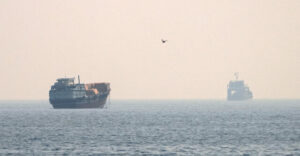
A senior Iranian official on Saturday laid out sweeping conditions for the United States before any de-escalation around the Strait of Hormuz, dashing hopes that the strategically important shipping lane—now at the center of the Middle East conflict—could soon reopen.
The remarks by Mohammad Bagher Zolghadr, secretary of Iran’s Supreme National Security Council, contrast with the progress reportedly made in recent days during talks between Iran and Oman over the future management of the Strait.
“The Strait of Hormuz will remain closed as long as the United States does not change its behavior,” he warned, according to Iranian media, outlining a series of demands.
Among them, Iran is calling on Washington to:
- Permanently end what it describes as the war and attacks against Iran and its allies.
- Lift the blockade imposed on Iranian ports.
- Remove U.S. sanctions.
- Release Iran’s frozen assets.
- Provide full compensation for the damage caused by the war that began on February 28 with U.S.-Israeli strikes against the Islamic Republic.
Several of these demands had already appeared in the June Iran-U.S. memorandum of understanding, which established a ceasefire and allowed shipping to resume through the Strait of Hormuz while opening the way for negotiations toward a broader settlement of the conflict.
However, that ceasefire collapsed in early July, leading to renewed U.S. strikes and Iranian retaliation against Washington’s allies in the Middle East.
The Strait of Hormuz—a critical artery for global oil and gas trade—was once again closed by Iran, which has regularly targeted vessels entering the waterway without its authorization.
Positive Negotiations
Tehran has made clear that it does not intend to return to the pre-war status quo and ultimately plans to impose transit service fees, a proposal strongly opposed by the United States.
Nevertheless, Iran said in recent days that it had reached an agreement with Oman, which also borders the Strait of Hormuz, on a shipping transit route.
Negotiations are taking place in a “positive and constructive atmosphere,” Oman’s Foreign Ministry said on Saturday. Without naming Iran directly, it condemned the “repeated attacks” and called on all parties to refrain from actions that could jeopardize the diplomatic process.
An oil tanker belonging to the UAE’s national oil company ADNOC was struck by a missile in the Strait on Saturday, though no casualties were reported. Abu Dhabi blamed Iran for the attack.
ADNOC said Friday that 15 of its vessels have been targeted in the Strait since the war began in late February, including three this week alone.
Bombing Pause
Iran, which has not commented on those attacks, said negotiations with Oman are “approaching their final stage,” according to Foreign Minister Abbas Araghchi. Although an announcement had been expected for several days, Araghchi attributed the delay to “technical issues.”
Even if the negotiations succeed, however, “that does not necessarily mean the Strait of Hormuz will reopen,” the Iranian foreign minister stressed, adding that additional “conditions and compensation” still need to be negotiated.
Beyond the continued closure of the Strait, no broader diplomatic breakthrough appears imminent, particularly regarding Iran’s nuclear program, after more than five months of conflict in the Middle East that has also shaken the global economy.
U.S. airstrikes have been suspended for more than a week, but U.S. President Donald Trump has made a rapid agreement a condition for maintaining that pause, while warning that large-scale strikes could resume if negotiations fail.
Against this backdrop, Admiral Brad Cooper, commander of the U.S. Central Command (CENTCOM), visited Israel, the United Arab Emirates, and Bahrain on Saturday to conduct what Israel’s public broadcaster Kan described as a “situational assessment.”
Neither the United States nor Israel has officially confirmed the visit.
Ask me anything
Explore related questions




