





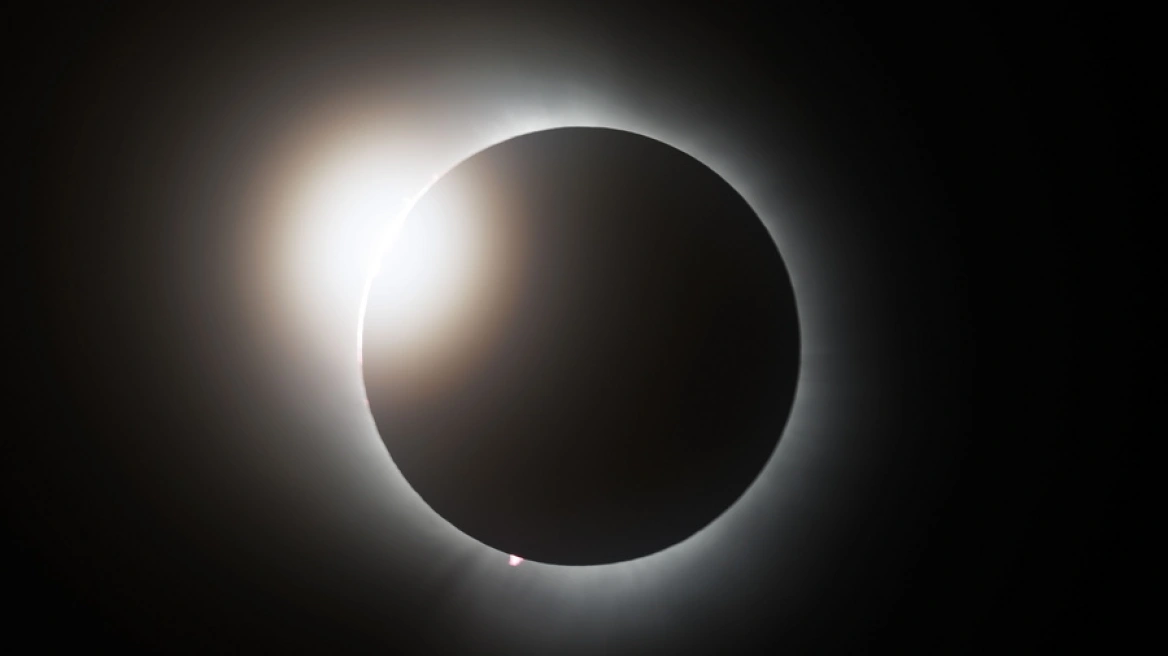
One of the most spectacular astronomical phenomena of recent years will take place on Wednesday, August 12, when a total solar eclipse will be visible from parts of Europe and the Northern Hemisphere.
For a few minutes, the Moon will pass directly between Earth and the Sun, completely covering the solar disk for observers located within the narrow path crossed by its shadow.
The eclipse is particularly significant for Europe, as it will be the first total solar eclipse visible from mainland Europe since 1999. The event is expected to attract thousands of travelers and astronomy enthusiasts to areas located along the so-called “path of totality.”
How a Total Solar Eclipse Occurs
A solar eclipse occurs when the Moon passes between the Sun and Earth, causing its shadow to fall on part of the planet’s surface.
During a total eclipse, observers in the right location see the Moon completely cover the Sun’s bright disk. Daylight suddenly fades, the sky takes on a twilight appearance, and the solar corona becomes visible around the darkened Moon.
The phenomenon is possible because of a remarkable relationship between size and distance: the Sun is approximately 400 times wider than the Moon, but it is also about 400 times farther away. As a result, the two disks appear almost exactly the same size when viewed from Earth.
Where the Moon’s Shadow Will Pass
The path of totality of the August 12 eclipse will cross northern Russia, Greenland and Iceland before moving over the Atlantic and reaching the Iberian Peninsula.
In Europe, Spain will have a particularly favorable position, while a small part of northeastern Portugal will also fall within the path of totality.
In Spain, the zone will cross a large part of the northern and eastern regions of the country, extending as far as the Balearic Islands.
A much larger area will experience the event as a partial solar eclipse. This will include much of Europe and Canada, parts of the northern United States and northwestern Africa.
Less Than Two Minutes of Totality in Parts of Spain
The complete covering of the Sun will last only a short time, particularly in Spain, where the eclipse will occur low on the horizon, shortly before sunset.
In the area around Burgos, for example, totality will last approximately one minute and 44 seconds, while the entire process, from the beginning to the end of the partial phases, will last nearly one hour and 47 minutes.
The maximum duration of totality anywhere along the eclipse’s entire path will be approximately two minutes and 18 seconds.
Why Total Solar Eclipses Are So Rare in Any One Place
Solar eclipses themselves are not particularly rare on a global scale. What is rare is for a specific location to fall directly within the narrow path of totality.
The Moon’s shadow covers only a limited area of Earth each time, meaning that a very long period can pass before a particular city or region experiences a total solar eclipse again.
Spain, however, is entering a particularly unusual period of eclipses. On August 2, 2027, another total solar eclipse will pass across southern Spain, northern Africa and the Arabian Peninsula.
Special Glasses Are Required for Viewing
Particular care is required when observing the event, as looking directly at the Sun without appropriate protection can cause serious eye damage.
During all partial phases of the eclipse, certified eclipse glasses or safe solar filters must be used. Ordinary sunglasses, even very dark ones, do not provide adequate protection.
Only observers within the path of totality may remove their eclipse glasses for a few moments, and only when the Moon has completely covered the Sun’s bright disk. As soon as even a small portion of the Sun begins to reappear, eye protection must be used again.
A special solar filter is also required for telescopes, binoculars and cameras, as concentrated solar radiation can cause serious eye injuries and damage to equipment.
Ask me anything
Explore related questions




