





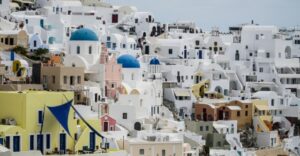
The government has published 12 questions and answers on the new framework, covering minimum plot sizes of up to 16 stremmas, restrictions in the coastal zone and what lies ahead for tourism investment
The Ministry of Environment and Energy has set out the new landscape taking shape for tourism investment, outside-plan development, coastal areas and short-term rentals, publishing 12 questions and answers on the new Special Spatial Planning Framework for Tourism, which has been in force since 7 August.
At the heart of the changes are stricter conditions for building new hotels outside town planning zones. The minimum plot size now rises to as much as 16 stremmas (about 1.6 hectares) in areas under the greatest tourism pressure and 12 stremmas in developed areas, while the threshold is set at eight stremmas for developing and early-development areas.
At the same time, a “red line” has been drawn along the coast: new structures and developments are now banned within 25 metres of the shoreline, with only limited exceptions.
The new framework also paves the way for tighter regulation of short-term rentals, allowing for geographical zones where the activity is restricted or even banned, limits on how many months of the year properties can be let, and a brake on new supply, including in newly built homes, in areas under particular pressure.
The transitional provisions also carry particular weight for investors. Projects and tourism investments already going through the licensing process before the new Framework was published can, under certain conditions, retain the previous regime, provided the relevant administrative act had already been issued or a complete application file had already been submitted.
With the new Framework, Greece is seeking to close a legal gap that has persisted for years, dividing the national territory into five categories according to the intensity of tourism development and introducing additional rules for the islands. The philosophy behind the new model is clear: the greater the tourism pressure on an area, the stricter the conditions for new investment, with the emphasis shifting towards upgrading existing units, organised development and landscape protection.
Compared with the draft put out for public consultation in 2024, the final Framework strengthens safeguards for islands, the coast, Natura protected areas and sensitive landscapes, further restricts scattered outside-plan building and places greater weight on destinations’ carrying capacity. At the same time, it broadens the scope for tourism development in areas earmarked for special development and refines the transitional provisions, in an attempt to strike a balance between protecting the environment and providing certainty for investments already under way.
The 12 questions and answers on the Special Spatial Planning Framework for Tourism in full:
- What is the Special Spatial Planning Framework for Tourism?
The Special Spatial Planning Framework for Tourism was published under a Joint Ministerial Decision signed by Environment and Energy Minister Stavros Papastavrou and Tourism Minister Olga Kefalogianni on Friday 7 August (Government Gazette, Series D, Issue 658, 7 August 2026). It is a national plan that, for the first time, sets out where and under what rules tourism can develop across the country.
The Framework is designed to set strategic directions and medium to long-term goals at national level for the spatial organisation of the tourism sector, on terms of economic, environmental and social sustainability.
Its aim is for tourism development to proceed in a more organised and sustainable way, while protecting the natural environment, local communities and the particular character of each area.
In simple terms, the Framework:
- sets clear, uniform and transparent rules for new tourism investment
- better organises the development of hotels and other tourism infrastructure
- protects areas under increased tourism pressure
- places particular emphasis on islands and environmentally sensitive areas, and
- guides town planning for the years ahead
It should be noted that the Framework contains, on the one hand, specific regulations for tourism development that take effect immediately from the date its Government Gazette notice was issued, meaning they have already applied since 7 August, and on the other, guidance for other levels of planning (Local Urban Plans, Special Urban Plans and others) so that the overall strategy for tourism policy can be incorporated, without conflicting with other land uses, into every spatial unit of Greece.
In effect, Greece now has, for the first time, a strategic legal text governing the spatial development of tourism.
- What changes from now on under the new Framework?
For many years, Greece lacked a modern, up to date strategic tool for organising tourism development spatially, at a time when Greek tourism was evolving rapidly and facing new challenges such as climate change and mounting pressure on popular destinations. To some extent, the organisation of tourism development and the needs of the sector were covered by Regional Spatial Plans.
The new Framework is intended to close that gap and set out clear rules and guidance for tourism development at national level, aiming for a balance between growth, environmental protection and quality of life.
- What are the Framework’s main goals and strategic priorities?
The Framework’s central aim is to develop tourism on sustainable terms, respecting the potential and particular characteristics of each area. The new spatial plan seeks to improve the overall visitor experience, promote forms of tourism beyond the traditional “sun and sea” model and extend the tourist season, through quality, modern tourism infrastructure.
It supports a more balanced spread of tourism activity across the country, backs specialist forms of tourism alongside sun and sea holidays, and promotes modern, high-quality tourism products, accommodation and specialist tourism infrastructure.
It also emphasises linking different forms of tourism with other productive sectors, reducing inequalities between and within regions, lengthening the tourist season, encouraging more organised siting of developments, integrated destination management and tackling overtourism pressures.
Further key priorities include adapting to climate change, promoting transport, environmental and digital infrastructure, and driving the green transition and reducing the environmental footprint of tourist accommodation.
- How is the national territory categorised, and on what criteria?
The main categorisation is based on the intensity of tourism activity, calculated chiefly from the number of tourist beds relative to the area and permanent population of each municipal unit.
On this basis, areas fall into five categories:
(A) Controlled Development Areas
(B) Developed Areas
(C) Developing Areas
(D) Early-Development Areas, and
(E) Special Development Support Areas
A more specific categorisation is also set out for the islands. Islands, other than Crete and Evia, are further grouped by size into three distinct groups, each with different guidance and development conditions. Group I covers islands larger than 250 square kilometres, while smaller islands fall into groups with more specialised provisions and greater scope for protecting the landscape and environment.
- So what are the practical effects of this categorisation?
In practice, categorising areas into zones A to E, and islands into Groups I to III, determines the conditions under which tourism can develop in each place. It affects what kind of tourism investment is permitted, the minimum plot sizes for new hotels, maximum bed capacity, and the terms for protecting the natural environment and distinct character of each area.
In Controlled Development Areas (A), meaning areas with very high levels of tourism, priority is given mainly to upgrading and modernising existing accommodation, with stricter conditions for building new tourism units. New hotels outside town planning zones require a minimum plot of 16 stremmas.
On the islands, new tourist accommodation of up to 100 beds is allowed for the first 16 stremmas of a plot. For any part of a plot exceeding 16 stremmas, a limit of six beds per stremma applies, up to the maximum bed capacity set for category B.
In Developed Areas (B), the focus remains on quality upgrades, but with milder restrictions. The minimum plot for new hotels outside town planning zones rises to 12 stremmas, while on islands in this category, units of up to 350 beds are allowed. Specialist forms of tourism and the development of modern tourism infrastructure are also encouraged.
Developing Areas (C) have greater scope for new tourism activities and accommodation, with the aim of gradually strengthening the tourism product. Early-Development Areas (D) place the emphasis on the gentle development of new destinations and making the most of each area’s particular characteristics, while Special Development Support Areas (E) are aimed mainly at specialist forms of tourism, such as mountain, spa, marine or diving tourism.
Group I covers the larger islands of more than 250 square kilometres, where greater tourism development is envisaged.
Stricter landscape protection guidance applies to the smaller islands in Groups II and III, along with limits on construction and on the capacity of new units (up to 100 beds), with the aim of preserving their character and encouraging gentler forms of tourism development.
Where two or more sets of guidance or regulations apply to the same area, the provisions offering greater environmental protection take precedence, in order to preserve the particular character of the islands.
- What changes regarding the minimum plot size required to build new hotels outside town planning zones, by category?
With the Framework’s publication in the Government Gazette, and until land uses, building terms and construction limits are set by first-level town planning tools, the following minimum plot sizes now apply, by regulation, to areas in categories A, B, C, D and E:
(A) 16 stremmas (previously eight stremmas, with exceptions down to four stremmas)
(B) 12 stremmas (previously eight stremmas, with exceptions down to four stremmas)
(C) and (D) eight stremmas (previously eight stremmas, with exceptions down to four stremmas)
(E) eight stremmas, with exceptions down to four stremmas (that is, unchanged from the current position), provided the tourism investment cumulatively meets strict town planning, energy and environmental requirements
The categories of tourist accommodation that can be developed in each area are also set out, with the emphasis mainly on higher-specification hotels, such as three, four and five-star units in areas A, B and C.
- What now applies to the coastal zone?
The Framework sets out strict, immediately applicable rules to protect the coastal zone, aimed at preserving the natural landscape and safeguarding the coast. Specifically, in the zone from zero to 25 metres from the shoreline, all new structures and developments are now fully banned. The only exceptions are works relating to access for people with disabilities, ambulance access, and specific interventions provided for under legislation governing the shore and beach.
The new Framework also places greater emphasis on protecting the landscape, on the carrying capacity of coastal areas and on more organised development of tourism activity along the coast and on the islands.
- How is protection handled for areas within the National System of Protected Areas?
The new Framework sets out additional protective guidance for areas within the National System of Protected Areas, with an emphasis on gentle, sustainable tourism development. The aim is to safeguard the natural environment, landscape and biodiversity, through stricter building conditions, limits on the intensity of tourism development and, where required, greater environmental assessment and carrying-capacity documentation requirements.
- How does the Framework affect the regulatory environment for short-term rentals?
The Framework sets out the rules and the framework within which tourism activities, including short-term rentals, can be regulated. Measures being promoted to organise and control short-term rentals include:
a) setting terms and conditions for putting properties up for short-term rental, particularly in relation to their use as a main residence
b) regulating how many months of the year the activity can take place
c) establishing geographical zones where the activity is banned or restricted
d) limiting the growth of new short-term rental supply, particularly in areas under increased pressure or with particular geographical characteristics, including newly built homes
- How does the Framework affect existing permits and already-approved plans?
For licensing procedures for tourism facilities, or approval of an organised tourism development zone or a Special Urban Plan, that were already under way when the Framework was published, the new provisions do not apply, provided a specific act had already been duly issued, or a complete application file had already been submitted, before publication.
Cases covered by this transitional protection include an environmental terms approval decision or a recommendation for environmental approval, inclusion under standard environmental commitments, a complete environmental impact study or strategic environmental impact study, pre-approval of a Special Urban Plan, pre-approval of a building permit or a building permit itself, a complete pre-approval file for construction, and approvals for inclusion under development legislation or funding programmes.
The Framework acts as guiding and binding for subordinate plans (Local Urban Plans, Special Urban Plans and others), as well as for Regional Spatial Frameworks, which will need to be gradually brought into line with its guidance whenever they are revised or amended.
- How does the Framework fit with other activities that affect tourism?
The Framework sets out rules and guidance for how tourism can coexist with other major sectors, such as industry, mining, renewable energy and aquaculture, among others. For wind farms specifically, within areas A and B and on islands in Group II, development is permitted only for self-consumption.
The aim is better spatial organisation of the different uses and activities, so as to limit potential conflicts, protect the environment and landscape, and secure sustainable development for tourist destinations.
- How does the Framework that went out for consultation in July 2024 differ from the one now enacted?
The final text that has now been enacted retains the core strategic direction of the 2024 consultation document, but incorporates adjustments arising from the extensive consultation process, the strategic environmental impact study, the appropriate assessment study, opinions from the relevant bodies and environmental approval.
The changes mainly involve the inclusion of more numerous and more specific guidance for greater protection of the islands, the coast, Natura and other protected areas and sensitive landscapes; greater emphasis on carrying capacity and the environmental performance of accommodation; the inclusion of neoclassical buildings within tourism regulations; further support for tourism activity in category E areas; tighter limits on scattered outside-plan building; and an explicit link to a dedicated monitoring mechanism. Particular emphasis was placed on additions and refinements to the transitional provisions, additional rules for the islands, and the proposed guidance on short-term rentals.
Ask me anything
Explore related questions




