





They say revenge is a dish best served cold. For a true knight like easyJet founder Sir Stelios Haji-Ioannou, such a modest emotion might hold little appeal, but there is another feeling entirely: vindication. And vindicated is surely how he feels, watching events unfold in favour of the most famous of his business ventures, easyJet.
After weathering countless storms, Haji-Ioannou and his family have found a partner who shares, or at least broadly aligns with, their vision for the future of the European low cost airline giant: the American investment fund Apollo Global Management.
Ahead of a takeover valued at around €6.7 billion, the Greek-Cypriot founder of the airline, who holds the rights to the entire easyGroup family of trademarks, saw early on that a fierce contest was brewing.
The American fund Castlelake attempted to buy the airline, already under pressure from fuel costs and reduced traffic, at a significant discount, valuing it at around £5 billion in late May.
With the share price rallying, up 29% since then, Castlelake’s proposal was rejected by the airline’s board as “opaque” and seen as an attempt to buy the company on the cheap. Apollo’s more recent offer, at £5.7 billion, was declared the winner of the contest after the fund secured the backing of the airline’s founder and largest shareholder, whose weight in the process proved decisive.
So Sir Stelios, who has clashed repeatedly with easyJet’s board in recent years, at one point branding directors “the villains”, and who has faced pressure from analysts and shareholders to step back and let others run the company, has not only avoided the nightmare scenario he feared but has been vindicated. The family retains its current 15.3% stake and looks set to emerge stronger from the contest.
“Having carefully reviewed Apollo’s proposal, my family and I have decided to support the recommended takeover announced by easyJet’s board. We will remain shareholders in the private company that emerges once easyJet leaves the London Stock Exchange. […] I welcome Apollo’s strategic intentions for easyJet, which aim to create new growth prospects for the company. The fact that Apollo, one of the world’s most powerful and experienced institutional investors, has decided to back and invest in easyJet’s growth, the flagship member of the easy family of brands, is a strong endorsement of the value of the easy brand and the strength of easyGroup’s business model. My family and I intend to remain significant long-term shareholders in easyJet, supporting the next chapter in the company’s journey,” he said in his statement.
The fight over a prize asset
Courage, honour, justice, compassion and courtesy: these are the qualities a knight is expected to have. Haji-Ioannou possessed them from a young age. That is why, in November 2006, Queen Elizabeth II made him a knight in a ceremony at Buckingham Palace. There, the Queen could not resist asking Haji-Ioannou why he was wearing an orange tie, whether he had a thing for the colour, and whether it reminded him of Greece’s orange groves.
Whatever the answer, Haji-Ioannou, part son of “the king of the tankers” Loukas Haji-Ioannou, part self-made billionaire who built an empire of his own, quickly acquired the sheen of a celebrity, albeit one with the profile of a philanthropist. And so, moving between the palaces of Buckingham and Monaco with the glow of an armour-clad champion about him, he fought his battles for easyJet, several of which he lost, at times coming close to being pushed out of the company he himself created.
For years, he clashed with management at the airline he founded and remains a major shareholder in, culminating in the confrontation of 2020. At that point, although he had cut his stake to below 33% and had just lost several battles, including a shareholder vote on removing three company executives, he pressed the fight even harder, focusing on a £4.5 billion order placed with Airbus, which he wanted cancelled.
Facing the Sir’s sword were Chairman John Barton, Chief Executive Johan Lundgren and Chief Financial Officer Andrew Findlay. Findlay resigned after Haji-Ioannou announced he was offering £5 million to any whistleblower who could provide evidence of a corruption scandal between Airbus and easyJet, saying he already had evidence of a secret dinner with an Airbus executive at the Schweizerhof hotel in Lucerne on 17 November 2016.
At the time, he seemed to have the whole world against him. Some seasoned and respected analysts, such as Michael Skapinker of the Financial Times, said Haji-Ioannou suffered from “founder’s syndrome”, a condition in which founders refuse to let the companies they built be run by the investors who control them.
But the reality was different. Hajioannou had explained that if he let the company go, as he was urged to, he risked a nightmare scenario he did not even want to imagine: the bankruptcy of easyJet. After all, it was his first successful venture, his first business “child”, from the time when, as a young man, he decided to become his own boss and transform air travel.
A brief rewind, 32 years back. In 1994, aged just 27, he took a business trip to Boeing’s offices in the United States, flying for the first time with a low cost airline and staying in a budget hotel.
That travel experience gave him the idea of naming an airline easyJet.com and a hotel chain easyHotel.com, sharing the same acronym. Sir Stelios chose “easy” as the core brand, which became the trademark of his companies. Before settling on the idea, he had considered using “Stel” at the start of each business name; his shipping company, for example, was called Stelmar, and he had thought about calling his airline Stelair, a shortened form of his own name, Stelios.
His idea of focusing on simple, no-frills air travel, cutting costs to the lowest possible level, proved to be a stroke of genius. Six years later, he floated easyJet.com on the London Stock Exchange.
With the calm that a private equity fund’s backing brings, it turns out the Sir was right to foresee growth prospects for the giant he created, one that has grown into Europe’s fifth-largest airline.
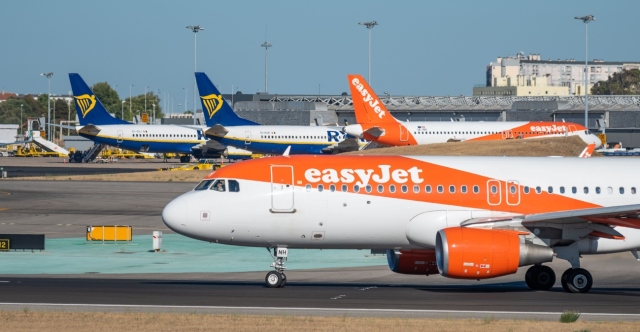
easyJet is a prize catch, retaining its original slot at London Luton, which Haji-Ioannou admits was a stroke of luck early in the company’s history, as well as valuable landing rights at other major European airports, including Milan and Geneva, and a modern fleet of 356 Airbus A320 aircraft plus a further 287 on order, 90 of which are due for delivery within the next three years.
The airline has a strong presence in European air travel and a strong brand, yet appears undervalued or unfairly treated given the times, at least to anyone who believes there is nothing fundamentally wrong with its competitive position or business model.
Over the past five years it has lost 45% of its stock market value (the opposite has happened at rival Ryanair), while it has paid a heavy price for geopolitical instability in the Middle East and rising fuel costs that have further squeezed profit margins. In the six months to 31 March, easyJet reported losses up 27% year on year, at £377 million (€436 million).
Souvlaki shops and other showdowns
Haji-Ioannou may have a thousand companies bearing the “easy” prefix, quite literally, but easyJet is his favourite child, since it was where his business success began (setting aside Stelmar, his shipping company listed on the American stock market, which he later sold). He describes himself as self-made, having funded his business idea, which turned out to be pure gold, with a loan from his father, whom he admits he had to work hard to convince.
“And what would you have done if you weren’t Loukas Haji-Ioannou’s son? If you hadn’t had access to that loan?” we ask him. Everyone around him freezes. He laughs loudly: “I have thought about it before. And I have concluded that, while I might not be who I am today, I would certainly still be a businessman. I could, for example, have run a chain of souvlaki shops. I would have started with one, then a second, then a third, and who knows? Maybe I would have owned a souvlaki chain, sold it, and used the money to found easy.”
He never did open a souvlaki shop; he is, after all, a fan of pasta, salad and a full English breakfast, but he did launch an easyPizza chain, which failed to take off. He may yet invest in the food sector again. He has more than 100 brand names beginning with “easy” and, using easyGroup as his investment vehicle, has launched a string of other low cost ventures across various sectors, all dedicated to offering consumers more value at a lower cost.
However, although he says that “for every 10 successes, you are entitled to one failure”, his track record includes several missteps. Among them, easyCinema, which sold cinema tickets for just 20 cents but closed in 2006, easyCar, which originally rented out brand new Mercedes but now operates as a broker referring customers to rental companies, easy4men, a men’s cosmetics line he did not even use himself, easyMobile, which shut down within a year, and easyInternetcafe, which the Sir has called one of his biggest business mistakes, having launched during the dotcom bubble and collapsed five years later, after losing £96 million.
As a knight, however, Sir Stelios has never hesitated to go to war, even with the boards of companies he himself founded, whenever he felt they were straying from the founding philosophy and concept. Years ago, for example, he blocked bonus payments for easyHotel executives, arguing they would hurt the company’s finances, were rising to unreasonable levels and sat at odds with the brand’s ethos.
In a similar dispute to the one at easyJet, in 2019 he accused a Luxembourg-based consortium of “stealing from under investors’ noses” the family’s hotel arm, easyHotel.
The Luxembourg-based fund manager ICAMAP, which oversees €1.5 billion in assets and is run by tycoons Guillaume Poitrinal (of the premium retail assets manager Unibail-Rodamco-Westfield), Harm Meijer (a Dutch financier) and Alexandre Aken (an asset manager), found itself in his sights. Shareholders did not heed his warning.
In other cases, he has not hesitated to go to court, as he did against Carrefour, when the French retail giant launched supermarkets under the name “easy” in the same distinctive orange colour (the French group eventually backed down and rebranded), and against Netflix, over a series titled “Easy”, as well as against private individuals in Greece who misused the “easy” name.
Photo: Getty Images / Ideal Image
Ask me anything
Explore related questions




