





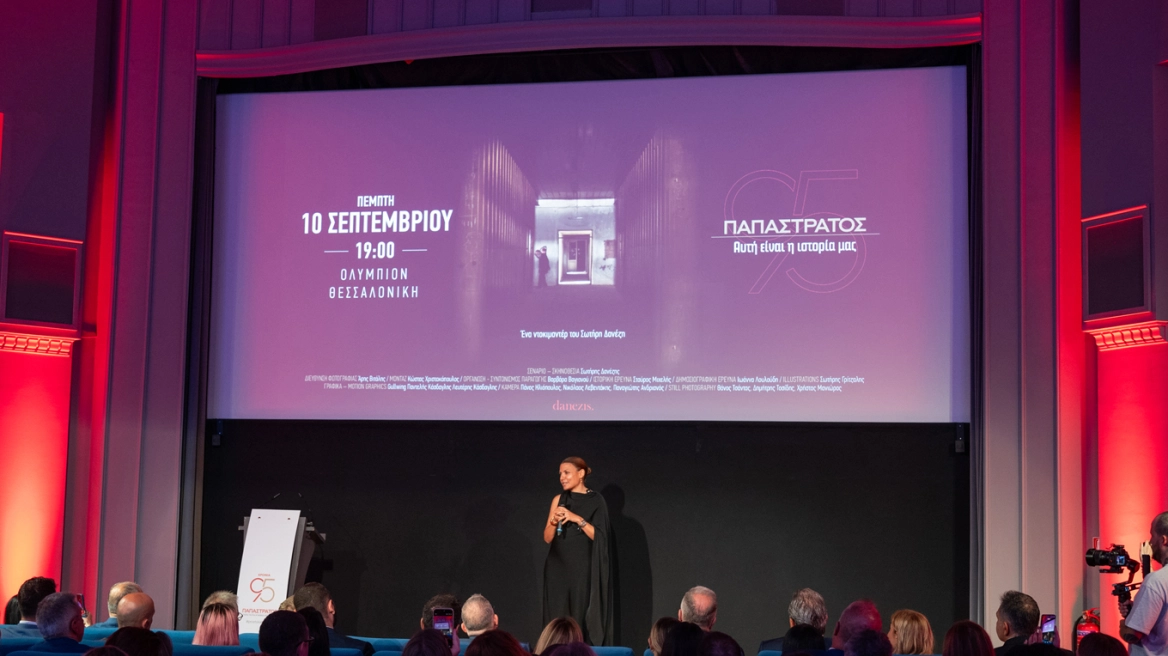
The anniversary documentary celebrating 95 years of Papastratos, created by Sotiris Danezis and produced by Danezis Stories, highlights how a company can evolve into a living organization with a human face, tracing a journey filled with success stories, challenges, critical decisions and moments that have shaped its history.
From 19th-century Agrinio to the modern era of transformation and innovation, the company, a member of the multinational Philip Morris International group, bridges the distance between yesterday and today, treating its people with the same respect and care envisioned by its founders.
There is a moment, at the end of every screening, when the audience decides what it has just seen. At the documentary’s premiere at the Olympion cinema on Thursday, September 10, the answer came immediately: loud and prolonged applause. It followed 70 minutes of history brought vividly to life.
“It was the first time we shared our story with the public,” said the company’s Managing Director, Tina Davou. “A story that is much more than a simple record of events. It is the journey of the company, its people and the decisions that have shaped it throughout all these years.”
It is a fascinating journey through space and time, intertwined with the history of Greece itself, which Sotiris Danezis unfolds from the very beginning, taking us back to the late 19th century.
Four Brothers and 3,000 Borrowed Greek Drachmas
In Agrinio at the time, one of the most sought-after tobacco varieties in the Mediterranean was being cultivated. German, Dutch and Egyptian merchants came to buy it, and thousands of families made their living from its leaves. It was in this world that four brothers, who had lost their father, grew up: Epameinondas, Ioannis, Sotiris and the youngest, Evangelos, who left school at the age of 12 and began working in a commercial establishment. Ten years later, in 1906, at just 22 years of age, he founded his first business with 3,000 borrowed Greek drachmas. Three years later came the first major deal, with 50,000 okes (64,100 kgr) of tobacco shipped abroad.
1913: The Beginning of a Story That Would Reach the Four Corners of the World
When his business partner passed away, Evangelos founded “Papastratos Brothers” in 1913 together with his brother Sotiris. The new company barely had time to get on its feet. The Balkan Wars and the First World War followed, and the brothers were called up for military service. Back in Agrinio, however, business continued to move forward, with orders doubling year after year. In 1919, all four brothers joined the company, and its headquarters moved to Athens. The name “Papastratos Brothers” was now being heard in Amsterdam, Dresden and Berlin, while branches opened in Xanthi, Kavala, Thessaloniki and Piraeus.
By 1922, exports had reached 3,600 tonnes, but in September of that same year Smyrna burned. The company’s warehouses in the city were reduced to ashes and 300,000 kilograms of tobacco were lost. The Papastratos brothers opened their doors wide to the refugees and hired many of them to work alongside them, people who brought with them the know-how of tobacco processing from Asia Minor.
1931: The Factory That Looked Like an American University
In 1930, the very year the global economy plunged into the greatest crisis of the century, the brothers decided to take the major step from commerce into industry and founded Papastratos AVES. The plans for the Piraeus factory were drawn up in Germany, as they wanted to create something unlike anything that had ever been built in Greece.
On May 30, 1931, in the presence of the Speaker of Parliament, numerous members of Parliament and the country’s political and military authorities, then Prime Minister Eleftherios Venizelos pressed a button, and the machines came to life. Newspapers of the time devoted extensive coverage to the inauguration, while journalists described a factory that looked more like an American university. Six floors filled with light, dining facilities, changing rooms, a medical clinic, a night school for illiterate workers, and exercise sessions on the rooftop for female employees.
From its very first period of operation, the factory stood out for something rare by the standards of the time: the way it treated its employees, the majority of whom were women. For every 100 men working there, there were more than 500 women. The Papastratos brothers organized group weddings in the factory courtyard and provided dowries for the brides. When the first National Collective Labour Agreement was signed in 1937, they were among the first to implement it.
They showed the same care for their hometown. In Agrinio, they built the Papastrateia Schools and later donated 100 stremmas of land for the city’s central park. An Archaeological Museum, Library, the Papastrateio Hall and the electrification of the entire city followed. In Piraeus, they built the Papastrateio Children’s Home. Somewhere along the way, as the documentary recounts, Agrinio simply stopped keeping count of everything the Papastratos brothers had built.
Shortly before the war, with factories already operating in Berlin and Cairo, Papastratos had become a small multinational company headquartered in Piraeus.
1940–1944: A Factory That Resists
On October 28, 1940, Greece entered the war, but the machines in Piraeus did not stop. A new cigarette pack was launched, bearing the Greek flag and a name, “Aera,” which reached the Albanian front together with soldiers’ rations. Every Papastratos worker who put on a military uniform continued to receive his salary.
During the Occupation, the occupying forces confiscated almost one-third of production, and in 1943 they took everything. In January 1944, Allied aircraft bombed Piraeus, and during the December clashes known as the Dekemvriana, the factory found itself caught in crossfire, was occupied and looted. By the end of the war, the company had suffered losses amounting to nearly 4 billion drachmas.
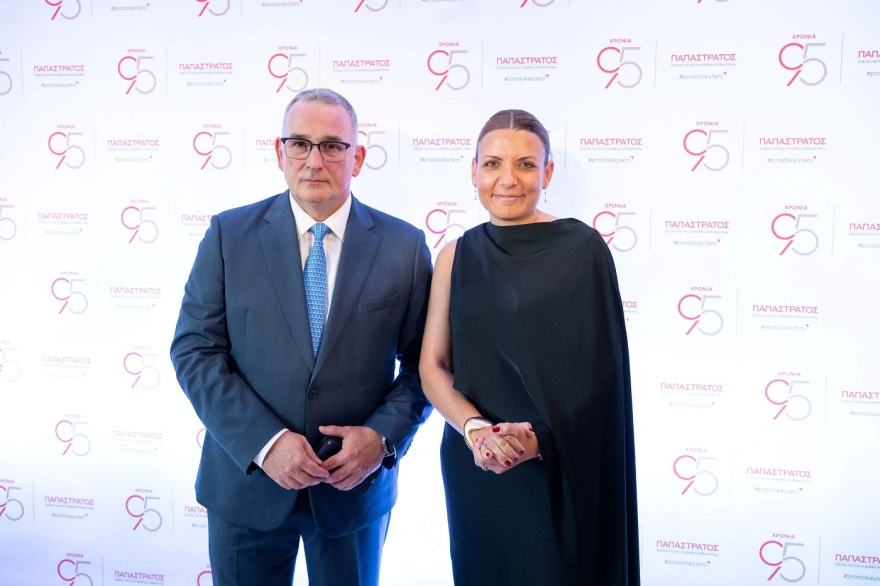
(Sotiris Danezis, producer of the documentary, and Tina Davou, CEO of Papastratos)
1950: The Beginning of Reconstruction
In the early 1950s, as the country struggled to get back on its feet, the factory’s machines started running again, while dowry schemes, group weddings and communal meals continued as before. Papastratos had not forgotten its most valuable asset: its people.
Building on their trust and hard work, by the end of the 1950s Papastratos had once again established itself as the leading force in the Greek tobacco industry, ready to take the next step and pursue the major international partnerships that would shape its future.
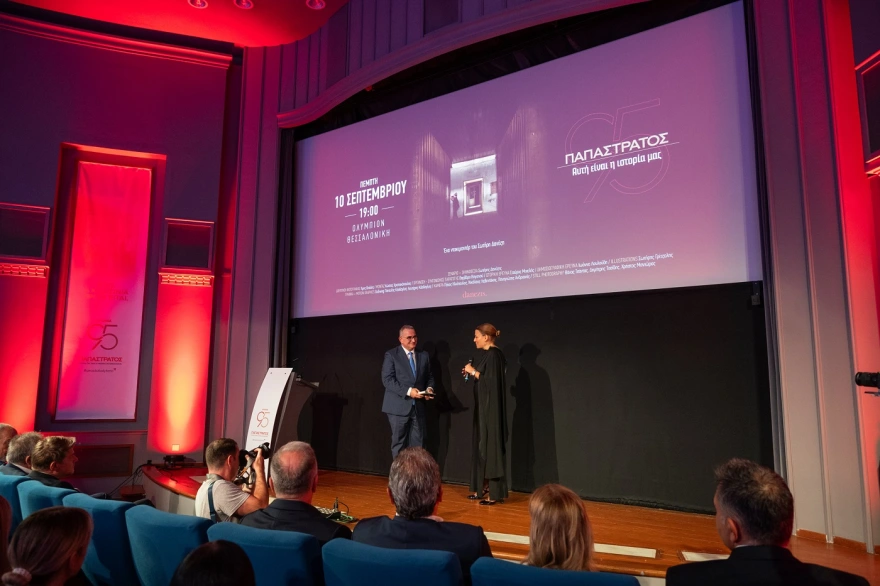
(Sotiris Danezis, producer of the documentary, and Tina Davou, CEO of Papastratos)
1974–2002: The Historic Agreement with Philip Morris International and the End of an Era
In March 1973, Evangelos Papastratos, the fourth brother and the man who had started it all, passed away. He had lived to see the company grow from nothing, survive wars and Occupation, and dominate the Greek market. One year later, in 1974, a landmark agreement was signed at the company’s Athens offices: Philip Morris International granted Papastratos the license to manufacture Marlboro in Greece.
The 1980s that followed were the most profitable decade in the company’s history: profits soared from 213 million to 3 billion drachmas. Operations opened in Romania and Ukraine, while more than 1,600 people worked at the factory. Every year, a portion of the profits was shared with employees: over the course of a decade, 4 billion drachmas were distributed in productivity bonuses and 1.5 billion went to public-benefit causes. It was the era when people in Piraeus used to say that anyone who got a job at Papastratos would also retire from Papastratos.
The 1990s found the company at the top, with exports recording impressive growth. In 1998, however, Tasos Papastratos, who had taken the helm of the company, passed away unexpectedly, and with him the Papastratos family name permanently disappeared from the company’s management.
2003: The Acquisition by Philip Morris International
The long-standing partnership with PMI led, in 2003, to the acquisition of Papastratos and its full integration into the global network of the world’s largest tobacco products company. Yet the name at the factory gate did not change: this was one of the key terms of the agreement. Papastratos remains one of the very few subsidiaries within the group worldwide to have retained its original name.
The name, however, was the easy part. The greatest challenge of the transition was the change in culture. What the company’s people did not want to lose was their identity. The DNA of Papastratos is its humanity, its sense of philotimo and its care for colleagues. Armed with this DNA and the capabilities of its parent company, PMI, Papastratos was ready for its next major step. This time, westward.
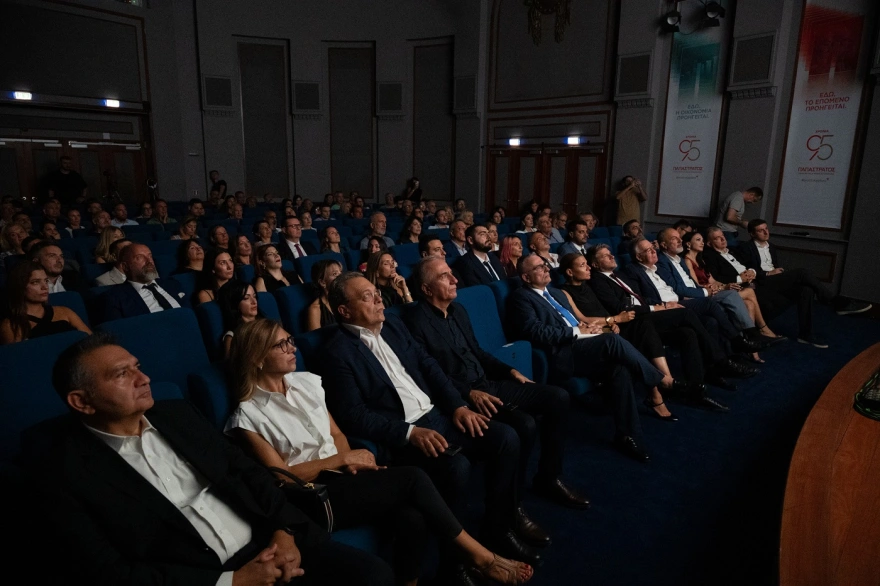
(The event was honored, among others, by the presence of representatives of the political and business world, the media, as well as executives of Papastratos)
2006–2008: From Piraeus to Aspropyrgos
In January 2006, Papastratos celebrated 75 years of operation and announced a plan for the future: a €100 million investment in a new factory in Aspropyrgos, with the aim of transforming the facility into a central export hub for PMI in Europe.
Two and a half years later, on August 13, 2008, the first products rolled off the new production lines. A few weeks later, on October 10, the machines at the Piraeus factory stopped for the last time, after 77 years of uninterrupted operation. One historic chapter had come to a close. The next one, without combustion, was preparing to begin.
2016: The Beginning of a Radical Transformation and the Last Cigarette
In 2016, a new product arrived on the Greek market: a device that heats tobacco without burning it. Greece was one of the first markets to welcome it. But the change was not only about the market. Under Philip Morris International’s new strategy, which emphasizes innovative smoke-free products with the vision of a world free from cigarette smoke, the Aspropyrgos factory, which was still producing cigarettes, had to find its place.
The answer came from the Greek management team itself, which sent a request to headquarters asking the parent company to invest so that Aspropyrgos could become PMI’s second facility worldwide dedicated exclusively to producing the new products.
One year later, the landmark €300 million investment was announced, accompanied by the creation of 400 new jobs. In March 2018, the new production line was ready and, for the first time since the factory inaugurated by Eleftherios Venizelos in 1931, Papastratos was no longer producing cigarettes.
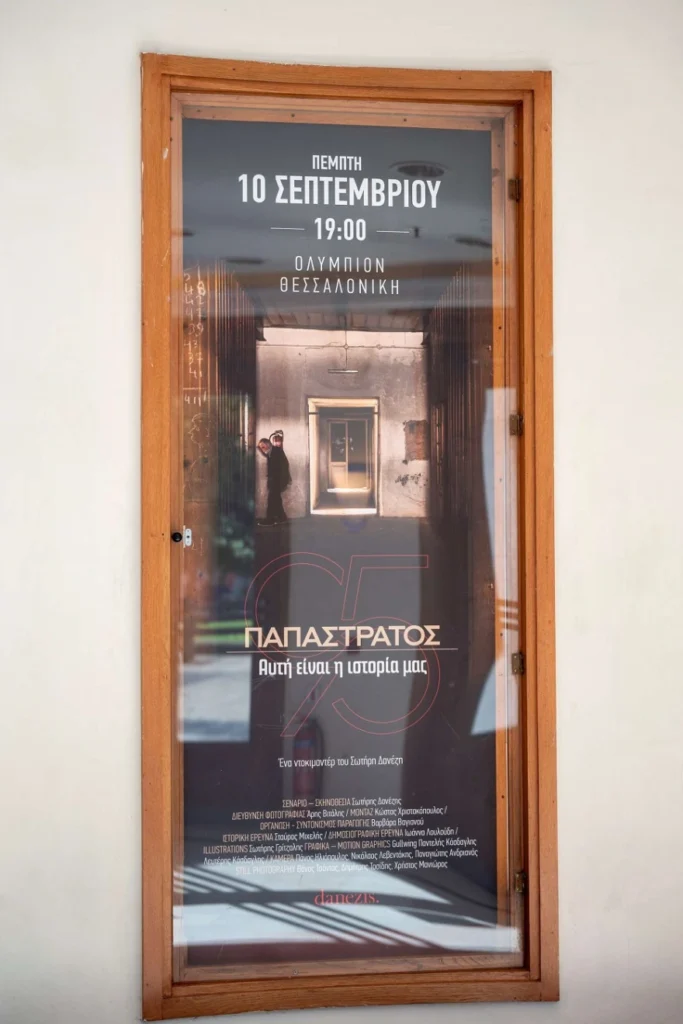
(“95 Years of Papastratos – This Is Our Story”)
2021–2031: On the Road to 100 Years
In 2021, at the anniversary event celebrating 90 years, a new €125 million investment was announced to increase the factory’s capacity, exports and employment. Total investments since 2017 have now reached €700 million, while exports account for 90% of production, reaching more than 30 countries. With the four new buildings scheduled to be completed by 2028, Aspropyrgos will rank among the two largest facilities in Europe for this specific product.
And this is where the documentary, created by Sotiris Danezis and produced by Danezis Stories, comes to an end. For its production, retired and current employees, former presidents and executives of Papastratos, senior PMI executives from Greece and abroad, as well as people whose lives intersected with the company at different points in its history, shared their stories.
It is a documentary that sheds light not only on the milestones of a journey spanning almost a century, but also on the values that return time and again in the stories told by its people: pioneering spirit, care for people and care for society.
Ask me anything
Explore related questions




