





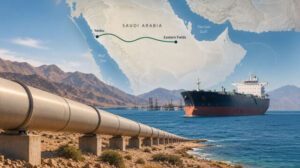
One of the factors that fueled the explosive rise in the VLCC market in recent days is beginning to change. Saudi Arabia has brought the East–West Pipeline back into operation, reopening the overland corridor through which it can transport millions of barrels of crude from its eastern fields to the Red Sea, without the cargoes having to pass through the Strait of Hormuz.
According to three sources familiar with the situation cited by Reuters, the Saudi Aramco pipeline restarted on 22 September, following the shutdown that came after the drone attacks. The system’s return is taking place gradually, as the volumes being transported remain limited for the time being.
For the international shipping market, however, the critical factor is not simply that the pipeline has resumed operations. It is how quickly Saudi Arabia will be able to increase flows towards the Red Sea. The East–West is Saudi Arabia’s main alternative to Hormuz, connecting the country’s oil-producing regions in the east with Yanbu. Through it, Riyadh can channel significant volumes of crude directly towards the western coast and from there to international markets.
The domino effect on tankers
The pipeline shutdown had caused precisely the opposite effect. With the western outlet restricted, a larger share of Saudi exports was moved towards Persian Gulf terminals. This increased the need for tankers in an area where available capacity had already been dramatically reduced because of the crisis in Hormuz. Aramco increased loadings from the eastern side of the country, while alternative transportation and ship-to-ship operations were also developed, including through Sohar in Oman. The result was the creation of additional demand for shuttle tankers and VLCCs, at a time when every available large tanker was becoming more valuable to charterers. The situation was strikingly illustrated on 20 September, when around 14 million barrels of Saudi crude were loaded onto seven VLCCs in a single day.
The return of the East–West Pipeline can now begin to reverse part of this process. The more barrels that are transported towards Yanbu, the smaller the need – theoretically – to channel additional cargoes through the Persian Gulf. And this means that part of the extraordinary demand for tankers created after the pipeline shutdown could gradually be reduced. This is not, however, a switch that changes the market from one day to the next. VLCC rates continue to be supported by the extremely limited actual availability of vessels, delays, increased exposure to war risk and, above all, the continuing disruption in Hormuz.
That is why the coming days are particularly important. If Aramco manages to significantly increase flows through the East–West, some of the VLCCs currently being used for the extraordinary handling of Saudi exports could return to the wider market. Otherwise, if the pipeline remains at low capacity for a longer period, the impact on the freight market will be limited. Its restart, therefore, does not bring the VLCC rally to an end. It does, however, remove one of the factors that sharply intensified it after mid-September. The market will now be watching not simply whether the East–West is operating, but how many barrels it manages each day to take out of the Hormuz equation.
Ask me anything
Explore related questions




