





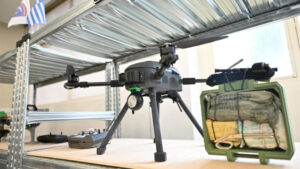
From a limited presence of unmanned systems just a few years ago, the Armed Forces are now seeking to create their own production base for drones, with the Defence Ministry’s plans providing for a significant increase in production capacity as early as the end of 2026 and a much greater scale-up by the end of the decade.
The new milestone was set by Minister of National Defence Nikos Dendias, who in a recent article said that by the end of 2026 the Defence Ministry’s factories would be able to produce 15,000 drones annually. This target concerns exclusively the production facilities of the Armed Forces and does not include the capabilities being developed in parallel by Greece’s defence innovation ecosystem.
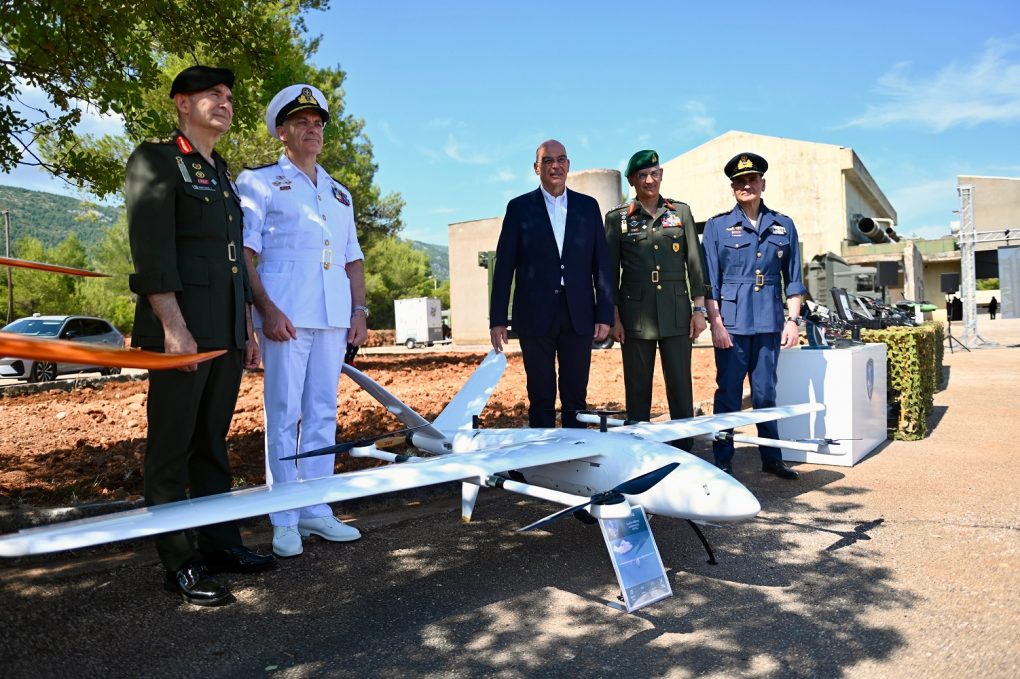
The progress made is reflected in figures presented by the minister in early September during his visit to the 316 Regional Technical Workshop in Toxotes, Xanthi. According to him, on 31 December 2023 the Armed Forces had two Israeli HERON Category III systems and 252 industrially manufactured drones. Today, the 316 in Xanthi, together with the 306 Telecommunications Base Factory in Acharnes, have already developed a production capacity of around 5,000 drones annually.
From 1,000 to 5,000 and now to 15,000
The development of the production base accelerated in 2026. In April, during his visit to the 306 EBT, Nikos Dendias referred to the expansion of the production line in Acharnes, where the Unmanned Systems Manufacturing Workshop operates, as well as to the mobile units that can manufacture, repair, configure and test drones in the field.
The next and larger step is the 309 Unmanned Systems Manufacturing Factory in Malakasa, whose foundation stone was laid on 12 June. With the completion of the new factory, according to the ministry’s plans, the total capacity of the military factories will reach 15,000 drones annually by the end of 2026.
The 309 is not being designed simply as another assembly line. The facilities in Malakasa, covering approximately 2,800 sq m, are intended to be transformed into modern production, technical and support facilities for unmanned systems, significantly expanding the production infrastructure that has begun to be developed within the Armed Forces.
The next target: More than 100,000 and then 1 million
The 15,000 drones per year at the end of 2026 do not represent the “ceiling” of the plan. Nikos Dendias has described a much greater scaling-up of production capacity, saying that from approximately 5,000 units annually, Greece could exceed 100,000 within one and a half to two years, while by the end of 2030 the plan envisages the capacity to produce more than one million drones annually.
The critical distinction is that these figures concern production capacity and not the creation of equivalent stockpiles.
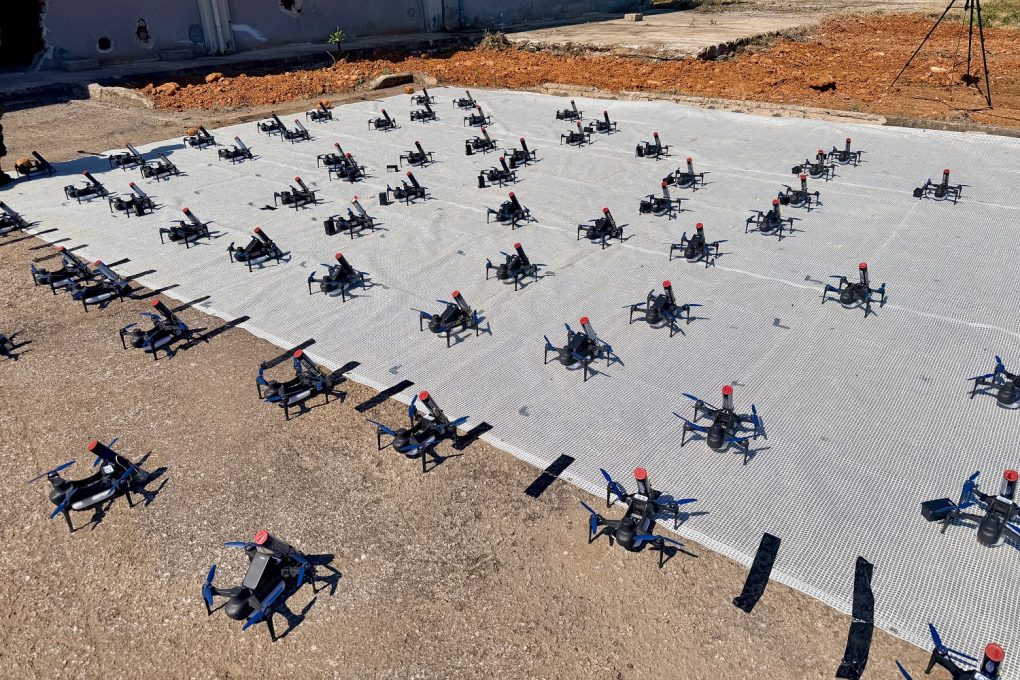
The difference in the new philosophy lies precisely in the word “capacity”. The plan does not envisage producing one million drones every year in order to build up huge stockpiles. Instead, the aim is to have the industrial and technological infrastructure capable of rapidly increasing production when required.
This approach is linked to one of the key conclusions of the war in Ukraine: small FPV drones are evolving so rapidly that storing them in large quantities for years carries the risk of technological obsolescence.
The minister himself has pointed out that even a stockpile of one million drones could become technologically outdated within two years.
“Factories” that will follow the Brigades
The Mobile Drone Manufacturing Units are also part of this approach. These are autonomous units capable of manufacturing, repairing, configuring and testing unmanned systems close to the operational theater.
The plan goes even further. As the minister has said, the aim is for every Brigade of the Hellenic Army to acquire the capability for on-site drone production, as well as to adapt their programming according to operational requirements.
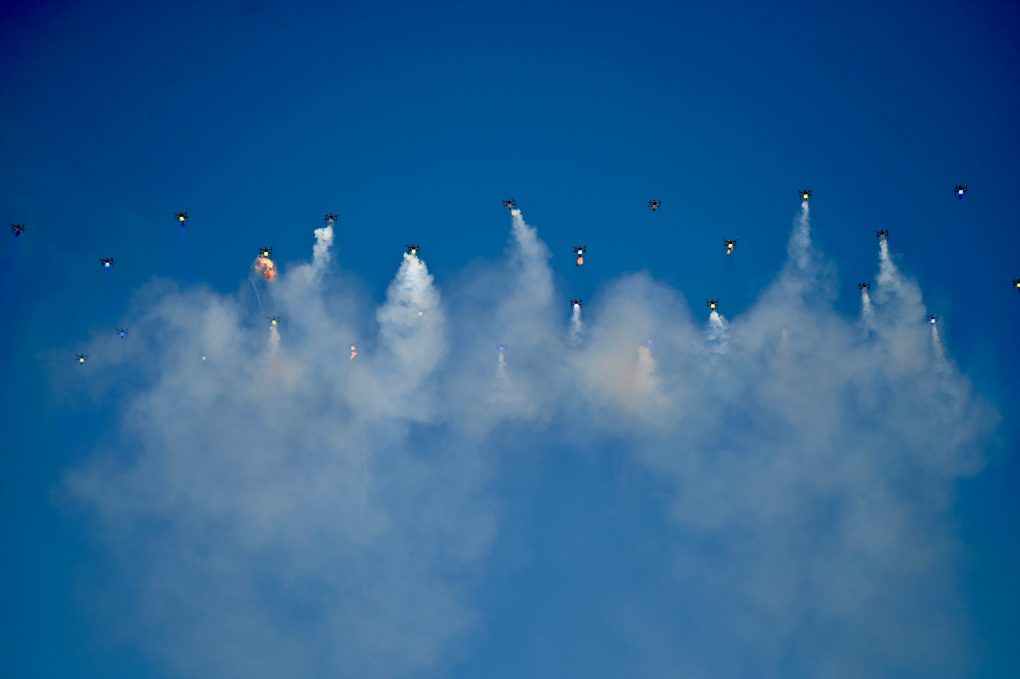
In this way, the model is shifting from the logic of centrally procuring a ready-made weapons system to a decentralised production structure that will be much closer to the end user.
Production alongside training
The second part of the plan concerns personnel. In July, the Inter-Service Training Center for Unmanned Aerial Vehicles was inaugurated in Tripoli, focusing, among other things, on training, testing new drones and anti-drone systems, and developing capabilities for surveillance, early warning and crisis management missions.
Alongside drones, the Armed Forces are also investing in the other side of the equation, namely countering unmanned systems, with Greek-developed solutions such as “KENTAVROS” and other anti-drone systems that are gradually being incorporated into the new defence architecture.
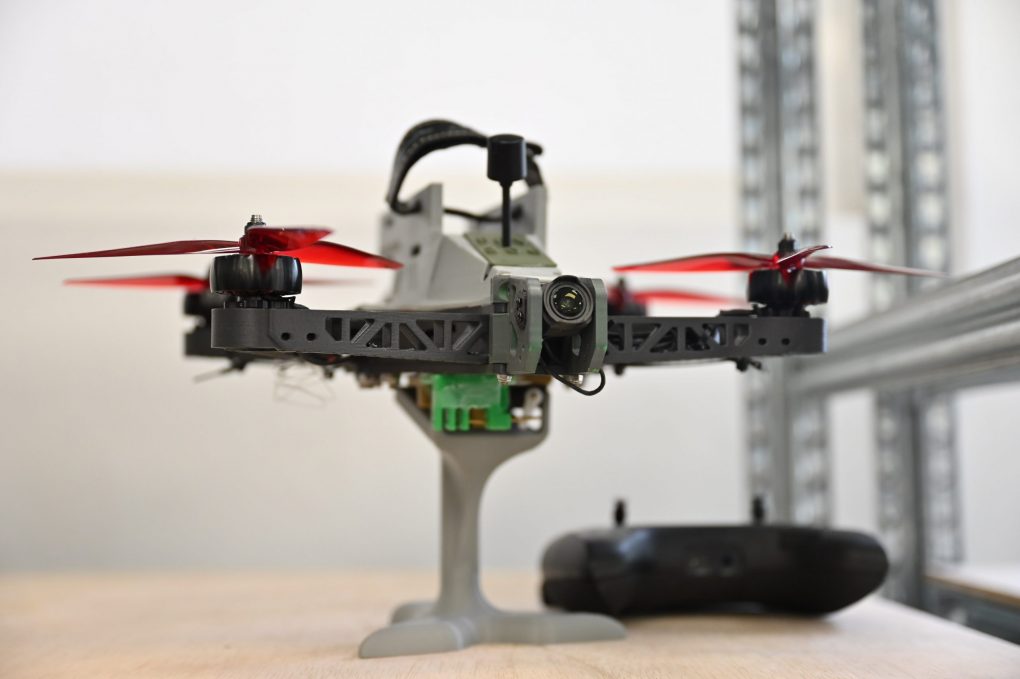
Thus, behind the figure of 15,000 drones in 2026 lies a much broader plan. The aim is not simply for the Armed Forces to acquire more unmanned systems, but to create in Greece the capacity to design, produce, program, repair and rapidly upgrade them.
And if the scaling-up outlined by the ministry is confirmed in practice, the 15,000 drones in 2026 will essentially constitute the first major step: from the approximately 5,000 units of current production capacity, to 15,000 by the end of the year, to a capacity of more than 100,000 in the coming years and, ultimately, to a production capacity that could exceed one million drones annually by the end of 2030.
Ask me anything
Explore related questions




