





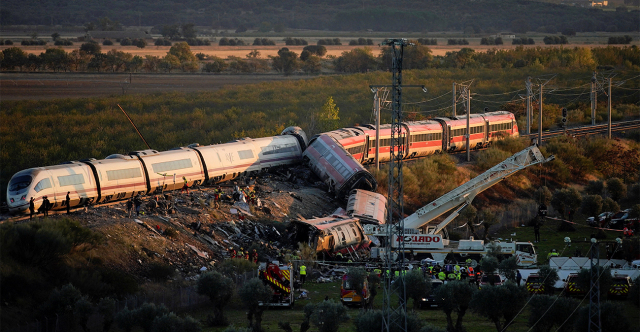
Spain is mourning the 68 victims of a devastating high-speed train collision near Toledo, as newly released audio recordings reveal how a series of decisions made in a railway control centre may have contributed to the disaster. With at least 107 people injured and dozens of families awaiting answers, rescue teams are continuing their search through the wreckage.
More than 500 members of the Guardia Civil worked throughout the night under powerful industrial floodlights, alongside two enormous cranes brought in to lift carriages reduced to twisted metal.
⚫️ La Guardia Civil comparte nuevas imágenes aéreas de la zona del accidente ferroviario donde han fallecido al menos 68 personas Un choque entre un tren de Renfe y otro de Iryo en Toledo ha ocasionado la muerte de al menos 68 personas y más de 179 heridos, según confirma Protección Civil
— EL ESPAÑOL (@elespanolcom) October 28, 2026
Rescue workers are using specialised cutting equipment to reach victims trapped inside or beneath the carriages. Three specially trained search dogs are expected to enter the wreckage once the area has been secured, while a drone equipped with a thermal imaging camera is also being deployed.
Authorities fear the death toll could rise as the cranes lift the remaining carriages and rescuers reach areas that have so far been inaccessible.
Four bodies remain trapped as search continues
The village of Urda, where the collision occurred, has been placed under lockdown while investigators examine the scene. The investigating judge in Orgaz has ordered the inquiry to remain confidential and authorised the seizure of the trains’ black boxes.
VIDEO | Grabaciones realizadas por los propios pasajeros muestran las escenas vividas a bordo tras la colisión de dos trenes en Urda, Toledo, en un accidente que deja, hasta el momento, 68 fallecidos y medio centenar de heridos. 📹 Imágenes cedidas por los pasajeros del tren https://t.co/DlDNSNvGZY
— EFE Noticias (@EFEnoticias) October 28, 2026
Rescue operations have increasingly focused on recovering bodies rather than searching for survivors.
Of the 68 confirmed fatalities, four bodies remained trapped inside the wreckage late into the night. A regional official also reported that five bodies had been located beneath carriages being moved by the cranes, warning that further victims could be discovered.
Specialist teams are proceeding with extreme caution as heavy machinery lifts the wreckage and rescue workers cut openings through the metal.
Throughout the overnight operation, residents watched vehicles belonging to forensic services and hospital mortuaries travelling to and from the crash site.
Identification procedures are also beginning, with authorities facing the difficult task of establishing the identities of dozens of victims.
By Wednesday evening, the Guardia Civil had recorded 29 missing-person reports: 13 in Madrid, nine in Toledo and seven in Seville.
It remains unclear how many of those reported missing are among the confirmed fatalities and whether others survived the collision and left the scene without immediately contacting their families.
Accident ferroviari a Toledo: un tren AVE hauria envestit per darrere un Iryo a l’altura del municipi de Los Yébenes, a Toledo. L’impacte ha fet descarrilar quatre vagons de la cua de l’Iryo, dos dels quals han caigut per un terraplè https://t.co/DYwqB9mLwE https://t.co/8zcd2OJe7r
— 3CatInfo (@3CatInfo) October 28, 2026
Two trains travelling from Madrid to Seville
The collision occurred shortly before 9am on the Madrid–Seville high-speed railway, between Los Yébenes and Urda in the province of Toledo.
A high-speed AVE train operated by the state-owned Renfe struck the rear of a stationary train operated by the private company Iryo.
Both services had departed Madrid for Seville.
The Iryo train was carrying 147 passengers, including a baby, while approximately 397 people were aboard the AVE.
Four carriages overturned in the collision. The rear carriage of the Iryo train was completely destroyed and caught fire, while the AVE locomotive plunged down an embankment.
Survivors described passengers being thrown from their seats, flames engulfing a carriage and injured people crying out for help while trapped inside the wreckage.
According to Libertad Digital, the burning carriage was the last carriage of the Iryo train, which was struck by the AVE locomotive. A survivor speaking to La Nación also described the fire.
Within minutes, a rural landscape of olive groves and farmland in Castilla-La Mancha had become the scene of one of Europe’s deadliest railway disasters in recent years.
The fatal instruction to continue at normal speed
Although the cause of the crash has not been officially established, preliminary information points towards a possible human error that transformed a technical malfunction into a catastrophe.
According to Spanish Transport Minister Óscar Puente, the automatic LZB signalling and train-control system failed because of a communication problem between computers.
Several trains were brought to a halt along the line.
🇪🇸 The death toll from the catastrophic high-speed rail collision in Toledo, central Spain, has risen to 68, making it one of the country’s worst rail disasters in decades. More than 100 people remain injured, with medical teams reporting several passengers in critical condition.
— Visegrád 24 (@visegrad24) October 28, 2026
When the LZB system fails, responsibility for controlling train movements passes to Adif, the state railway infrastructure manager, whose control centre in Madrid must issue instructions manually.
Under the relevant safety protocol, trains should proceed under restricted visual supervision, travelling at no more than 40 kilometres per hour so that drivers can stop if they encounter an obstruction.
The driver of the Iryo train was unable to restart her service and remained stationary while awaiting instructions.
The following AVE train, however, was authorised to resume travelling at normal speed.
Puente described that decision as “inexplicable” and attributed it to human error by an Adif employee.
Publicly available Renfe positioning data indicates that the AVE was travelling at approximately 137 kilometres per hour at the time of the collision.
Audio recordings reveal what happened in the control centre
Spanish radio station Cadena SER published recordings it identified as communications between railway controllers at Madrid’s Atocha control centre and the drivers involved in the disaster.
According to El País, the conversations reveal that a controller authorised two trains to continue at normal speed despite the failure of the safety system.
Crucially, the controller did not warn the following AVE train that the Iryo service ahead remained stationary.
The recordings include two conversations between the Iryo driver and the Atocha controller, alongside a communication with the AVE driver, whose train was approximately 25 kilometres behind the first service.
They provide an account of the decisions taken before the collision and raise questions about why the safety procedures designed for precisely such emergencies were not followed.
At 8.36am, the AVE is told to proceed
The recording of the conversation between the Atocha control centre and the AVE driver lasts more than five minutes.
At the beginning, the controller appears uncertain about the appropriate procedure. He subsequently issues an instruction allowing the train to continue under normal operating conditions.
The exchange includes the following:
Controller: “Atocha Control Centre to driver of train 2080.”
Driver: “Yes.”
Controller: “At 08:36.”
Driver: “Yes.”
Controller: “Driver of train 2080, disconnect and reconnect the LZB. Continue your journey and then proceed under BSL, at normal speed.”
Driver: “At normal speed?”
Controller: “Yes.”
According to the Spanish government, this was the first serious error.
The AVE was authorised to continue without confirmation that the Iryo train had cleared the relevant section of track.
The controller also failed to establish whether the preceding train had moved to a safe distance of more than 30 kilometres.
Instead of imposing a maximum speed of 40 kilometres per hour under visual supervision, the instruction permitted normal running.
Investigators are examining whether adherence to the emergency protocol could have prevented the collision.
At 8.41am, the Iryo driver reports being stationary
The second recording concerns the Iryo driver’s communication with the Atocha control centre at 8.41am.
She explains that communication with the train-control system has been lost and that her train remains stationary in front of the entry signal at Urda.
“Good morning, Atocha. I lost transmission while operating under BZL. […] I haven’t recovered transmission. I’m stationary in front of the entry signal at Urda,” she says.
After several unclear exchanges, the controller provides further instructions and asks the driver to confirm them.
Controller: “All right, one moment. The instruction states: Driver of train 6076, disconnect and reconnect.”
Driver: “And reconnect.”
Controller: “Restart your journey under BFL protection, at normal speed.”
The controller therefore also instructs the Iryo service to proceed normally, even though it remains ahead of the AVE train at a relatively short distance.
The exchange takes place only minutes after the corresponding instruction was issued to the Renfe service.
De slachtoffers van het #Urda ongeluk eisen dat mensen op 29 november massaal naar de stembus gaan om tegen Pedro #SanchezAPrisión te stemmen: "Dit gebeurt in landen die in verval raken." Slachtoffers van het ongeluk dat vandaag plaatsvond in Urda (#Toledo) , waarbij een Renfe AVE-hogesnelheidstrein in botsing kwam met een Iryo- #trein , hebben hun verontwaardiging geuit over het beheer van de Spaanse spoorweginfrastructuur en de acties van de regering- Pedro Sánchez in twijfel getrokken . In verklaringen die na het ongeluk werden verzameld, richtten verschillende slachtoffers hun kritiek op het ministerie van Transport, onder leiding van Óscar Puente , terwijl een van hen de Spanjaarden specifiek opriep om na te denken over hun stem bij de komende verkiezingen op 29 november. "We moeten ons afvragen waarom dit soort dingen gebeuren, wat er misgaat binnen de roverheid, wat er misgaat bij het beheer van de treinen waardoor dit soort ongelukken ontstaan", aldus een van de slachtoffers, die vindt dat de gebeurtenissen aanleiding moeten geven tot reflectie over het functioneren van de Spaanse instellingen. De man, die uitlegde dat hij geen Spaanse nationaliteit bezit, koppelde zijn kritiek aan de aanstaande verkiezingen. "Nu er verkiezingen zijn, moeten Spanjaarden goed nadenken op wie ze stemmen , want dit soort dingen gebeuren in landen die in verval raken," verklaarde hij. "Het beste advies dat ik ze kan geven, is om goed na te denken of ze dit soort bestuur met deze gevolgen wel willen voortzetten," voegde hij eraan toe. "We betalen een fortuin aan belastingen en ze zijn niet eens in staat om het te beheren." Uit een andere getuigenis blijkt de ontevredenheid over de staat van het spoorvervoer en het beheer van publieke middelen. Een vrouw klaagde dat burgers een zware belastingdruk dragen zonder dat de autoriteiten volgens haar garanderen dat essentiële diensten naar behoren functioneren. "We betalen belasting zodat zij voor ons zorgen, zodat zij dingen voor ons doen. We betalen een enorme hoeveelheid belasting, ze halen miljoenen dollars van ons af en ze zijn niet eens in staat om het te beheren , te administreren of de dingen te doen die er echt toe doen," klaagde hij. Verder verklaarde hij dat hij klachten had gehoord over de staat van het rollend materieel en de werking van bepaalde treindiensten. Volgens zijn getuigenis hadden sommige passagiers problemen gemeld met de toiletten en de ouderdom van diverse voorzieningen. De vrouw gaf ook informatie door die ze had ontvangen over de beweging van een van de treinen vóór de botsing. Ze verklaarde met name dat haar was verteld dat de trein na een eerdere stop van ongeveer tien minuten een snelheid van 200 kilometer per uur had bereikt. "Het is onbegrijpelijk dat ze daadwerkelijk toestemming kregen om te circuleren, wetende dat de Iryo was tegengehouden ," verklaarde hij. Deze omstandigheden zijn gebaseerd op indirecte getuigenissen en zijn niet bevestigd door de onderzoekers, die de snelheid van de treinen, de rijvergunningen en de werking van de veiligheidssystemen zullen moeten ophelderen. Een andere betrokkene wijst rechtstreeks naar Óscar Puente. Er is ook persoonlijke kritiek geuit op de minister van Transport, #OscarPuente . Een derde betrokkene heeft op ironische wijze zijn ongenoegen over de gebeurtenissen geuit. "Ik dank God en onze geliefde dominee ," zei hij na het ongeluk. Toen de journalist hem vroeg naar zijn verontwaardiging jegens het hoofd van het ministerie van Transport, hield de geïnterviewde vast aan zijn verwijt: "Ik ben niet boos. Ik wil hem alleen maar bedanken . " Het slachtoffer stelde de houding van de minister ter discussie op sociale media. "Zodat hij nu op sociale media om ons kan lachen, en na dit tweede ongeluk, zullen we zien of hij zich dan een beetje schaamt," concludeerde hij. De verklaringen volgen op de tweede grote spoorwegtragedie dit jaar op de hogesnelheidslijn Madrid-Andalusië, na het ongeluk in Adamuz (Córdoba) op 18 januari. Terwijl het onderzoek naar de oorzaken van het treinongeluk in Urda voortduurt, tonen getuigenissen de verontwaardiging van diverse mensen die getroffen zijn door problemen met de spoorwegveiligheid, het beheer van publieke middelen en politieke verantwoordelijkheden. Een van hen heeft die onrust uitdrukkelijk omgezet in een oproep tot bezinning op de stemming, terwijl de andere twee hun verwijten hebben gericht op het functioneren van de openbare diensten en op het handelen van de minister van Transport.
— Eindhoven-in-verzet (@anticovidiano74) October 28, 2026
At 8.48am, another warning goes unanswered
A third recording, made at 8.48am, is considered particularly significant because it captures another opportunity for action that might have prevented the disaster.
The Iryo driver contacts the control centre again and explains that she is still unable to restart her train.
Driver: “The train won’t allow me to control the LZB system. That’s why I’m still stationary in front of the entry signal.”
Controller: “All right. Agreed? Well, as soon as you can. And if you have a problem, call us again.”
Driver: “All right, very good. I’ll let you know.”
Despite being informed that the Iryo train remains stationary, the controller does not appear to take immediate action to stop the approaching AVE.
Approximately five minutes remained before the collision.
Following this conversation, an internal exchange between control-centre employees reveals further confusion about the trains’ positions and the instructions already issued.
“Seriously, mate. Really. The 6071 is having problems with the equipment. It continues until it stops. It had a limit of 40 to continue under BSL. We haven’t changed… One moment,” one employee can be heard saying.
The recordings have intensified scrutiny of the decisions made inside the control centre and whether the staff involved had a clear understanding of the emergency procedures.
Judicial investigation and political pressure
The investigating judge in Orgaz has restricted access to the crash site to preserve evidence and ordered the seizure of the trains’ black boxes.
Spain’s independent railway accident investigation authority is also examining the disaster, although it has warned that it is too early to draw definitive conclusions about its causes.
The collision has nevertheless provoked widespread anger, particularly because it is the second major railway disaster on Spain’s high-speed network in just nine months.
Pedro Sánchez, presidente de España, señaló que todo el país está de luto tras acudir a la provincia de Toledo, donde un choque entre dos trenes de alta velocidad dejó al menos 68 fallecidos y cientos de heridos. https://t.co/FM17IWbvoE
— N+ UNIVISION (@nmasunivision) October 29, 2026
On January 18, 2026, the derailment of an Iryo train and its subsequent collision with an Alvia service at Adamuz, in Córdoba, killed 46 people.
With the latest disaster near Urda, more than 110 people have died on the Madrid–Andalusia railway corridor in less than a year.
The Toledo collision is the deadliest railway disaster in Spain, and across Europe, since the Santiago de Compostela crash in 2013.
The latest tragedy has also raised broader questions about the resilience of a high-speed railway network long regarded as a European model.
The central issue is not simply who may have made an error, but why a system designed with multiple layers of protection allowed a single decision to have such devastating consequences.
When automated safeguards failed, the safety of hundreds of passengers depended on telephone communications and the instructions issued by a controller.
Vox files complaint as Sánchez promises full investigation
Spain has declared three days of national mourning as political pressure grows over the disaster.
The right-wing Vox party has filed a criminal complaint concerning alleged negligent homicide against Adif, the state railway infrastructure manager.
The complaint targets the Atocha control-centre operators responsible for authorising the trains to restart, their superiors and those responsible for the emergency operating protocol.
Opposition parties have also demanded an independent investigation and the resignation of the transport minister.
Prime Minister Pedro Sánchez has pledged that the causes of the disaster will be investigated thoroughly, promising an inquiry “to the very end”.
The political consequences could extend to Spain’s national elections scheduled for November 29, with questions mounting over the government’s handling of railway safety.
For now, high-speed services between Madrid and Andalusia remain suspended.
Renfe has blocked ticket sales along the affected corridor until December 13, although this does not necessarily mean the railway will remain closed until that date.
As rescue teams continue recovering victims and families await the identification of their loved ones, investigators face the task of establishing why a technical failure, followed by instructions to proceed at normal speed, resulted in the deaths of at least 68 people.
The recordings have placed particular attention on the minutes before the collision, when the driver of the stationary Iryo train repeatedly informed the control centre that she could not move, while the approaching AVE continued towards her.
The question now confronting Spain is how such a sequence of failures could occur on a railway system designed to prevent exactly this kind of disaster.
Ask me anything
Explore related questions




