





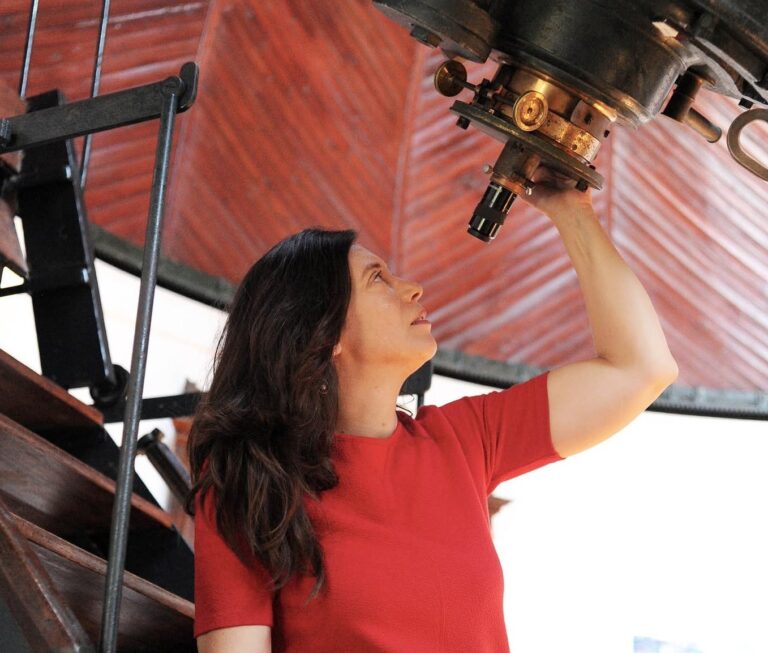
The National Observatory of Athens announced that Dr. Fiori-Anastasia Metallinou, an astrophysicist and research scientist at the Observatory’s Institute for Astronomy, Astrophysics, Space Applications and Remote Sensing, has been selected to join the support team for the Greek astronaut mission at the European Space Agency (ESA).
According to the relevant Facebook post:
“Within the framework of her new role, Dr. Metallinou will be responsible for supporting communications for the first Greek mission to the International Space Station (ISS), both during its preparation and throughout its implementation.
“During her term, she will contribute to promoting and informing the public about the work of Dr. Adrianos Golemis, who is expected to travel to the International Space Station in 2027. His mission will include conducting scientific experiments proposed by Greek and European scientific centres and organisations.
“Dr. Metallinou’s selection for this important role is a particular honour for the Institute for Astronomy, Astrophysics, Space Applications and Remote Sensing (IAASARS) and the Visitor Centres of the National Observatory of Athens, where she has developed and applied her knowledge and skills in science communication, making a substantial contribution to disseminating scientific knowledge and familiarising the public with astronomy and space sciences.
“We wish Dr. Fiori-Anastasia Metallinou every success in her new duties at ESA’s European Astronaut Centre in Cologne, Germany, and look forward to her contribution to highlighting this important undertaking for Greece.”
For her part, she stated on Facebook:
“My selection to contribute to communications for the first Greek mission to the International Space Station (ISS) is a great honour and responsibility. […] I can’t wait to start working at the European Astronaut Centre in Cologne, Germany, on the new mission!”
In an earlier interview with Marie Claire, she had spoken, among other things, about her first encounter with the magic of astrophysics:
“One evening, while I was still a schoolgirl, I was surprised to realise that, since starlight takes years to reach Earth, when we observe the sky, we are looking into the past. That was a moment of personal revelation. It was then that I began to understand the complex subject of space and time.
“Later, my systematic studies of astronomy taught me that nature often reveals itself to be more spectacular than our imagination. Stars that rotate around themselves in milliseconds (pulsars), galaxies moving towards one another, supermassive black holes, or planets continually being discovered outside our own Solar System still seem exotic to me. When I compare these phenomena with the conditions prevailing here on Earth, I feel such gratitude that I have the good fortune to exist, to evolve and to observe the world from this planet.”
Ask me anything
Explore related questions




