





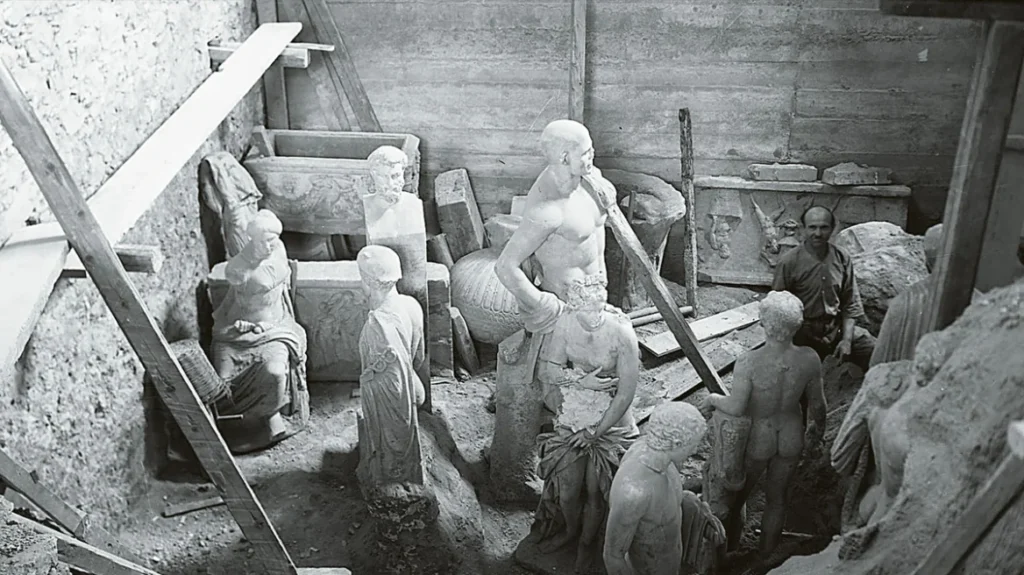
One glance at the photograph from the dramatic days of the winter of 1940 is enough to capture, in the most undeniable way, the paradoxical, almost metaphysical nature of History: ancient statues, taken down from their pedestals, stand inside the National Archaeological Museum, ready to return to the earth from which they had been unearthed centuries earlier, in order to be saved from an impending catastrophe.
It is as though the ancient gods, the marble youths and the bronze heroes, having already traveled the long journey from antiquity to the postwar world, were being forced to descend into Hades for a second time – this time with the invaluable assistance of the very people who had devoted their lives to bringing them into the light.
An act of resistance
For during those first, extremely dramatic weeks of 1940, Greece was not only facing the evil that descended upon it with the German occupation, but also the threat of destruction and bombing, which spread like a dark shadow over its people and its treasures. Consequently, just a few days after October 28, 1940, the Archaeological Directorate of the Ministry of Education issued special technical instructions for safeguarding museum exhibits, and an unprecedented operation began unfolding behind the closed doors of the National Archaeological Museum.
Archaeologists, conservators, craftsmen and other employees undertook the task of dismantling the Museum’s entire exhibition space, packing smaller objects into crates and burying the large sculptures in specially dug trenches, covering them with protective materials and sand. It was almost an inversion of the archaeological process, a symbolic undoing of the excavation: instead of bringing antiquities to light, the scientists were burying them, removing them from public view, having realised that the survival of cultural memory sometimes requires its temporary disappearance under certain historical circumstances. Semni Karouzou, curator of the Collection of Vases and Minor Arts, would later describe those days in deeply moving detail, recalling how the staff gathered at the Museum very early, before the moonlight had even faded, and returned home only after night had fallen.
Her account, published in the proceedings of the first conference of the Association of Greek Archaeologists, conveys both the physical exhaustion and the collective self-sacrifice of those who worked for months to complete the concealment operation:
“The sculptures were stored according to their importance, either inside crates or directly in the ground. Quite a few important statues were transferred to natural hiding places in Athens in order to avoid concentrating them all in one location. Before being buried, the large bronze statues were covered with black tar paper; the crates were coated with tar, inside and out, as a necessary precaution against moisture. All the small bronzes were photographed before being packed into crates,” she wrote.
Thus, by the time German troops entered Athens on April 27, 1941, the operation had essentially been completed. The halls were empty, the most important exhibits were out of sight, and Greece’s archaeological wealth appeared to have been protected, at least from the immediate threat of looting. At the centre of this operation was Christos Karouzos, director of the National Archaeological Museum and one of the most important figures in Greek archaeology. Together with his wife, Semni, he would come to define his scientific vocation through a profound sense of historical and moral responsibility.
Their stance towards the occupation authorities was categorical from the outset. The day after the Germans entered Athens, the two archaeologists resigned their membership of the German Archaeological Institute, rejecting the idea that their longstanding scientific relations could remain unaffected under military occupation.
Karouzos returned to the issue after Liberation, in an interview he gave in June 1945 to the magazine Elefthera Grammata (“Free Letters”), describing the pressure exerted by German archaeologists to reopen the museums. According to his account, the arguments changed depending on the circumstances: at times, they claimed that the war was essentially over; at others, they invoked the supposed need to offer people, amid widespread misery, the consolation of art.
Karouzos, a far-sighted man and a scientist of great strength of character, had recognised that behind the distinguished archaeologists, whose scientific work he appreciated and respected, stood a military power that, in practice, would act against rather than in favour of archaeological culture and heritage. The conflict became even more concrete in June 1941, when the German archaeologist Hans-Ulrich von Schoenebeck, head of the German department responsible for the protection of monuments and works of art, demanded that the National Archaeological Museum reopen.
The German authorities even drew up a list of 103 statues they wanted to put on display, including the bronze god from Artemision, the Antikythera Ephebe and the Marathon Ephebe. Karouzos refused to comply, knowing that he had not only a scientific duty but also a humanitarian one towards the enormous heritage he had been entrusted with protecting. This moral dimension is precisely reflected in his admission during the 1945 interview that the Germans had attempted to win over their Greek colleagues through seemingly innocent initiatives. He pointed out that “for many years [the Institute] had ceased to have anything to do with science.”
The German archaeologists
Opposite Karouzos and his Greek colleagues, a different camp ultimately emerged: the world of the German archaeological presence in Greece, which, however, had begun as early as the 19th century and had made a decisive contribution to the study of ancient Greece. Although the German Archaeological Institute was one of the country’s most important scientific institutions, directly associated with excavations, publications and internationally renowned research programmes, it could not remain unaffected by the rise of National Socialism and the subsequent occupation regime.
After the German troops withdrew in 1944, the building of the German Archaeological Institute came under Greek administration, a situation that would last until 1951. As part of the seizure, archaeological objects, documents and photographic material were transferred to the National Archaeological Museum, while further material was confiscated from Brente’s residence in Filothei in the summer of 1945.
Most of these seemingly inexhaustible treasures, however, would remain in the Museum’s storerooms for decades, like a second, lesser-known archaeological burial – no longer because of the threat of war, but as a result of complicated postwar administrative procedures. Among the confiscated items were approximately 1,000 antiquities, mainly pottery fragments, as well as coins now kept at the Numismatic Museum.
The archival material includes archaeological notes, drawings, manuscripts, photographs and correspondence – evidence that allows researchers today to reconstruct not only the history of the objects, but also the personal journeys of the people who handled them.
Karouzos’s postwar stance is of particular interest. Despite his categorical opposition to the occupation authorities, he defended the importance of preserving scientific collections and the information accompanying archaeological objects. His position reveals the distinction he drew between condemning an institution’s political choices and recognising the need to protect the scientific material itself.
The white-ground lekythos
This multilayered and often contradictory history is brought to light by the exhibition “A Divided Past – Greek-German Relations in Dark Times”, which opened on October 12, 2026, and is being presented simultaneously at the National Archaeological Museum and the German Archaeological Institute until January 31, 2027.
The timing, marking the anniversary of the Liberation of Athens and the forthcoming celebration of the heroic “No” to the invaders, is no coincidence. The exhibition confronts the troubled relationship between archaeological research and occupying power, the management of cultural property and postwar claims.
An illustrative and particularly vivid example is an Attic white-ground lekythos, with its delicate relief scenes. It tells the story of its association with archaeological collections during the interwar period, the German occupation and the subsequent confiscation of the German Archaeological Institute’s property immediately after the War. Two photographs from 1927 and 1929, found in the German Archaeological Institute’s photographic archives, made it possible to identify the vase and establish that it was among the objects that had come into the possession of the Institute’s then director, Ernst Buschor.
The exhibition’s narrative unfolds through a selection of antiquities, photographs, documents and catalogues. It traces the relationship between the two archaeological institutions, the concealment of the exhibits in 1940–1941, the period of the Occupation, the confiscation of 1944 and the contemporary effort to investigate the archives.
At the German Archaeological Institute, the exhibition continues in the foyer and library, in the very spaces where some of the events it recounts took place. There, archaeological fragments, historical documents and research case studies shed light on how the collection was assembled and on the different paths taken by its objects.
The exhibition is the result of a joint research programme carried out between 2024 and 2026, which seeks to reconstruct the history of the confiscation and investigate how relations between the two institutions developed under difficult historical circumstances. The collaboration thus acquires particular symbolic significance, as it seeks to establish a shared space for scientific research and critical engagement with the past, moving beyond the obvious points of conflict and the dark period of the Occupation to focus on their common scientific interest in the world of antiquity.
Perseverance
The story, however, has another, lesser-known chapter. In December 1944, during the December events, the building of the National Archaeological Museum sustained serious damage. Semni Karouzou recalled that bombs struck the wooden roof of the old building, but did not reach the ancient marble sculptures, which remained protected deep beneath the earth.
Their actual return to the light would take place gradually after the war. In 1947, the Museum’s first three galleries reopened in the new wing, with an entrance from Tositsa Street. Among the works on display was the Aristodikos Kouros. Even amid the turmoil of the postwar period, Christos Karouzos would persist in insisting on the need to restore the Museum’s function as a place of public education and scientific research.
The return of the antiquities to the galleries was not simply the restoration of normal museum operations. It was also a symbolic reconnection of the country with its historical past, following a dark period of great risk and trial.
Ask me anything
Explore related questions




