





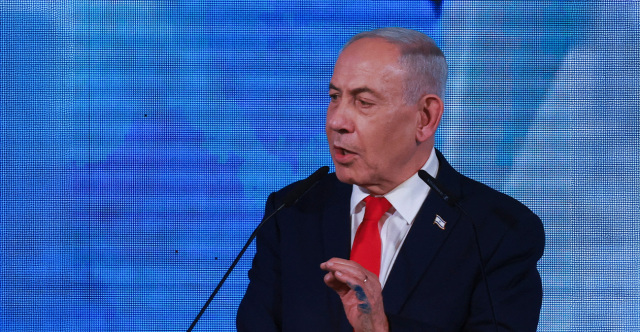
Israeli Prime Minister Benjamin Netanyahu is continuing his confrontation with the opposition in particularly forceful terms, attacking the Arab parties and calling for the formation of a national unity government under Likud leadership.
Netanyahu specifically called on the parties of the national camp and the other Zionist political forces to join a broad-based government led by his party. “There is a government that can meet this challenge: a broad national government under Likud leadership, with me at its head, in which all the forces of the national camp and all Zionist parties that wish to join will participate,” he said.
With Israeli President Isaac Herzog having announced that he would reveal his decision tomorrow, Sunday, on which political leader he will ask to form a government, Netanyahu warned that a government dependent on the support of Arab parties, which he describes as “supporters of terrorism”, would threaten the country’s security and unity.
“Not only would such a government be unable to fight our enemies, it would tear us apart from within,” Netanyahu said, adding that “our very existence is at stake”.
Netanyahu’s intervention comes at a particularly critical moment. His bloc holds 53 seats in the Knesset, leaving it eight short of the 61 seats required for a majority. The Jewish opposition parties have 48 seats, while the Arab parties hold a total of 19, making them a decisive factor in determining the balance of parliamentary power.
Gadi Eisenkot has secured the support of 67 lawmakers to receive the mandate to form a government. However, this support does not automatically translate into the ability to establish a stable governing coalition. He has ruled out including the Arab parties in his government, significantly limiting his available options.
Netanyahu remains caretaker prime minister until a new government is formed, while the prospect of prolonged political uncertainty remains.
In his latest remarks, the Israeli prime minister linked domestic political developments to the threats that, he argues, the country faces from Iran and its allies. “Radical Islam is the challenge that is tearing countries apart in Europe today. It is the challenge that threatens us, too. It threatens us from outside, through Iran and its allies, and from within, through Islamist parties that support terrorism,” he said.
He accused the Arab parties of seeking to undermine the Jewish character of the state and its ability to defend itself, arguing that a government dependent on them would be unable to deal effectively with external threats.
He also accused opposition leaders of placing their personal and party interests above the national interest in their pursuit of a minority government.
Netanyahu’s strategy
Of particular interest is the fact that, in his latest intervention, Netanyahu insists that all his previous coalition partners must be included in the government, including the far-right and ultra-Orthodox parties.
By taking this position, he is seeking to keep his political camp united while simultaneously setting conditions that make it harder for his opponents to reach an agreement. His proposal does not necessarily represent a retreat from his bid to retain power; rather, it could serve as a means of putting pressure on the other political forces.
Even more striking is his warning of the risk of civil conflict if a government is formed with the support of the Arab parties. The reference sharply raises the temperature of the political confrontation and highlights the depth of the divisions caused by the election.
In essence, Netanyahu is seeking to shift the focus of the debate away from parliamentary arithmetic and towards the legitimacy of a potential government that would rely on the votes of the Arab parties. At the same time, he aims to increase the political cost for Eisenkot and reduce the prospects of an agreement between the different opposition forces.
The next decisive step is expected on Sunday, 8 November, when Israeli President Isaac Herzog must decide whom to appoint to form a government.
The decision will mark the beginning of the next phase of negotiations, but it will not necessarily guarantee an end to the political deadlock. Netanyahu will remain prime minister until a new government is formed, while the inability of either camp to secure a parliamentary majority leaves open even the possibility of another election.
Ask me anything
Explore related questions




