





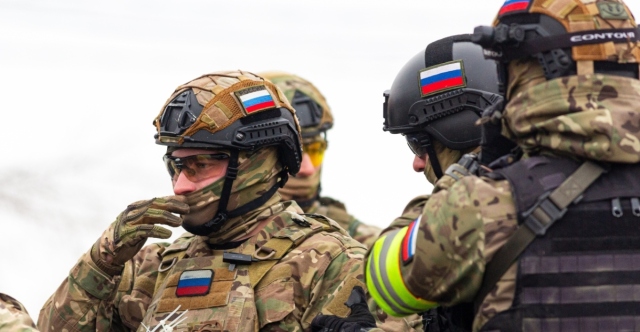
The large number of Russian soldiers killed on the Ukrainian front since February 2022, when Putin’s invasion began, has now been confirmed by data also held by Moscow. Specifically, nearly 400,000 Russians have lost their lives in the war, according to confidential data from Russia’s state statistics service, Rosstat, obtained and analysed by Bloomberg. The data, drawn from more than 11 million death certificates, reveal the true scale of the losses that the Kremlin has systematically sought to keep out of the public eye, while documenting the increasingly severe consequences of the war for Russian society.
The files came into the possession of the Belarusian opposition hacker group Cyber Partisans and the Ukrainian group Silent Crow, which subsequently shared them with Bloomberg.
According to the analysis, from 24 February 2022 to the end of August 2026, nearly 392,700 death certificates explicitly link the loss of life to the war in Ukraine.
The connection arises either from the official coding of causes of death or from descriptions in the relevant documents, which include references to a “military operation”, “shelling” and “unmanned aircraft”.
The true death toll may be even higher
The data are believed to understate the true number of Russians killed in the war, as recording deaths under combat conditions presents serious difficulties.
Some soldiers have been reported missing, others have not been identified, while there are also cases of people who succumbed months later to injuries sustained at the front, without the link to the war being explicitly recorded on their death certificates. In addition, some losses may have been entered under unrelated categories or may not have been recorded at all.
Silent Crow puts the death toll at around 450,000, as its own calculations also include deaths not directly linked to military operations, as well as records in which no specific cause of death is given.
Putin keeps Russian military losses secret
Vladimir Putin has made significant efforts to avoid the disclosure of the true number of Russians who have lost their lives in Ukraine.
As early as 2015, the Russian president classified as a state secret military losses occurring “in peacetime during special operations”, as well as those occurring during periods of war.
Moscow has not officially released figures on its losses since the first months of the invasion. At the same time, Rosstat gradually restricted the publication of a range of statistical data after February 2022, making this particular leak especially significant.
The data show that the number of deaths rose dramatically after the first months of the conflict, when Russian forces became bogged down in eastern Ukraine and Ukrainian defensive operations began to become increasingly effective.
Record 54,000 killed and seriously wounded in October
Separate information indicates that this year’s fighting has proved even bloodier for Russia, with less territorial progress compared with 2025 and mounting human losses.
According to Ukrainian and Western intelligence services, Russian forces suffered a record 54,000 casualties in October, with the soldiers either killed or seriously wounded.
On the Ukrainian side, Volodymyr Zelensky told French media in February that at least 55,000 Ukrainian soldiers had been killed in the war, while a large number of people remained missing.
As Russia has failed to make significant territorial gains during 2026, it has altered its tactics, launching extensive bombardments against Ukrainian cities and critical infrastructure in an effort to break Kyiv’s morale and resilience.
At the same time, the Kremlin is seeking to persuade the United States to pressure Ukraine into ceding additional territory as a condition for ending the war.
Officials from Russia, Ukraine and the United States are expected to meet in Abu Dhabi this week to discuss the terms of a possible ceasefire.
How the hackers gained access to the confidential data
On 1 November, Silent Crow and Cyber Partisans announced that they had breached Rosstat’s internal infrastructure.
According to their claims, they gained access to approximately 25,000 computers and managed to extract around 23 terabytes of data, including information on Russia’s military losses.
A few days later, Russia’s state statistics service confirmed that it had detected targeted cyberattacks against its systems between 29 October and 1 November. However, it maintained that it had found no evidence that its databases had been compromised or that confidential information had been leaked.
Rosstat also announced that it was working to restore its systems, as the attack had taken parts of its technological infrastructure offline.
Independent estimates of Russian losses
People familiar with the situation within the Russian armed forces told Bloomberg, on condition of anonymity, that the estimate of around 400,000 dead was realistic.
The figure is also close to other independent estimates.
The casualty-tracking project run by independent Russian outlet Mediazona and the BBC’s Russian service had identified 285,881 dead by name by November 2026.
A separate estimate by Mediazona and Meduza, based on Russia’s register of inheritance cases, puts the number of dead at around 352,000 by December 2025. This calculation does not include fighters from occupied Ukrainian territories.
For its part, Ukraine’s General Staff maintains that Russia has suffered a total of 1.6 million casualties, including those killed and seriously wounded, since the start of the war.
The risk of a new mobilisation in Russia
Rosstat’s data record nearly 37,800 military deaths during 2026. However, the figure is considered almost certain to be lower than the actual number, as in many cases several months pass before a death is officially registered.
More than half of the recorded deaths in 2026 occurred in eastern Ukraine, where Russian forces are facing major difficulties in their efforts to break through some of the strongest Ukrainian defensive fortifications.
With monthly losses often exceeding the number of new recruits and Russia’s advance remaining limited, Moscow may soon need to move towards a more aggressive mobilisation.
The Kremlin has already created the necessary digital infrastructure to issue military call-up notices, while restricting the means of escape available to those who do not wish to fight.
Moreover, the 2022 decree on partial mobilisation has never been formally revoked. This means that the Russian authorities could call up additional reservists without having to announce a new mobilisation.
To attract new soldiers, Russia has introduced substantial enlistment bonuses and additional benefits. However, some of these payments are now being cut as the country’s public finances come under increasing pressure.
The heaviest losses in the poorest regions
The statistics examined by Bloomberg, covering the period from 2021 to the end of August 2026, also illustrate how the war has affected different social and age groups across Russia.
The army that invaded Ukraine in February 2022 consisted largely of younger men. Gradually, however, Moscow began drawing manpower from increasingly older age groups.
At the same time, Russia’s poorer, more remote and ethnically diverse regions have borne a disproportionately large share of the losses, while residents of the country’s major urban centres appear to have been shielded to some extent.
The figures are revealing. During the first half of 2022, just 146 men aged between 50 and 59 died from causes linked to the war, accounting for less than 1% of all deaths in that particular age group.
By the first half of 2025, that number had surged to more than 12,600 deaths, representing more than 16% of all deaths among Russian men aged between 50 and 59.
The picture was even more dramatic for younger people. Among those aged 18 to 29, the war accounted for around two-thirds of all deaths during the same half of 2025.
One in three young men who died in Siberian regions was killed in the war
In remote areas of Siberia, such as the republics of Buryatia and Tuva, as well as Zabaykalsky Krai, which border Mongolia, losses were particularly high.
Around one-third of men aged 18 to 49 who died in these regions from the start of the invasion until mid-2024 were recorded as having lost their lives because of the war. In Moscow and St Petersburg, by contrast, the corresponding figure was around one in ten.
The disparity highlights the unequal distribution of the conflict’s human cost, with remote and economically weaker regions recording a far higher proportion of war-related deaths than major urban centres.
How reliable are the leaked data?
Bloomberg makes clear that it was not possible to independently verify the authenticity of the entire database using cryptographic methods.
However, an examination of the metadata showed that the files had characteristics consistent with a genuine data export, with no signs of fabrication or tampering detected.
In addition, the data correspond very closely with the official death figures published by the Russian government for the period from 2021 to 2023.
2023 was the last year for which Rosstat published final annual statistical data. According to Bloomberg’s comparison, the discrepancy between total deaths in the leaked database and the official records was just 0.1% for 2021 and 0.2% for 2022. The largest difference was found in 2023, when the deaths included in the leaked files were around 1% higher than those officially reported by Rosstat.
Thousands of deaths among young men appear to have been missing from that year’s official statistics, probably in part because the registration of war casualties can be delayed for months.
Ask me anything
Explore related questions




