





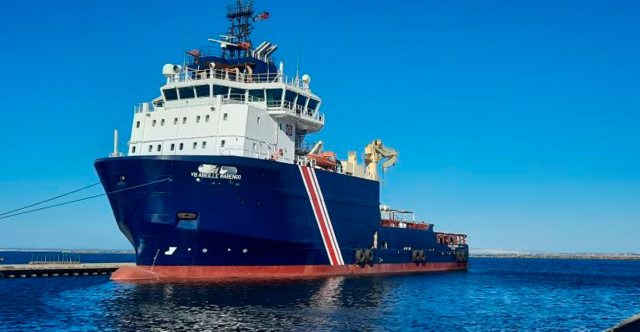
After a slight delay, the research vessel Abeille Marengo is expected to depart from the port of Heraklion on Wednesday, according to sources at its operating company, heading towards international waters southeast of Karpathos. It is there that the effectiveness of the understanding reached between France and the Turkish government will be tested, as efforts get under way to ensure that surveys for the Crete-Cyprus electricity interconnector can proceed without obstruction.
After leaving Heraklion, the vessel will carry out a calibration test to check and calibrate its sensors and measurement systems while sailing in territorial waters. The procedure takes approximately 24 hours, after which the vessel will head towards the survey area.
The delay, initially attributed to weather conditions, also appears to be linked to the completion of delicate diplomatic manoeuvres that have been under way in recent days, based on the French formula. Meanwhile, there has been no official reaction from the Turkish government beyond the reassuring but enigmatic statement made by Turkish Foreign Minister Hakan Fidan.
For Athens, where the resumption of surveys also carries considerable political significance, the priority is to ensure that any French communication with Ankara, intended to reassure the Turkish side and facilitate the unobstructed start of operations, leaves no room for ambiguity. The first step has already been taken, with Nexans submitting its request exclusively to Greece and Cyprus, which subsequently issued NAVTEX notices covering the vessel’s survey operations along the entire cable route, from Crete to Cyprus.
Although the full contents of the French note verbale to Ankara are not known, information points to two key provisions: an explicit statement that the communication does not constitute a request for authorisation to conduct surveys, and a clarification that the French position neither addresses nor prejudges claims concerning maritime zones.
According to the Greek side, these provisions safeguard Greece’s position by preventing the note verbale from being invoked as a legal argument to legitimise Turkish demands and claims, or from being presented as a French request for authorisation.
It is also stressed that documents of this nature, including a note verbale, neither carry the legal force nor contain the substance necessary to establish maritime zones or sovereign rights. Nor can they prejudge future maritime delimitations, as they concern practical arrangements, including those relating to navigational safety.
Nevertheless, officials in Athens remain cautious. Until the vessel reaches the disputed area of international waters southeast of Karpathos, there is no certainty that Turkey will refrain from exploiting the situation to press for clearer wording concerning its claims or to demand other concessions from France.
Possibility of a new Turkish NAVTEX
Sources familiar with the consultations nevertheless insist that the most likely scenario is for tensions to be avoided, with Turkey potentially issuing what Athens would regard as an illegal and irregular NAVTEX incorporating the coordinates already included in the Greek notice issued on Friday. Ankara could then claim that the surveys are taking place with its own authorisation and consent. Such a move, however, would neither establish a precedent nor legitimise Turkey’s claims, according to the same source, and would be met with a Greek counter-NAVTEX invalidating the Turkish notice.
The period between the issuance of the NAVTEX and the vessel’s departure nevertheless carries risks, partly because of pressure on the Turkish government following coverage in Turkish media of the public debate taking place in Greece. Even before the vessel has set sail, both triumphalist and alarmist scenarios and commentary have emerged, making the task considerably more difficult for those handling the sensitive diplomatic negotiations.
Athens is also keen to avoid any further delay, believing that this week offers favourable circumstances because the major UN Climate Change Conference, COP31, is taking place in Antalya, attended by numerous foreign leaders and government representatives. Greek officials believe the occasion could discourage any attempt to provoke tensions in the Eastern Mediterranean over a project with significant environmental implications, particularly one involving an EU member state.
Ask me anything
Explore related questions




