




Thousands of flats remain unused while rents soar, students struggle to pursue their studies and workers search for accommodation in tiny properties, often lacking even basic amenities.
Why do so many homes remain empty, and what could change to improve the housing crisis? The problem is not simply a shortage of affordable housing on the market, but also the fact that hundreds of thousands of existing properties remain outside it.
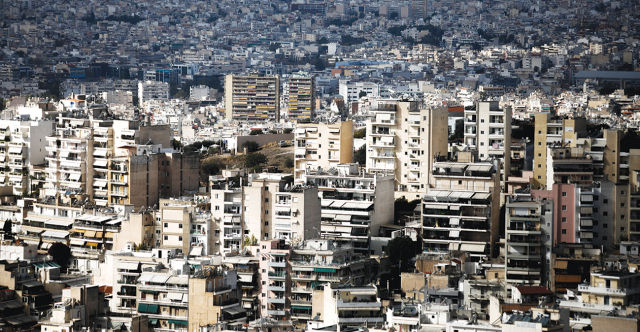
At a time when someone earning the minimum wage struggles to rent even a small flat, approximately 794,000 homes across Greece are recorded as vacant. More than 117,000 are located in the Municipality of Athens alone, while tens of thousands have no electricity supply.
The problem is also linked to a vast stock of residential properties that remains unused, either because they require expensive repairs, because of unresolved ownership issues or because their owners are unwilling to put them on the market. As these properties remain empty, demand is concentrated on the homes available to rent, driving up landlords’ asking prices and limiting tenants’ options.
Homes without heating
The reality is reflected in property listings. For monthly rents of around €850 to €900, roughly equivalent to a low monthly salary, prospective tenants may find themselves looking at properties more than 50 years old, without heating, adequate insulation or protection against damp. Those seeking something significantly cheaper often face a choice between extremely limited living space and serious deficiencies.
The housing crisis affects the daily lives of workers, families and students, restricts their financial independence and, in some cases, even determines whether young people can study away from home.
According to listings on property platforms, the average asking rent in Athens for homes of up to 80 square metres has reached €12.70 per square metre. In 2019, asking prices for comparable properties in neighbourhoods such as Kypseli and Patissia started at €6 to €6.50 per square metre.
This indicative comparison illustrates the sharp increase, although it does not mean that every neighbourhood or category of property has experienced the same rate of growth. At today’s average asking price, a 60 sq m property costs approximately €762 a month. That is almost the entire net minimum wage, based on the €772 figure used in this comparison. And that covers rent alone, excluding building maintenance charges, electricity, heating, food and other essential living expenses.
In Kypseli, where approximately one in four homes was vacant according to the 2021 census, a fourth-floor flat measuring just 12 square metres is being advertised for rent at €280 a month.
The listing even states that the property has one bedroom. Its total floor area is approximately the size of a parking space. At €23.33 per square metre, its asking rent is higher than the average for small flats in the affluent southern suburb of Voula, where the figure stands at €19.49. Nevertheless, the monthly rent comes relatively close to the traditional benchmark of spending around one-third of income on housing. It accounts for 36% of a net monthly wage of €772.
In other neighbourhoods, properties may offer more space, but not necessarily better amenities. In Nea Smyrni, a 69 sq m flat built in 1969 is being offered without heating or parking, while its old wooden window frames raise reasonable questions about its thermal insulation.
In Marousi, prospective tenants can find a renovated 60 sq m ground-floor property in a building dating from the 1950s. Even among cheaper options, the relationship between price and quality remains problematic. In Amerikis Square, a listing offered a 40 sq m ground-floor flat for €650, describing it as “luxuriously and fully renovated”.
That amount represents 84% of a €772 net monthly wage, leaving just €122 for all other monthly expenses. In Kypseli, a 23 sq m studio flat on the mezzanine floor of a building dating from 1970 is being offered for €420. In a 2025 listing in Ano Kypseli, a 35 sq m first-floor flat, renovated in 2020, had an asking rent of €380.
The listing stated “No heating”, while the property’s energy efficiency rating was G. In September, other flats advertised in Kypseli included a 29 sq m property for €350 and a 45 sq m property for €370. These represent the lower end of this particular market, where much of the demand comes from people with limited financial resources.
The cost of renting goes beyond the monthly payment
The financial obstacle, however, extends beyond the monthly rent. In many cases, landlords impose strict conditions, refusing tenants with children or pets, or those who smoke. Others demand advance payments equivalent to three to five months’ rent, often accompanied by an estate agent’s fee, often equal to another month’s rent. Moving into a property can therefore require an upfront payment equivalent to several months’ wages, sometimes six months or more.
One of the most serious social consequences of the housing crisis concerns students and their families. For thousands of young people admitted to universities away from their hometowns, the cost of accommodation has become a second major financial challenge following Greece’s nationwide university entrance examinations.
According to a 2026 rental price table, a 35 sq m studio in central Athens costs an estimated €440 a month, while a 50 sq m one-bedroom flat costs €630. In Zografou, near the University of Athens campus, the corresponding figures are €420 and €590. In some cases, financial difficulties even lead students to postpone or abandon their studies.
According to an Alpha Bank study, Greece has approximately 794,000 vacant homes. When holiday properties and secondary residences are included, the proportion of properties not used as primary residences approaches 35% of the country’s total housing stock, the third-highest rate in the European Union. The two categories, however, should not be confused.
A holiday home used seasonally is not necessarily available for long-term rental, and not every vacant flat can be occupied immediately. Nevertheless, the scale of the unused housing stock makes bringing these properties back into use a crucial part of tackling the crisis.
Attica accounts for 255,298 vacant homes, roughly one-third of the national total. In the Municipality of Athens, the 2021 census recorded 117,137 vacant properties, representing 26.8% of its housing stock. In other words, more than one in four homes in the capital was unoccupied at the time of the census.
In the Municipality of Zografou, where demand for student accommodation is particularly strong, there were 9,706 vacant homes, representing 21.6% of the total. Piraeus recorded 21,712 vacant homes, Peristeri 13,212 and Kallithea 13,093. Their distribution, however, is far from uniform. In Vrilissia, the vacancy rate is just 9%, while in Agia Paraskevi it stands at 10.2%.
By contrast, higher vacancy rates are recorded in lower- and middle-income neighbourhoods, precisely where financially vulnerable tenants are seeking accommodation. On the one hand, small flats without heating are offered at rents disproportionate to incomes. On the other, thousands of homes in the same or neighbouring areas remain off the market.
Of the approximately 120,000 vacant homes in the Municipality of Athens, an estimated 38,000 are not connected to the electricity network. The absence of an electricity connection does not, in itself, mean that a property is unfit for habitation.
In many cases, however, it is associated with long-term abandonment, serious deterioration or other unresolved issues that complicate a property’s return to the market. Some homes require extensive renovation, others are subject to seizure proceedings, while others remain empty because heirs cannot agree on how to use them.
Deteriorating housing stock
An earlier estimate by the National Bank of Greece put the number of homes that had deteriorated to the point of being uninhabitable without substantial intervention at approximately 250,000.
The same estimate links this situation to a €35 billion investment shortfall in property repairs and maintenance accumulated during the years of Greece’s financial crisis. That figure should not be confused with the number of properties without electricity connections. It does, however, illustrate why bringing 794,000 vacant homes back into use cannot be treated as a simple matter of making them available to rent.
The Alpha Bank study also examines in detail why owners leave their properties empty. The leading obstacle is renovation costs, cited by 42% of owners with vacant homes. The age of Greece’s housing stock largely explains this difficulty.
Some 64% of homes were built before 1990, while only 2.6% have been constructed since the beginning of the financial crisis. A flat that has remained empty for years may need new electrical and plumbing systems, bathroom and kitchen renovations, replacement windows and improved energy efficiency. For many owners, the cost of this work is prohibitive.
A second major obstacle concerns property ownership. Some 21% cite multiple co-owners or unresolved inheritance issues. An old flat inherited by five beneficiaries may remain empty for years if they cannot reach an agreement over its future.
Other reasons include keeping a property for future personal use (15%), believing there is insufficient demand (15%) and dissatisfaction with the rent or sale price being offered (12%). These percentages reflect different reasons that may overlap.
Factors discouraging owners from renting
Another deterrent is the fear of tenants who may fail to pay their rent or cause damage. Significantly, only 11% of property owners say they have an unused residential property. Moreover, vacant properties are not exclusively privately owned. In Athens, homes and other properties are held by public bodies such as the EFKA social security agency and the municipality, as well as foundations, banks and debt management companies, commonly known as servicers.
The government has introduced a series of housing measures in an attempt to address the problem. These include a three-year income tax exemption for owners who make properties that have stood empty for three years available for long-term rental, subject to the relevant conditions.
However, the results so far suggest that bringing vacant homes back into use is proving more difficult than initially anticipated. The Renovate 2026 programme opened in the summer, but by mid-July, of more than 41,000 eligibility certificates issued, only 1,500 concerned vacant homes, representing just 3.6%.
The Alpha Bank study proposes systematic registration and mapping of vacant homes as a first step, using information from the Hellenic Cadastre and the Independent Authority for Public Revenue (AADE). The proposal has practical significance. Without an accurate picture of the available housing stock, policies risk being designed according to broad criteria that fail to reflect the different needs of individual areas.
A municipality with thousands of ageing and abandoned homes requires different measures from a neighbourhood where properties are habitable but owners are reluctant to put them on the rental market.
The study also recommends creating a register of rental payment behaviour to reduce the perceived risks faced by landlords when letting their properties. Such a measure, however, would require clear rules to protect personal data.
Ask me anything
Explore related questions