





“Geography does not change, and I want to tell you that Greece is ready to deal with any eventuality,” Kyriakos Mitsotakis said in an interview with Antonis Sroiter at the Greece Talks conference, in response to a question about the bill being promoted by Ankara on the so-called “Blue Homeland”.
Such an initiative would constitute “an unnecessary escalation”, with serious consequences for Greek-Turkish relations, the prime minister warned, adding that if this were to happen, there would be “a robust response”.
Asked whether Athens’s response could involve extending Greece’s territorial waters, he did not rule it out. Initially, he merely said that he would not go “into such details”, but when the journalist pressed him, asking whether he was ruling out that particular possibility, the prime minister replied: “I do not rule it out.”
The French diplomatic note
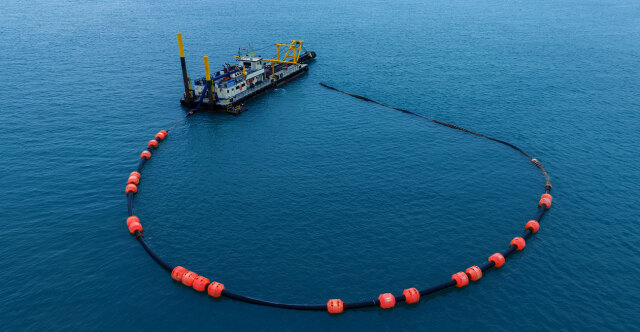
The prime minister said he expected the French vessel’s research mission to be completed “without disruption”, while drawing a clear distinction between informing third countries and the process of authorising research activities.
“I want to be absolutely clear. What has been sent by the French side does not create any issues for the Greek government,” he said, declining to provide further details about the content of the communication.
“The information provided by the French side to Turkey cannot under any circumstances be interpreted as a request for authorisation,” he stressed, making clear that the Greek government has no problem with the Turkish authorities being informed.
Kyriakos Mitsotakis insisted that information sent to third countries, such as Turkey or Egypt, should not be confused with the licensing process, which falls exclusively within the remit of the Greek and Cypriot authorities.
In the same context, he responded to reports in the Turkish press portraying the French notification as a request for permission from Ankara.
“Turkey may often intervene and believe that it should grant this authorisation. It is neither unusual nor new,” he said, recalling that similar claims had also been made in the past.
“What Turkey says publicly is not of such great importance to me. What matters greatly to me is reality and the actual facts: who granted the authorisation and from whom was the authorisation sought,” he added.
He made clear that authorisation had not been sought from Turkey or from any other coastal state, but from the competent Greek and Cypriot authorities.
The French presence
The prime minister also highlighted the broader European dimension of the electricity interconnection, placing particular emphasis on the presence of French capital and companies.
As he noted, the project has been designated as being of European common interest, with more than €650 million in funding from European resources. Its aim, he said, is to connect Greece and Cyprus electrically and then Cyprus with Israel, bringing the island out of its energy isolation.
He placed particular emphasis on the participation of French investment capital in the project, as well as the role of a French company as the main supplier for the construction of the cable.
“It is not exactly a Greek-Cypriot project. It is a European project with a strong French presence,” he said.
The prospect of a Turkish warship
During the interview, the possibility of a Turkish warship appearing in the area where the research is being carried out was also raised, with reference to the events off Kasos.
Kyriakos Mitsotakis initially clarified that, in the case of Kasos, the research had been conducted within Greek territorial waters, before firmly reiterating the country’s readiness.
“Greece is ready at any time for all eventualities. I do not believe there will be any escalation of tensions at this point, but I would like to remind you that we have handled difficult situations in the past. Remember the summer of 2020,” he said.
The prime minister thus referred to Greece’s experience in managing the Greek-Turkish crisis of 2020, while maintaining his assessment that the current research work would not lead to a similar scenario.
In the same part of the discussion, he also strongly criticised opposition parties and media outlets for the way they have approached the government’s handling of the cable project.
According to Mitsotakis, some either believe that the project will not go ahead or expect a crisis to be triggered from which Greece will emerge defeated.
“Neither one nor the other will happen,” he replied.
Kyriakos Mitsotakis questioned why, on matters of national interest, there could not be “a minimum common denominator” and why some “choose to believe the other side rather than the Greek government”.
His criticism also extended to media outlets which, he claimed, portray him, the government and the foreign minister as “traitors”.
Ask me anything
Explore related questions




