





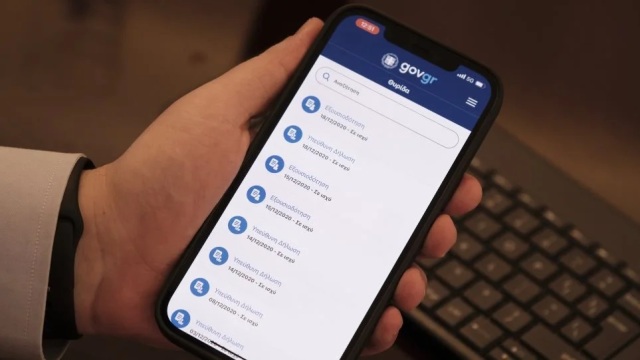
A new version of gov.gr will allow administrative procedures to be completed without citizens having to search for and submit digital certificates, Minister of Digital Governance and Artificial Intelligence Dimitris Papastergiou said in an interview with state television.
“The next step, then, builds on what we discussed earlier: after so many interoperable systems have been developed, particularly recently, citizens will, to a very large extent, no longer need to download even digital certificates. These will already be available, and with their consent, various procedures can be carried out – including complex procedures, or those that may require five or even ten such certificates,” he said.
Describing how the new platform would work, with its launch expected in early 2027, he said: “We will give our consent for our personal data to be used for the purpose for which we have applied, and the process will then run automatically, without us having to download the certificate or make a formal declaration.”
On the system for recording traffic offences, Mr Papastergiou said there were 388 cameras operated by the Attica Region and around 40 additional smart cameras on roads and buses.
“The two tenders – one for the information system and the other for the remaining 1,000 cameras – have been completed, and we are now at the stage of evaluating the bids,” he said, clarifying that the delays had been due to issues with the tendering process rather than personal data protection concerns.
He also spoke about the electronic delivery of traffic fines and the need to be alert to attempted scams.
“You will receive an SMS. And be careful: the SMS you receive will never contain a link for you to click on,” he stressed, explaining that the notification would inform drivers that a traffic fine was waiting in their inbox on the gov.gr Wallet.
Mr Papastergiou also pointed to a reduction of more than 30% in fatal road accidents since 2019, stressing that “the fine now arrives within a few hours, not 10 years”.
Age verification on social media through Kids Wallet
On protecting minors from social media, the Minister of Digital Governance referred to the legislation introduced in Greece and discussions with digital platforms ahead of its implementation on 1 January 2027.
“What we are asking the platforms to do, after explaining the legislation to them and why it applies to these platforms and some others, is primarily to address the issue of age verification,” he said.
He clarified that the check would not involve identifying the user, but rather confirming whether they meet the relevant age requirement through Kids Wallet.
“In Greece, we have Kids Wallet for this purpose. We receive only one thing – the platforms receive just one signal, a single digit indicating whether the user is above or below 15,” he said.
Mr Papastergiou acknowledged that implementing the measure universally would not be easy, while also highlighting the effects of excessive social media use on children’s sleep, education and socialisation.
‘We will see more cases in the coming period’
On the interconnection of public services and the role of digitalisation in uncovering tax evasion networks, Mr Papastergiou said that 800 new interoperable connections between information systems had been secured through the Recovery and Resilience Facility.
“What is digitalisation, essentially? It is transparency; digitalisation is traceability,” he said, adding that the Independent Authority for Public Revenue (AADE) and the Greek FBI now had more tools at their disposal to cross-check and process data.
“And in the coming period, we will see even more such cases being investigated, because the cases and the technology are there, and they are being used,” he said.
Referring to the interconnection of public registers and the use of the Personal Number, he stressed that in the past it had not always been possible even to match the records of the same citizen securely across different public services.
“We can now make data available, cross-check databases and provide the authorities with all the information they need to carry out proper checks,” he said.
According to the minister, artificial intelligence makes it possible to process large volumes of information more quickly, both to identify financial offences and to solve crimes through the analysis of video footage.
Ask me anything
Explore related questions




