





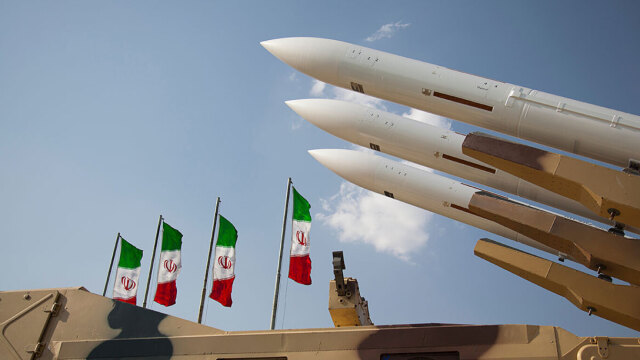
Iran has threatened to attack US military bases, including those in Europe, should the United States launch further strikes against the Islamic Republic, escalating its rhetoric towards Washington. The warning was issued by the secretary of the country’s Supreme National Security Council, General Mohsen Rezaei, who also made clear that Tehran would not allow enriched nuclear material to be removed from Iranian territory.
In an interview with Lebanon’s pro-Iranian television network Al Mayadeen, Rezaei said that any new US military operation would trigger retaliation extending beyond American facilities in the Middle East.
“If the United States launches another attack, Iran will target not only nearby bases, but also distant bases in areas it has not struck to date,” he warned, explaining that US military bases in European countries could be targeted if American aircraft took off from them to carry out attacks against Iran.
“Any new American attack will also be met with strikes against distant US bases,” the Iranian official reiterated. According to reports, Rezaei has been presented as Washington’s preferred choice to negotiate with JD Vance.
‘Not a single particle of enriched nuclear material will leave’
Rezaei was equally categorical on the issue of Iran’s nuclear programme, rejecting any possibility of transferring enriched nuclear material outside the country.
He said that Iran “will not allow a single particle of enriched nuclear material to leave the country”, signalling that Tehran remains firmly committed to this position.
According to estimates by the International Atomic Energy Agency (IAEA), Iran possessed 440.9 kilograms of uranium enriched to 60% when Israel and the United States attacked Iranian nuclear facilities in June 2025.
This level of enrichment is far higher than that required for conventional civilian uses of nuclear energy. However, it remains unclear how much of this stockpile survived the attacks.
Israel, the United States and other Western countries have accused Tehran for years of seeking to acquire nuclear weapons, an allegation Iran rejects.
Washington has made clear that the nuclear issue must be included in any initial negotiations with Tehran aimed at ending the war.
Last May, Israeli officials told Reuters that US President Donald Trump had assured the Israeli leadership that any agreement would include a condition requiring Iran’s stockpiles of highly enriched uranium to be removed from the country.
Israeli Prime Minister Benjamin Netanyahu, for his part, has said he will not consider the war over until the enriched uranium is removed from Iran, Tehran ends its support for organisations that Israel describes as terrorist groups, and the country’s ballistic missile capabilities are eliminated.
‘We are not negotiating with the US’ – Tehran’s seven conditions
Turning to diplomatic efforts to end the war, Rezaei said that no negotiations were currently under way between Iran and the United States. According to him, Tehran has already presented Washington with seven conditions and is awaiting the US response.
According to the Iranian official, the first item on his country’s diplomatic agenda is an end to the war on all fronts, with particular emphasis on Lebanon.
Iran has made clear that it will not agree to the reopening of the Strait of Hormuz until its seven conditions have been met. Among the demands that have been made public are the lifting of the naval blockade, the release of frozen Iranian assets and guarantees that there will be no further military attack.
Proposal for a union of Gulf countries
Rezaei also referred to Tehran’s regional ambitions, saying that Iran is determined to move forward with the creation of a union of Gulf countries.
According to him, Oman, the United Arab Emirates, Saudi Arabia, Qatar, Bahrain, Kuwait, Iraq and Iran could take part.
At the same time, the Iranian official claimed that Tehran’s previous attacks on US military bases had caused no harm to civilians in Arab countries. This claim was made by Rezaei without being accompanied by independently verified evidence.
Ask me anything
Explore related questions




