





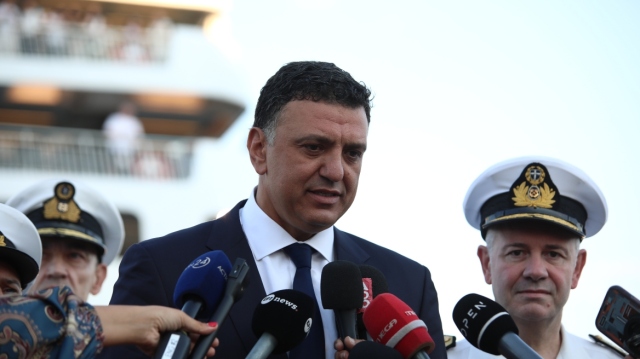
Greek Minister of Maritime Affairs and Insular Policy Vassilis Kikilias has announced the launch of a tender for the procurement of two offshore patrol vessels, each more than 80 metres long and equipped with a helipad, with an option to build two additional vessels.
The announcement was made at a special event held on Monday at the Ministry of Maritime Affairs and Insular Policy. The two state-of-the-art vessels form part of a strategic plan to strengthen and comprehensively upgrade the operational capabilities of the Hellenic Coast Guard. The total project budget stands at €492.8 million, including the option for the additional vessels.
Kikilias described the publication of the tender as an important step in the wider effort to modernise the Hellenic Coast Guard, stressing: “The two large offshore patrol vessels will have all the technological equipment and enormous capabilities. It is a very ambitious undertaking, but we will deliver it, just as we did two years ago in Civil Protection with the procurement of helicopters, aircraft, vehicles and so on, following all the prescribed procedures and with absolute transparency.”
He placed particular emphasis on the importance of allowing Greece’s shipbuilding industry to participate in the international tender, making use of the capabilities of the country’s shipyards.
“It is an open tender in which the Greek shipbuilding industry will also be able to participate. This is a very important sector, closely linked to maritime professions. It is something that has caused us great difficulties for many decades, and our government has managed to put this sector on a trajectory that is now allowing us to see significant private-sector investment gradually taking shape.
“We are talking about an entire ecosystem surrounding shipping, which is also connected with tourism, cruise shipping, high-end yachting and the energy sector. This is an ambitious plan that we must continue to promote, support and strengthen in order to achieve measurable results,” he said, adding: “Of course, this is an open tender, and we expect major international players to take part as well.”
The two new vessels will have extensive operational range and the capacity to remain at sea for several days, even in adverse weather conditions. They will be equipped with a helipad suitable for helicopters weighing up to 11 tonnes, modern surveillance and tracking systems, thermal cameras, the capability to support unmanned aerial vehicles (UAVs), as well as high-speed inflatable boats for the rapid deployment of operational teams.
They will be able to take part in maritime border surveillance operations, search and rescue missions, efforts to combat the illegal trafficking of migrants and smuggling, as well as the policing of maritime activity. Their addition to the Hellenic Coast Guard fleet will strengthen its operational presence in the Aegean and the Eastern Mediterranean, as well as its ability to respond to emergencies across Greece’s islands.
On the project’s funding, the minister thanked Migration and Asylum Minister Thanos Plevris and the ministry’s officials, noting: “This is a tender funded by the Asylum, Migration and Integration Fund (AMIF) and the Ministry of Migration. So, first of all, I would like to thank the minister, Mr Thanos Plevris, as well as all the officials at the Ministry of Migration, because it is important to have the resources to support the Hellenic Coast Guard, so that its officers can do their jobs.”
Regarding the implementation of major public procurement projects, Kikilias stressed the importance of complying with the prescribed checks and transparency requirements, while also taking into account observations from the competent services and the market.
“The history of public-sector tenders in Greece – with the exception of the Ministry of National Defence, where procedures are different for the sake of the country’s defence and security – has shown that all other ministries are required to carry out tender procedures in a specific way, which can take years, even more than 10 years. This creates a series of problems, alongside the legislator’s provision for transparency and oversight safeguards, intended to ensure that Greek taxpayers’ money is respected.
“We did not bypass these procedures either at the Ministry of Climate Crisis and Civil Protection or here. Quite the opposite. We have followed them, giving everyone – both the competent services responsible and the market – the opportunity to intervene and make observations during the public consultation. We incorporate these observations to the greatest extent possible, in line with actual capabilities and needs.”
Referring to plans to modernise the Hellenic Coast Guard technologically, the minister singled out the tender already under way for the new Operations Centre.
“Now, at the Ministry of Maritime Affairs, if there is one tender that I consider crucial, it is the one already under way for the new Operations Centre (KEPIX). We are now seeking to organise it and, following the tender process, take delivery of the most advanced systems available in artificial intelligence and cutting-edge technologies, so that we can have an immediate picture of what is happening at every point across our seas, in our ports and along our maritime borders.”
Finally, Kikilias announced that new tenders would be launched immediately to further strengthen the Hellenic Coast Guard fleet.
“At the ministry, we have undertaken to move ahead immediately with further tender procedures for interceptor vessels measuring 18 metres and 30 metres, as well as any other vessels the service has decided are needed. One thing is certain: we will leave the officers of the Hellenic Coast Guard a very important legacy, with a large number of vessels and state-of-the-art systems.”
The tender will be conducted through a competitive dialogue procedure, in accordance with Article 41 of Law 3978/2011. The contracting authority will be the Hellenic Corporation of Assets and Participations (HCAP S.A.), through its Strategic Contracts Unit.
The project is co-financed by the Border Management and Visa Instrument (BMVI) for the 2021–2027 period. The estimated delivery time for the two vessels is 30 months from the signing of the contract.
For his part, the Deputy Chief Executive Officer of the National Development Fund, Panagiotis Stampoulidis, said:
“The National Development Fund has undertaken the preparation and tendering of an extensive programme to upgrade the Hellenic Coast Guard’s equipment, with a total value of more than €1 billion, on behalf of the Ministry of Maritime Affairs and Insular Policy.
“Through open, transparent and competitive procedures, the Strategic Contracts Unit of the National Development Fund is drawing on the expertise and experience gained through the successful implementation of the AIGIS programme, with the aim of ensuring that the new projects are effectively prepared and put out to tender.
“We aspire for 2027 to become a landmark year for the modernisation of the Hellenic Coast Guard, as deliveries of the new equipment are due to begin, continuing into 2028. The central priority throughout this process is to safeguard the public interest and strengthen the operational readiness and effectiveness of the Coast Guard.”
The Chief of the Hellenic Coast Guard, Vice Admiral Christos Kontorouchas, said:
“Good morning, Minister, Deputy Minister, Secretaries-General, distinguished guests and colleagues,
“It is truly a particular pleasure for any Chief of the Hellenic Coast Guard to welcome such a major and landmark project, concerning the procurement of two 80-metre offshore patrol vessels, with an option, as has already been mentioned, for two more.
“In my view – and I said this in my speech at the ceremony marking my assumption of command – this project signals a new era for the Hellenic Coast Guard. These are the procurements that will lead the Coast Guard and our personnel into a new age.
“Beyond our traditional duties, which you all know and which there is no need to repeat, the Hellenic Coast Guard of the new era will be called upon to operate in offshore areas and protect critical infrastructure. It will carry out search and rescue operations much farther afield than we have been accustomed to until now, namely close to our maritime borders and near the coastline. And much more is to come, such as marine parks, where effective policing will also be required. This is what the Coast Guard is expected to do, and this is what we will deliver.
“The preparation of a project on this scale – both in terms of the size of the vessels and, above all, its financial scope – is naturally demanding. This is the first time the Hellenic Coast Guard has issued a tender for a project of this kind. It has required coordinated action and a major effort by our personnel to draw up the technical specifications, as well as close coordination and cooperation with the authorities, particularly HCAP, the Strategic Investments Unit and the Managing Authority, whom I would also like to thank from this platform.
“We are continuing with a plan and a firm commitment to our mission. The next steps, for which preparatory work has already been carried out, concern staffing the vessels. This is obviously linked to the broader need to strengthen the Hellenic Coast Guard’s personnel, and you all know that the ministry and the Coast Guard headquarters are working in this direction as well.
“And, of course, we must develop the skills that will allow these vessels to be used to their full potential. These next steps are complementary, necessary and self-evident, and we will move forward rapidly in this direction too. Thank you very much.”
Also attending the ceremony were Deputy Minister of Maritime Affairs and Insular Policy Stefanos Gikas; Secretary-General for Maritime Affairs and Ports Manolis Koutoulakis; Secretary-General for the Aegean and Insular Policy Fotis Maggos; President of the Piraeus Chamber of Commerce and Industry Vassilis Korkidis; Vice-President and Chief Executive Officer of Skaramangas Shipyards Miltiadis Varvitsiotis; representatives of the Hellenic Chamber of Shipping, Greek shipyards and the shipping community; Deputy Chiefs of the Hellenic Coast Guard, Vice Admirals Fotios Kiamos and Drakoulis Kouvaris; and senior and high-ranking Hellenic Coast Guard officers.
Ask me anything
Explore related questions




