





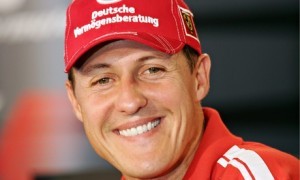
Michael Schumacher has made it home – 254 days since smashing his head on to rocks in a freak ski accident in the Swiss Alps.
He returned to his family home at Gland on Tuesday, according to Germany’s biggest newspaper Bild, way ahead of a schedule set by doctors at a rehabilitation clinic in Lausanne who predicted he might be home by Christmas.
‘He is back home again!’ the newspaper trumpeted on its website.
Although his wife Corinna, 45, and children Mick, 15, and Gina-Maria, 17, are ecstatic, it is understood he remains mute and unable to move apart from random flutterings of his eyelids.
Schumacher was taken in June to the clinic after 189 days in a medically induced coma.
‘He relies on the help of strangers 24 hours around the clock. No one dares make a prediction about How long it might take until he has regained motor skills such as language and memory,’ said Bunte magazine last week, a publication which is noted for having close contacts with the Schumacher family.
Two months ago it reported how work has been going on at his £35million mansion at Gland, a short drive from the rehabilitation clinic, to build a care facility for him in the grounds that is wheelchair accessible.
The magazine and a Swiss newspaper also reported that another building has been constructed for his father Rolf to move into from his home in Germany. The prognosis is that Schumacher, whose life was catastrophically changed by a low-speed ski accident on December 29 last year, will need years of therapy and, most likely, will always remain a shell of his former self.
The summer makeover of his home was no mere re-decorating project, but one intended to turn this trophy, glitzy Downton-of-the-Alps into a singular care facility, one dedicated to giving back as much of life as it can to the monarch who built it.
‘The mansion is being remade to become the sanctuary which, it is hoped, will remake him,’ said a family friend.
Some critics have questioned the wisdom of bringing a man who lay in a coma for almost six months home from the clinic so soon, but Professor Peter Vajkoczy is not one of them.
‘If financial resources allow for someone to create their own home rehabilitation facility complete with gym, and to bring the necessary medical staff and therapists to it, then that is certainly a possibility,’ said the professor who heads the neurosurgical clinic of the world renownded Charite Hospital in Berlin.
The wherewithal to finance the move was never in question. A decade ago the financial bible Forbes Magazine in America listed him as the 2nd highest-paid athlete in the world while the following year Eurobusiness magazine identified him as the world’s first dollar billionaire athlete.
The fortune remains intact and has grown with lucrative advertising and sponsorship deals which sometimes earned him over £100million a year on top of his race winnings in the last few seasons of his career.
Schumacher, 45, remains riddled with tubing, hooked up to complex machines that feed him, enable him to breathe for long periods of sleep, remove waste from his body and monitor vital signs.
He is massaged for hours each day to stimulate muscle mass shed during his long sleep and assessed by the hour to see if his awareness of his environment is rising, waning or static.
Someone who has been a friend of the family for 25 years said: ‘Corinna is happy at the progress he has made so far and optimistic that much more can be achieved. She is counting the successes one by one and ignoring the likelihood that he will make anything other than a full recovery.
‘He didn’t die in the accident and he didn’t die during the two emergency operations that followed it. He came out of the coma and he has had periods of awakening where he is able to make the smallest of nods. He was deemed well enough to be released from the hospital and may be fit enough to sit in a wheelchair by autumn’s end. All of this is positive and Corinna takes each small dose of good news as it comes.
‘The question remains, however, about how much improvement can be expected the coming months and years. Will he speak again? Will he walk again? Will he be able to feed and dress himself? The doctors don’t know. No-one can know. The probability is that he will never be the man he was before the accident, that much is starkly clear.’
As of now, Schumacher lies in a state of what is termed ‘minimal consciousness’ in which he can briefly move eyes toward persons or objects, experiences sleeping and waking cycles and has been known to react to loud sounds with a startled look. But he is unable to follow instructions, has no speech or other forms of communication and no purposeful movement of his limbs.
According to the source a thin buzzcut of down has regrown over the savage dragon’s-teeth scars crisscrossing Schumacher’s skull, the evidence of the lifesaving operations performed on him at Grenoble where, initially, he was not expected to last the night after the accident at Meribel.
He is moved every two hours to prevent pressure sores by carers who are required to hand in their mobile telephones before they report for duty in case the temptation to take a photograph of him proves too much. And a tent has been constructed at the back of his ward to prevent long-lens paparazzi shots of him when he is moved outside, as he is from time to time.
Via: Daily Mail
Ask me anything
Explore related questions




