





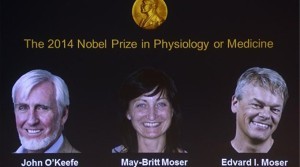
The Nobel Assembly at Karolinska Institutet has decided to award The 2014 Nobel Prize in Physiology or Medicine with one half to John O´Keefe and the other half jointly to May-Britt Moser and Edvard I. Moser for their discoveries of cells that constitute a positioning system in the brain.
According to an official announcement released by the Nobel Assembly on Monday, this year´s Nobel Laureates have discovered a positioning system, an “inner GPS” in the brain that makes it possible to orient ourselves in space, demonstrating a cellular basis for higher cognitive function.
This inner system allows us to know where we are, to find the way from one place to another and to store this information in such a way that we can immediately find the way the next time we trace the same path.
In 1971, John O´Keefe discovered the first component of this positioning system. He found that a type of nerve cell in an area of the brain called the hippocampus that was always activated when a rat was at a certain place in a room. Other nerve cells were activated when the rat was at other places. O´Keefe concluded that these “place cells” formed a map of the room.
More than three decades later, in 2005, May-Britt and Edvard Moser discovered another key component of the brain’s positioning system. They identified another type of nerve cell, which they called “grid cells”, that generate a coordinate system and allow for precise positioning and pathfinding. Their subsequent research showed how place and grid cells make it possible to determine position and to navigate.
The Nobel Prize in Physiology or Medicine has been awarded 104 times to 204 Nobel Laureates between 1901 and 2013.
Ask me anything
Explore related questions




