





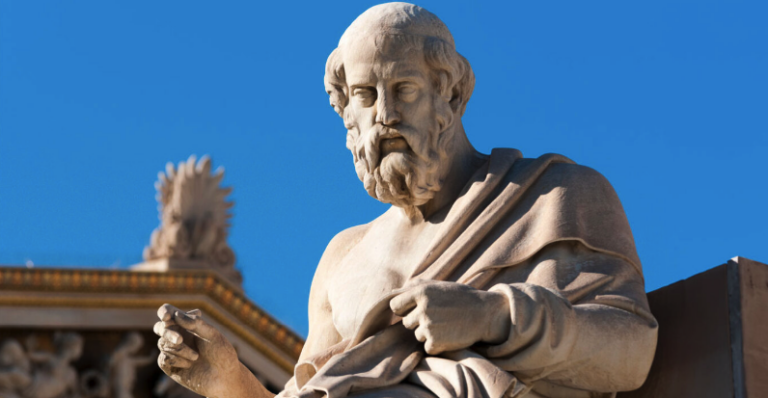
Recently deciphered passages from papyrus scrolls buried under layers of volcanic ash after the eruption of Mount Vesuvius in 79 AD may shed light on the final hours of Plato, one of the most important figures in Western philosophy.
According to the Guardian, Italian scientists have discovered that the ancient scrolls in question contained a previously unknown narrative describing how the Greek philosopher spent his last night, listening to the music played on the flute by a Thracian slave girl.
Despite the fact that he was roasting in fever and on the verge of death, Plato seems to have possessed considerable intellectual clarity, as he criticised the musician for her lack of rhythm, according to the account.
Recall that decoded passages of the papyrus in question indicated, among other things, the exact location of Plato’s burial in a garden near the ‘Temple of the Muses’, in the Academy that bears his name in Athens. Previously, it was known only in general terms that he was buried within the Academy.
Presenting the findings of the research at the National Library of Naples, Professor Graziano Ranocchia, of the University of Pisa, who led the team responsible for deciphering the scroll, described the discovery as a “great development that helps us to have a deeper understanding of ancient history”.
“Thanks to the most advanced imaging diagnostic techniques, we finally have the ability to read and decipher new passages of texts that were previously considered inaccessible,” the scientist said.
The text also reveals that Plato was sold as a slave on the island of Aegina, possibly as early as 404 BC, when the Spartans conquered the island, or alternatively in 399 BC, shortly after Socrates’ death.
“Until today it was believed that Plato was sold as a slave in 387 BC during his stay in Sicily at the court of Dionysius I of Syracuse,” Ranocchia said. “For the first time, we were able to read sequences of hidden letters from scrolls that were wrapped in multiple layers and had been stuck together over the centuries through an unrolling process using a mechanical technique.”
According to him, the ability of scientists to locate these layers and virtually reposition them in their original position, thus restoring the coherence of a text, represents a major advance that could lead to the future recovery of vast amounts of information. The impact of this development will be fully realised in the coming years, he pointed out.
Former NASA engineer says he’s invented a thruster that doesn’t require propellant
At the heart of Ranocchia’s team’s work are the scrolls found in the luxurious Roman villa at Ancient Heraklion (Erculaneum) in Campania, also known as the “Villa of the Scrolls”. This villa, which had an impressive library, was registered on earth during the eruption of Vesuvius in 79 AD, which destroyed Herculaneum and Pompeii.
The villa was accidentally found in 1750 and from 1752 to 1754, through the excavation process, numerous scrolls of papyrus came to light. The effort to decipher them continues with modern digital technology methods.
Ask me anything
Explore related questions




