





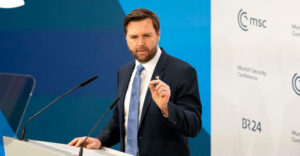
Although Vance is relatively new to politics and lacks a deep understanding of diplomatic language and behavior, his remarks have reverberated throughout Europe. As the second-most powerful political figure in the United States, Vance’s speech carried weight and left many questions about the future of US-European relations.
What Did Vance Really Say?
Vance made it clear that the United States would no longer act as Europe’s patron, signaling the end of a longstanding protective relationship. The US, he suggested, would no longer intervene in Europe’s regional issues and that these problems should be handled by Europe itself. While the message may have startled many, it reflected a growing trend in US foreign policy under the Trump administration, emphasizing that European nations must be responsible for their own geopolitical issues.
He also repeated the Trump-era emphasis on military spending, suggesting that Europe should invest more in defense. In line with US Defense Secretary Hecker’s earlier remarks, Vance stressed that military industries should be prioritized. Vance’s speech then shifted to a lecture on how Europe should manage its internal affairs, particularly focusing on democracy and the far-right AfD.
In a striking moment, Vance offered a political “lesson” to Germany, admonishing it for how it handles far-right extremism. His tone and rhetoric, which seemed to lack diplomatic awareness, particularly surprised those who understood the historical context of Europe’s commitment to confronting its Nazi past.
Key Omissions
Despite the grand political stage, Vance avoided discussing critical global issues that have been at the forefront of US foreign policy in recent times, particularly those addressed by President Trump. He made no mention of Russia, Ukraine, Gaza, or Syria—subjects that have been central to the administration’s agenda. He also failed to touch on values or shared ideals, omitting any reflection on the longstanding historical partnership between Europe and the United States.
This silence was telling. It revealed that, for Vance and his political circles, issues like democratic values or international cooperation hold little weight compared to more immediate concerns like defense spending and geopolitical dominance.
Europe’s Shrinking Role
Vance’s remarks can be seen as a stark reminder that Europe is no longer the focal point of US foreign policy. His speech left many pondering whether Europe, despite its economic and political significance, has lost its place in shaping global affairs. His remarks were particularly impactful to the Trump supporters within Europe, as they underscored the growing divide between the US and Europe. For Vance, the message was clear: “We’re separated by an ocean, and the responsibility for your own continent lies with you.”
His comments about the European Union and its role in global affairs should not be taken lightly. Europe is facing significant internal challenges, including a lack of trust in its institutions and political systems, growing discontent among its citizens, and the rise of extremist movements. The European project, which has been based on unity and shared values, appears to be in crisis. Vance’s speech highlighted that the US is less concerned with European solidarity and more focused on its own strategic interests, particularly military dominance and economic self-sufficiency.
The European Response and the Future
The reaction in Europe has been mixed, with some leaders pushing back against Vance’s comments. German Defense Minister Pistorius, for instance, openly challenged Vance, rejecting unsolicited advice on political management, but also acknowledging Europe’s flaws and the need for self-reflection.
This tension between the US and Europe is unlikely to disappear soon. Europe is facing a moment of reckoning, and the challenges it faces—both internal and external—are daunting. The future of the European Union, and Europe’s place in the world, will depend on how it addresses these issues.
In the years to come, Vance may be remembered not for his political legacy, but as the figure who helped Europe realize that it must confront its own challenges without relying on the US. His speech served as a wake-up call for Europe to reassess its priorities and find a way forward on its own terms.
As Europe grapples with its internal struggles and redefines its role in the world, Vance’s words should not be forgotten. Whether Europe takes these lessons to heart and adapts will determine its future trajectory on the global stage.
Ask me anything
Explore related questions




